
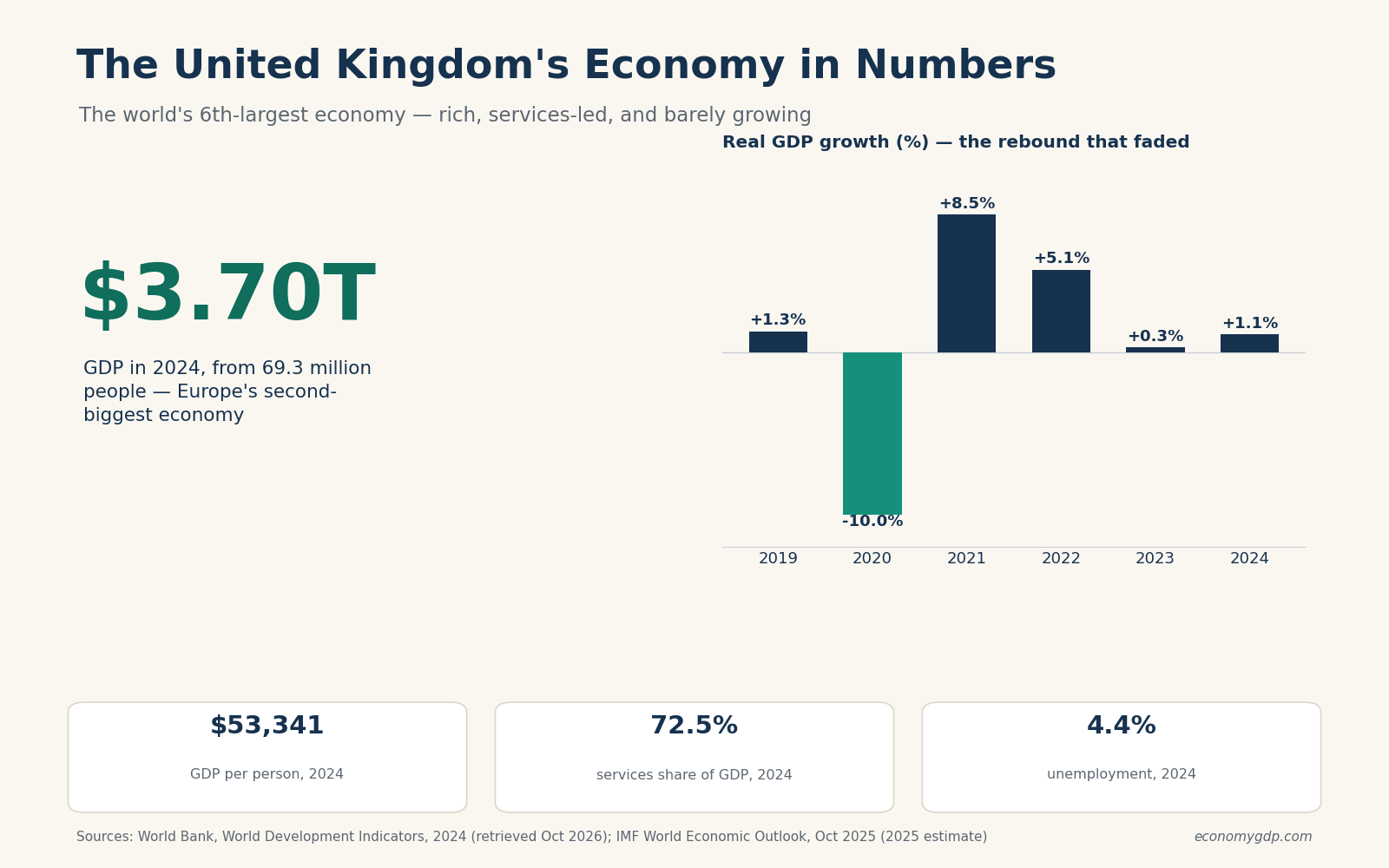
The United Kingdom is the world’s sixth-largest economy, and the second-biggest in Europe behind Germany. It produces about $3.70 trillion of output a year, from a population of 69.3 million people. Per person, that’s about $53,341 — comfortably rich-country territory, ahead of France and Japan, though well behind the United States.
That’s the headline. The harder question is why a country with London, world-class universities, and some of the best-known brands on earth has barely grown in years.
A services economy, anchored by London
Services account for about 72.5% of British output, one of the highest shares of any big economy. The City of London is still one of the world’s two great financial centres, alongside New York: banks, insurers, asset managers, and law firms that sell their services to the whole planet. Add in retail, hospitality, creative industries, and the NHS and education, and you get an economy that mostly earns its living by doing things for people rather than making things.
But Britain still makes things too, just fewer of them than it used to. It builds jet engines (Rolls-Royce), medicines (AstraZeneca and GSK are both British), cars, and whisky — Scotch remains one of the country’s most recognisable exports. North Sea oil and gas, once a major earner, are in long decline, and manufacturing now accounts for less than a tenth of output.
The slow-growth problem
The growth record tells the story. The economy shrank 10.0% in 2020 during the pandemic — the worst year in centuries — then bounced back 8.5% in 2021 and 5.1% in 2022. Then the engine sputtered: 0.3% in 2023 and 1.1% in 2024. For a country whose population is still growing, that means living standards have roughly stood still.
Plenty of explanations are on offer, and most of them are at least partly true. Productivity — output per hour worked — has barely budged since the financial crisis. Brexit added friction to trade with Britain’s biggest market, the European Union, just as the pandemic and the energy shock hit. Inflation surged to 7.9% in 2022, the highest in decades, before easing back to 3.3% in 2024, squeezing household budgets in between.
One bright spot: unemployment stayed low through all of it, at 4.4% in 2024. The problem isn’t that Britons can’t find work. It’s that the work doesn’t seem to be getting more productive, or better paid, fast enough.
The Budget and the bind
That bind was on full display this week, when Chancellor Healey delivered her first Autumn Budget on October 28. It was, by design, a deliberately uneventful affair — no big tax giveaways, no dramatic spending splurge — and markets took it calmly. The government has little room to move: borrowing costs are high, growth is slow, and every pound spent servicing debt is a pound not spent on schools, hospitals, or tax cuts.
The IMF estimates Britain’s economy will reach about $3.96 trillion in 2025, which would keep it sixth in the world. Whether it stays there depends on the same question that has hung over the country for a decade: can a services superpower with a world-beating financial centre, but flat productivity and sluggish growth, find a second gear? For now, Britain remains very rich, very open, and very stuck — waiting for the growth to come back.