
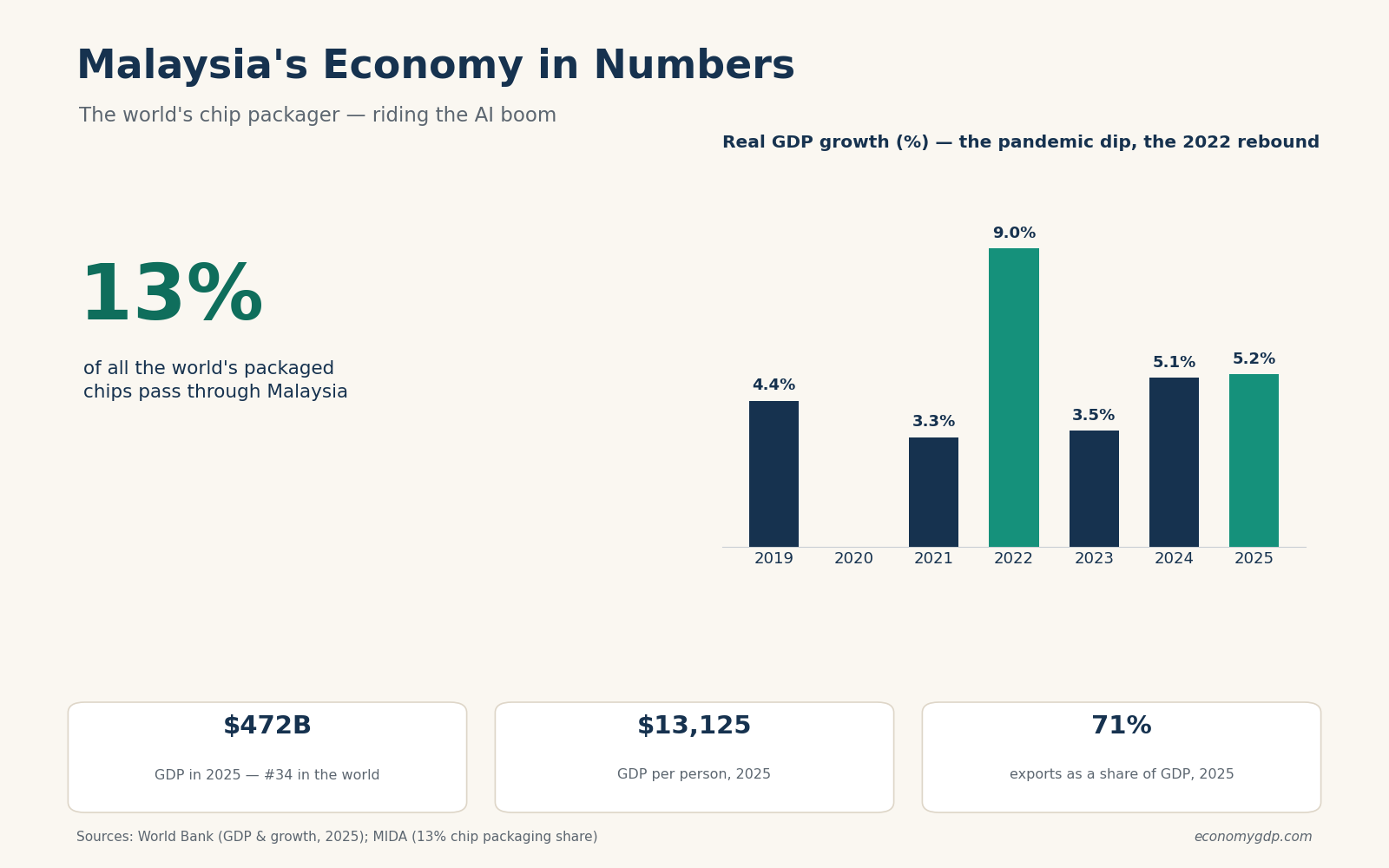
There’s a good chance the phone in your pocket passed through Malaysia before it reached you. Not the whole phone — Malaysia doesn’t make the flashiest chips. It tests them, packages them, and ships them out by the billions, and right now that unglamorous middle of the chip business is booming.
Malaysia’s economy was worth $472 billion in 2025, the world’s 34th largest, and it grew 5.2% in real terms — one of the faster rates among economies its size. Yesterday, Bank Negara Malaysia reported growth of 5.5% in the third quarter of 2026, with manufacturing up 7.7% on demand for AI hardware. The country is riding the global tech cycle hard, and it knows it.
The chip economy
Malaysia got into semiconductors in the 1970s, when Intel set up in Penang, and it never really left. Today the country handles about 13% of all semiconductor packaging, assembly and testing done anywhere in the world, and roughly 7% of global semiconductor trade flows through it. Electrical and electronics goods make up around 40% of everything Malaysia exports.
That’s a remarkable position for a country of 36 million people, and it explains why the AI boom shows up in Malaysia’s numbers so fast. In the third quarter of 2026, domestic electronics exports jumped 66.9% year on year. September brought the highest monthly export value Malaysia has ever recorded — RM215.1 billion, the first time it’s crossed RM200 billion in a month.
The government is trying to climb further up the value chain. Its National Semiconductor Strategy, launched in 2024, puts about US$5.3 billion behind moving from packaging and testing into chip design and advanced packaging. The bet is that the skills built up over fifty years in Penang and Kulim can be turned into something worth more per chip.
More than chips
Chips are the headline, but Malaysia is still a commodity economy underneath. It’s the world’s second-largest palm oil producer, and oil and gas — pumped and processed largely by the state-owned Petronas — remain a big earner. Services account for about 55% of GDP, industry 36%, agriculture 8%. Exports of goods and services run to 71% of GDP, which makes Malaysia one of the most trade-exposed economies in Asia.
One quirk worth knowing: the dollar value of Malaysia’s economy jumped almost 12% in 2025, from $422 billion to $472 billion. Most of that wasn’t extra growth — real growth was 5.2% — it was the ringgit strengthening against the dollar. When your currency moves, your economy’s size in dollars moves with it, and Malaysia’s has swung both ways over the years. In 2022 it grew 9.0% in real terms, the fastest in two decades; in 2020 it shrank 5.5% in the pandemic.
Life for ordinary Malaysians looks steady rather than spectacular. GDP per person is about $13,125 — roughly a tenth of Singapore’s, but adjusted for local prices it’s closer to $41,500. Inflation ran at just 1.4% in 2025, and unemployment sits under 4%. The country crossed into upper-middle-income status years ago; the question now is whether it can make the final jump to high income.
What could go wrong
The honest answer is: the same thing that makes Malaysia exciting. An economy this plugged into the global tech cycle feels every wobble in it. If AI spending cools, or if US restrictions on chip exports tighten further, Malaysia’s factories feel it within a quarter. Bank Negara has flagged exactly that risk, even while forecasting growth of 4.2% to 5.2% for 2027.
Government debt is around 71% of GDP, high for the region, which limits how much fiscal room there is to cushion a downturn. And the ringgit’s habit of swinging means the dollar figures can flatter or punish the economy in ways that have little to do with what’s happening on the ground.
Still, Malaysia’s position is enviable in one specific way: the world keeps needing more chips, and more of them keep passing through Penang. For a country that built its fortune on being useful to other people’s supply chains, that’s a pretty good place to be.