
Here’s a strange thing about the Philippines: one of its biggest industries is people who don’t live there. Around 10 million Filipinos work overseas — nurses in London, sailors on container ships, domestic workers in Hong Kong and Singapore — and the money they send home is one of the pillars the whole economy stands on. The other pillar is the people who stayed: nearly two million of them answer phones, process claims and write code for companies on the other side of the world.
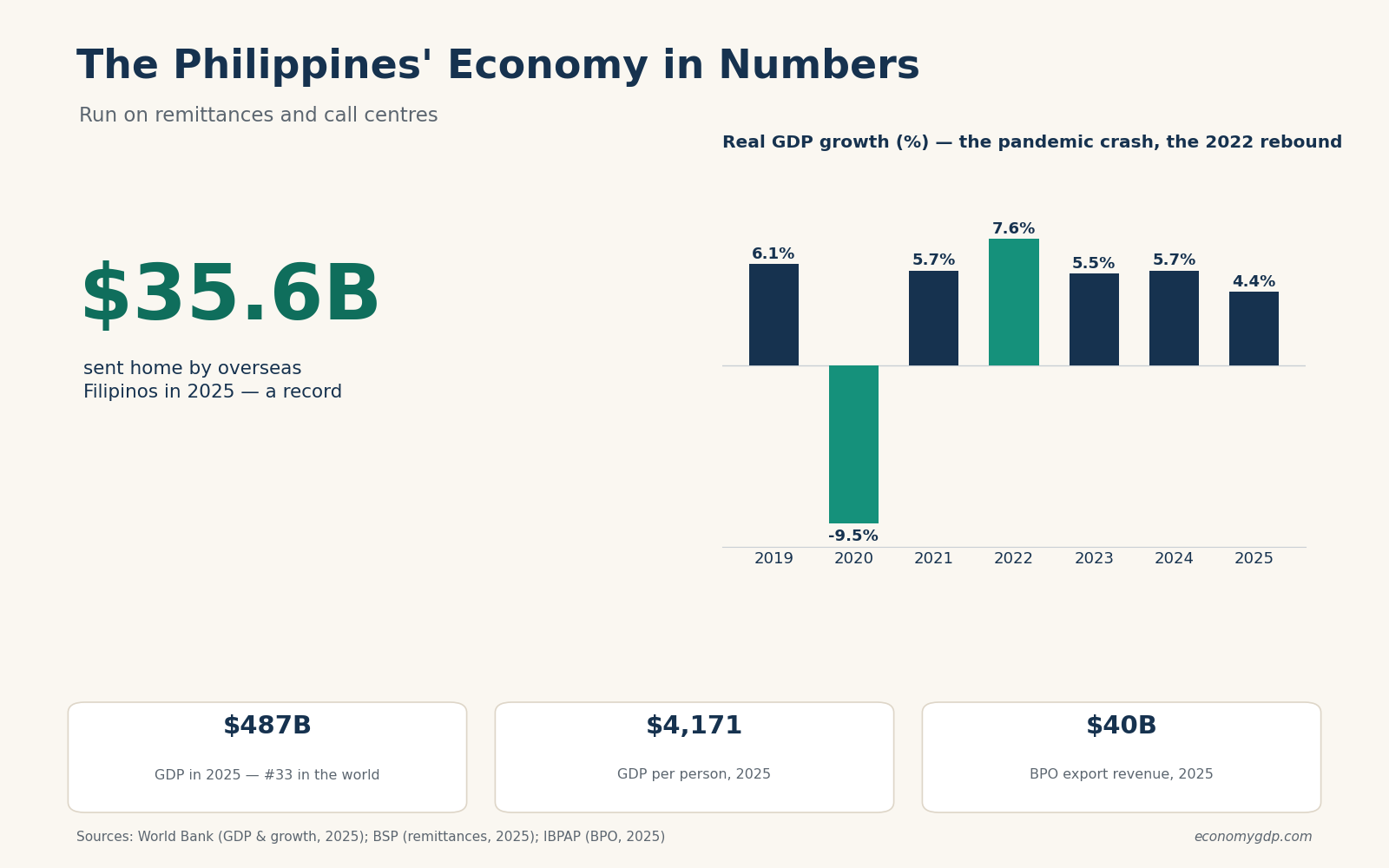
Put together, it’s an economy worth $487 billion in 2025, the world’s 33rd largest, home to 116.8 million people. It grew 4.4% last year. Not bad — but the latest numbers suggest the engine is sputtering a bit.
The remittance economy
Filipinos working abroad sent home a record $35.6 billion in cash remittances in 2025, according to the central bank, Bangko Sentral ng Pilipinas. Count the money and goods that travel through informal channels too, and the total reaches $39.6 billion — roughly 7.3% of everything the economy produces. The United States is the biggest source by far, at nearly 40% of the total, followed by Singapore and Saudi Arabia.
That money does real work. It pays school fees, builds houses, and keeps consumption going in a country where the average person earns $4,171 a year — about $12,577 once you adjust for what things actually cost locally. Remittances kept flowing through the pandemic, through recessions, through everything. They’re the steadiest income stream the Philippines has.
But there’s a catch that’s hard to ignore: an economy that depends this much on its citizens leaving isn’t quite the same as an economy that gives them a reason to stay. The government knows it. Every president promises more jobs at home. The money keeps arriving anyway.
The call-centre economy
The Philippines’ IT and business-process outsourcing industry — the call centres, back offices and software teams — pulled in about $40 billion in export revenue in 2025 and directly employs around 1.9 million people, according to the industry group IBPAP. That’s more than 8% of GDP, built from almost nothing in the early 2000s.
It worked because the Philippines had exactly what the industry needed: a huge English-speaking workforce, a time zone that covers the US overnight shift, and wages far below American ones. Services now make up 64% of the economy, while industry accounts for 27% and agriculture — still employing about a quarter of workers — just 9%.
Now the industry faces its first real threat. Artificial intelligence is coming for exactly the kind of routine voice work the Philippines sells. IBPAP itself estimates AI could displace or transform 500,000 to 800,000 BPO jobs by 2030 if the industry doesn’t retrain fast enough. The group’s roadmap target for 2028 was already cut in July 2026, from $59 billion in revenue to a best case of $50.5 billion. The race now is to move upmarket — from answering phones to the kind of knowledge work a chatbot can’t do.
What could go wrong
The warning signs showed up in the latest official figures. Growth slowed to just 2.1% in the third quarter of 2026, the weakest since the pandemic, according to the Philippine Statistics Authority. Government construction fell 15.1% as public works froze amid a corruption scandal over flood-control projects, and household spending weakened as food and energy costs bit. Growth for the first nine months of 2026 averaged 2.5% — well short of the government’s 3.5% to 4.5% target. The IMF expects growth of 3.4% for 2026 as a whole, on an economy it estimates at about $502 billion.
That’s a sharp comedown from the recent run: 7.6% growth in 2022, then 5.5% and 5.7% in the two years after. Inflation has at least cooled — 1.7% in 2025, down from 6.0% in 2023 — and government debt, at about 59% of GDP, is manageable by regional standards.
The Philippines has two remarkable assets that most economies would envy: a young, English-speaking workforce and a diaspora that sends home a fortune every year. The question is whether the country can turn those into industries that live at home — before AI eats the call centres and before another generation decides its best option is a plane ticket out.