
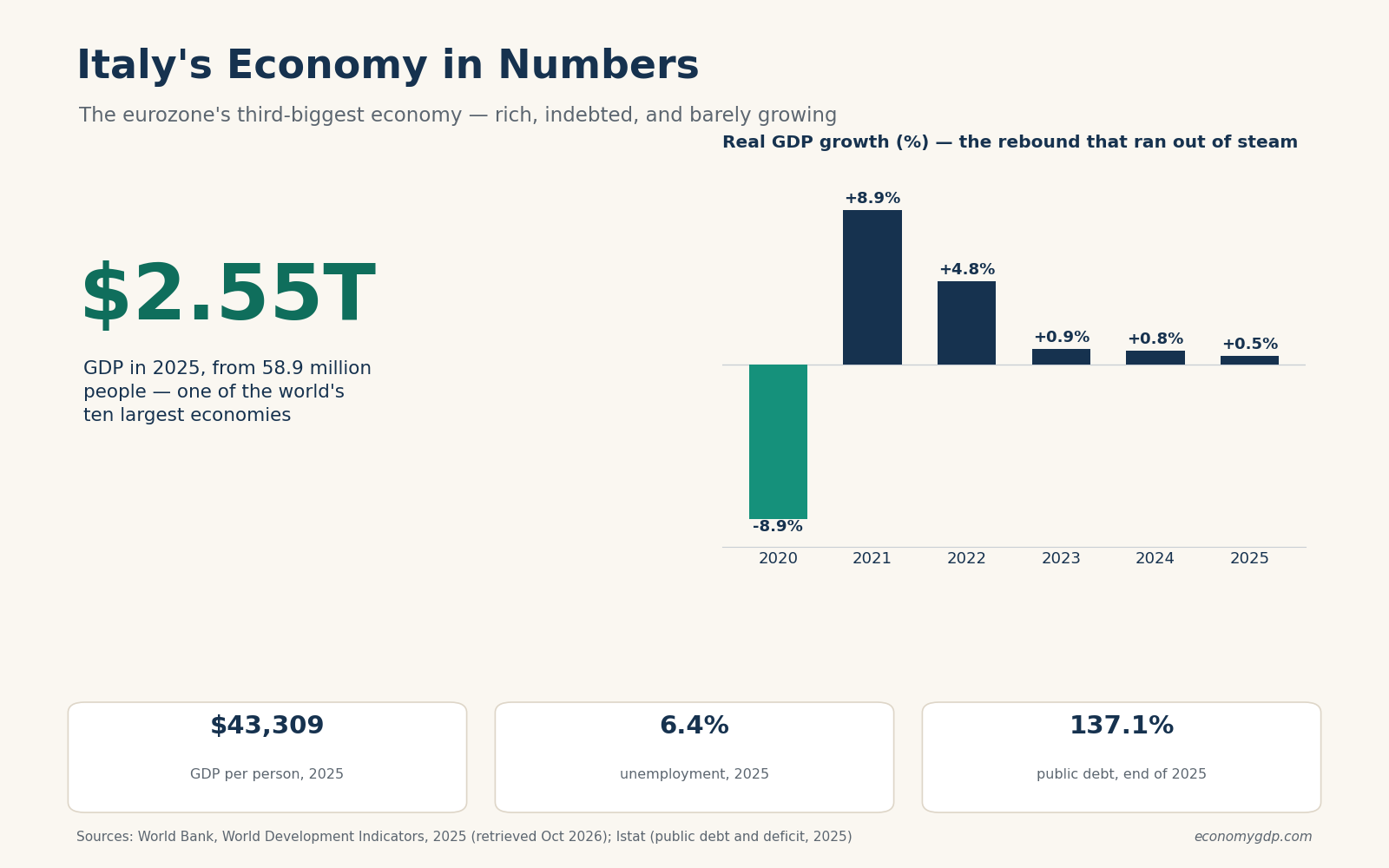
Italy is one of the world’s ten largest economies, and the third-biggest in the eurozone — and also one of its most contradictory. It produces about $2.55 trillion of output a year, from 58.9 million people. Per person, that’s about $43,309, solidly rich-country territory. It also carries one of the heaviest public debt loads on earth, and its population is getting smaller every year.
Put it this way: Italy has the factories, the brands, and the tourists that most countries would kill for — and still can’t seem to grow much faster than half a percent a year.
Still a country that makes things
Services account for about 65% of Italian output, but Italy is no post-industrial museum piece. Industry still makes up nearly 23% of the economy, a bigger share than in France or Britain, and Italy is Europe’s second-largest manufacturer after Germany. Its factories turn out machinery, cars, chemicals, and pharmaceuticals, mostly from family-owned firms clustered in the north, around Milan, Turin, and Bologna.
Then there’s the stuff with the label on it. Italian fashion, furniture, and food — the leather bags, the shoes, the pasta, the wine, the cheese — sell around the world at a premium, and they keep a huge network of small and mid-sized firms in business. Exports are worth about 32% of GDP, a lot for an economy this size.
And tourism, Italy’s other quiet engine, keeps the rest of the country going: Rome, Florence, Venice, the Amalfi Coast, and the Alps draw tens of millions of visitors a year, filling hotels and restaurants from the cities to the smallest hill towns.
Growth that never quite arrives
The numbers tell a story of a rebound that ran out of steam. After crashing 8.9% in 2020 during the pandemic, the economy bounced back 8.9% in 2021 and grew 4.8% in 2022. Then the pace faded year by year: 0.9% in 2023, 0.8% in 2024, and just 0.5% in 2025. That’s not a recession, but it’s barely growth — and with the population shrinking, from 59.4 million in 2020 to 58.9 million in 2025, it means the economy is roughly standing still in absolute terms too.
One thing has genuinely improved: unemployment, at 6.4% in 2025, is down from 9.5% in 2021 and far below the double-digit rates Italy lived with for much of the 2010s. Inflation, which spiked to 8.2% in 2022, is back down to 1.5%. The trouble is productivity — output per hour worked — which has barely budged in decades, and a birth rate among the lowest in the world, which means fewer workers to support more retirees.
The debt that won’t go away
That brings us to the awkward part. Italy’s public debt stood at 137.1% of GDP at the end of 2025, according to Istat, the national statistics office, up from 134.7% a year earlier. The budget deficit narrowed to 3.1% of GDP in 2025, and the government even ran a primary surplus — revenue above spending before interest payments — of 0.8% of GDP. But with growth this slow, the debt ratio keeps creeping up anyway.
None of this means Italy is about to run out of money. It borrows in euros, investors still buy its bonds, and its economy is far too big and diversified to be written off. But every euro spent servicing debt is a euro not spent on schools, trains, or tax cuts, and the debt ratio is still rising because growth is still slow and the population is still shrinking.
Italy’s challenge, then, is a familiar one with an Italian twist: how to get a rich, productive, much-loved country growing again without blowing up the public finances — or losing the way of life that makes people want to visit, and live, there in the first place.