
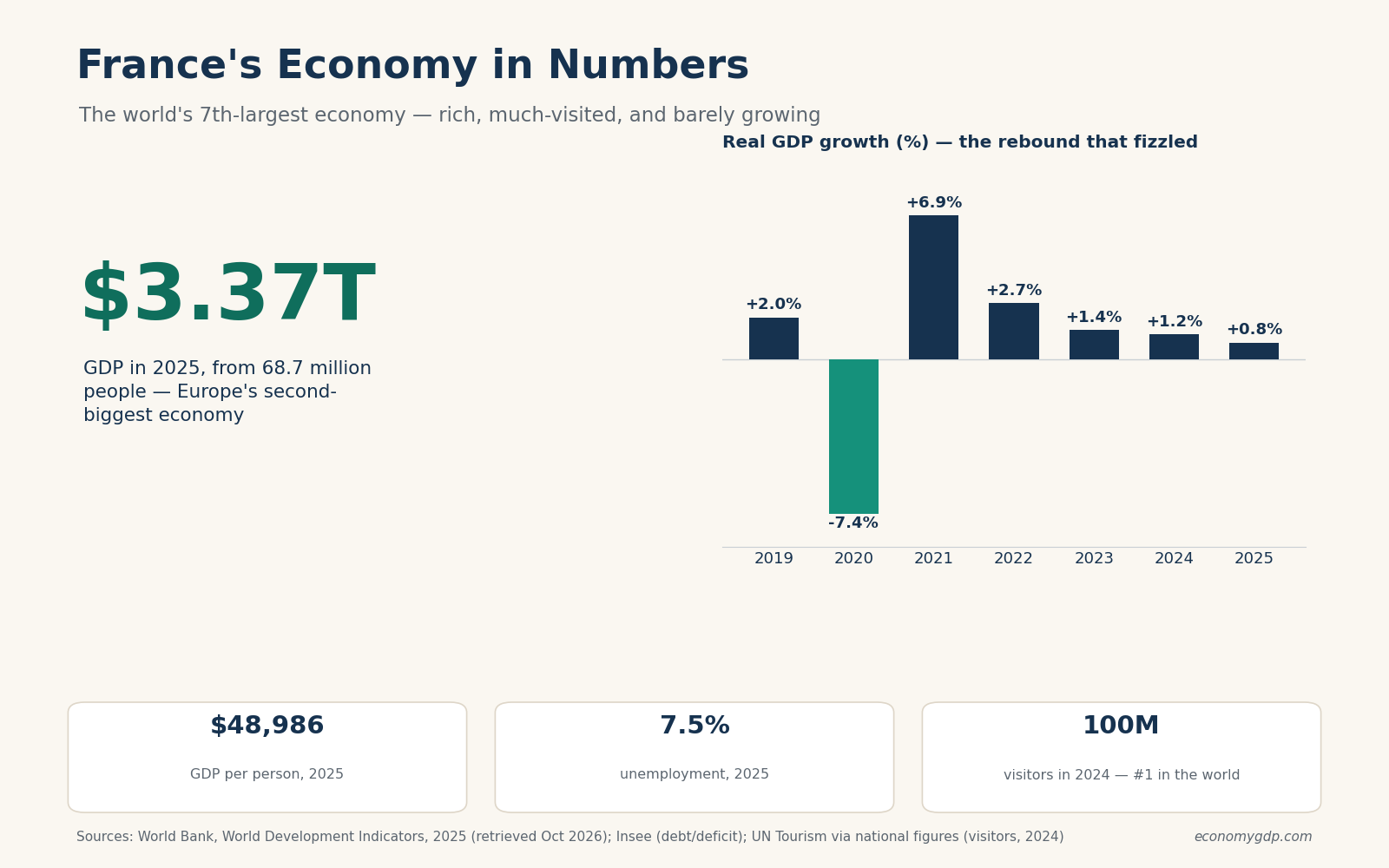
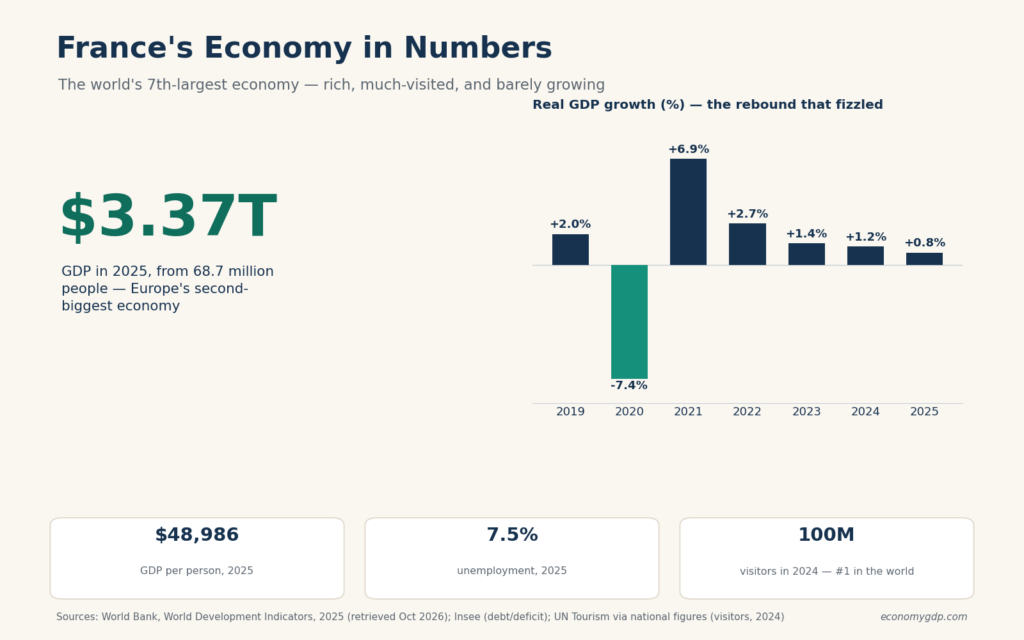
France is the world’s seventh-largest economy, and the second-biggest in Europe — but lately it has felt more like a country running in place than one pulling ahead. It produces about $3.37 trillion of output a year, from a population of 68.7 million people. Per person, that’s about $48,986, comfortably rich-country territory. Yet growth has slowed to a crawl, and the government’s debts keep piling up.
Put it this way: France has everything a big economy is supposed to have — world-class companies, a huge domestic market, Paris — and still can’t seem to get its growth rate above 1%.
A services economy that still makes things
Services account for about 71% of French output: the banks and insurers of Paris, the shops and restaurants, the trains and telecoms. But France is no post-industrial museum piece. It builds Airbus jets, high-speed trains, and nuclear reactors, and its luxury houses — think LVMH, Hermès, Chanel — sell handbags and perfume to the whole planet at prices most countries can only dream of charging.
Then there’s tourism, France’s quiet superpower. About 100 million international visitors arrived in 2024, more than any other country on earth, drawn by Paris, the Riviera, the Alps, and a food culture that treats lunch as a serious institution. Visitors don’t just take photos; they fill hotels, restaurants, and museums, and they keep a lot of small towns in business.
Agriculture punches above its weight too. France is Europe’s biggest farm producer, and its wine, wheat, and dairy exports are a point of national pride as much as an economic fact.
The slow-growth problem
The numbers tell a story of a rebound that fizzled. After crashing 7.4% in 2020 during the pandemic, the economy bounced back 6.9% in 2021. Then the pace faded year by year: 2.7% in 2022, 1.4% in 2023, 1.2% in 2024, and just 0.8% in 2025. That’s not a recession, but it’s barely growth — and with a population still edging up, it means living standards are roughly standing still.
Unemployment, at 7.5% in 2025, is down from the double-digit days of the 2010s, but it has stopped falling. Young workers still have a harder time than most of their European peers finding a first stable job, and productivity — output per hour worked — has been flat for years. France works fewer hours than many of its neighbours, by choice and by law, and its generous welfare state has to be paid for somehow.
The bill that keeps growing
That “somehow” is the awkward part. France’s public debt stood at 115.6% of GDP at the end of 2025, up from 98.2% in 2019, according to Insee, the national statistics office. The budget deficit was 5.1% of GDP in 2025 — well above the European Union’s 3% limit, which is why France is under the EU’s excessive deficit procedure.
None of this means France is about to run out of money. It borrows in euros, investors still buy its bonds, and its economy is far too big and diverse to be written off. But every euro spent servicing debt is a euro not spent on schools, trains, or tax cuts, and the debt ratio is still rising because the deficit is still large and growth is still slow.
France’s challenge, then, is a familiar one with a French twist: how to get a rich, productive, much-loved country growing again without blowing up the public finances — or giving up the way of life that makes people want to visit, and live, there in the first place.