
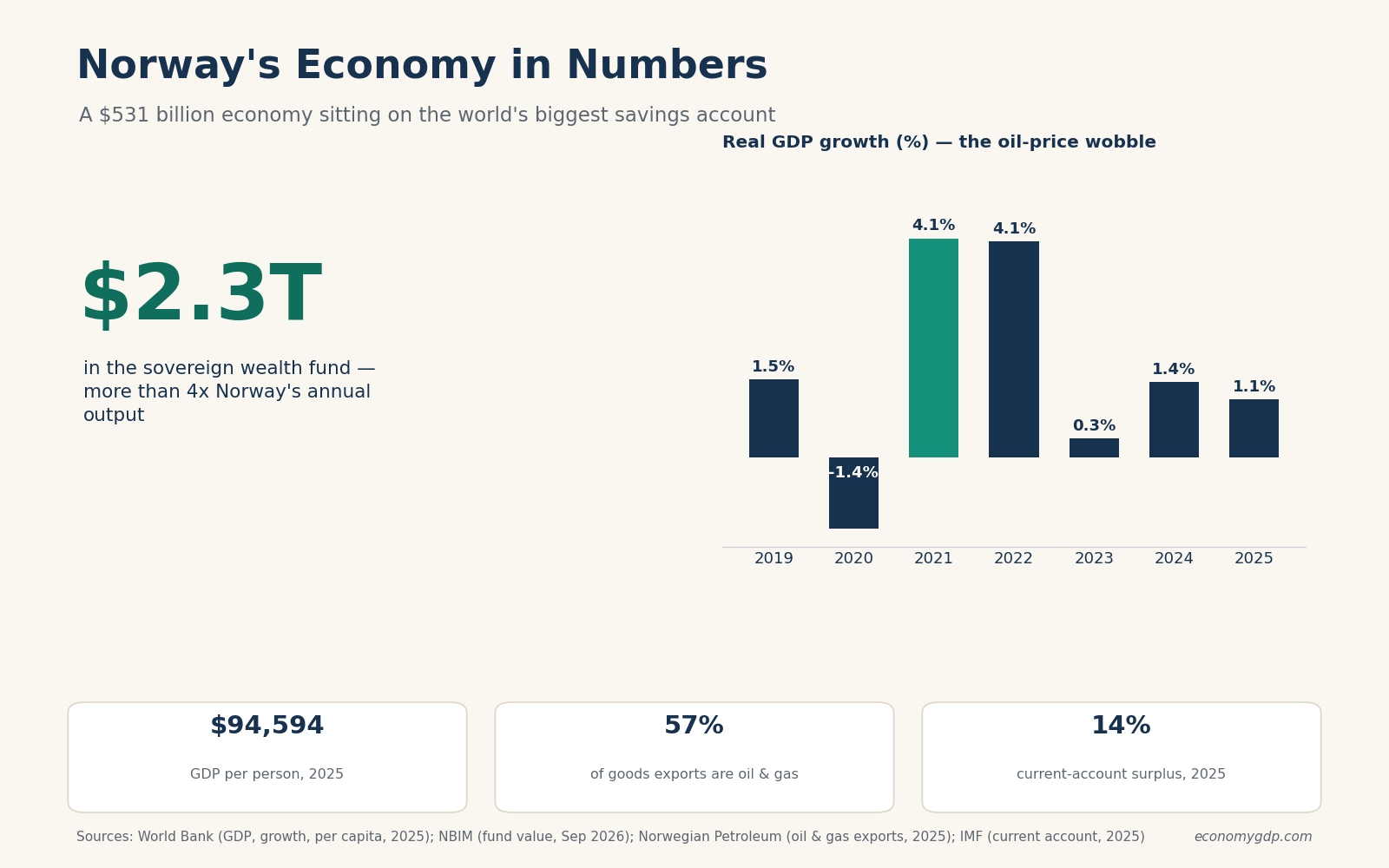
Norway has 5.6 million people, an economy worth $531 billion, and a savings account worth about $2.3 trillion. No other country has turned a natural resource into a fortune quite like this — or been quite so careful about spending it.
The economy itself is the world’s 30th-largest, and at $94,594 per person in 2025, Norway sits among the ten richest countries on earth by income per head. It grew just 1.1% in 2025, which sounds sleepy until you remember what it’s growing from. Unemployment runs at 4.6%, and the government runs a budget surplus worth about 9% of GDP.
The fund that owns a slice of everything
The piggy bank has a formal name: the Government Pension Fund Global, usually just called the Oil Fund. Every krone of oil and gas revenue the state doesn’t need goes into it, and it’s now worth 22 trillion kroner — roughly $2.3 trillion as of September 2026, more than four times Norway’s entire annual output.
The fund owns about 1.5% of every listed company on earth. In 2025 alone it earned a 15.1% return, about $248 billion in profit. But it’s the discipline around it that matters. A rule written into Norwegian politics says the government can only spend about 3% of the fund’s value each year — roughly its expected real return — so the principal keeps growing for the generations that come after the oil runs out.
The fund was created in 1990. The idea was simple: oil is a one-time gift, so treat it like one. Don’t blow it. Invest it, live off the interest, and let your grandchildren thank you.
Oil pays the bills — and sets the mood
The money still comes from under the sea. Oil and gas earned about 1 trillion kroner in 2025 — 57% of everything Norway sold abroad. The petroleum sector is roughly a quarter of GDP, and when energy prices move, the whole economy feels it.
You can see it in the numbers. In 2022, when gas prices spiked after Russia invaded Ukraine, Norway’s GDP jumped to $617 billion. In 2020, when oil crashed during the pandemic, it fell to $382 billion. Same country, same people, same fjords — a $235 billion swing driven almost entirely by the price of what comes out of the ground.
Europe has noticed. Norway now supplies nearly a third of the European Union’s gas imports, up from about a quarter before the war in Ukraine. That also leaves Norway exposed: if gas prices fall or Europe weans itself off fossil fuels, the export machine slows.
The central bank knows it. Norges Bank held its policy rate at 4.50% in early November 2026 because inflation is still running at 3%, above its 2% target, with the door open to another hike in December. Exports run to about 45% of GDP, and the current-account surplus is a remarkable 14% of GDP. Norway doesn’t just sell a lot abroad; it saves most of what it earns.
The catch: rich, but not immune
Norway’s oil production is past its peak, and the Norwegian Offshore Directorate warned in August 2026 that output could fall sharply after 2030 without significant new discoveries. The fund is now so big that its investment returns matter more to national wealth than new petroleum revenue does.
Meanwhile the mainland economy — everything that isn’t oil and gas — runs a structural deficit worth about 11.6% of mainland GDP, covered by transfers from the fund, which now finances roughly a quarter of all public expenditure. That’s fine while the fund keeps growing. It’s a different conversation if it stops.
There’s also the climate contradiction, which Norwegians argue about constantly. The country runs almost entirely on hydropower — about 90% of its electricity — and its domestic emissions are modest. But the fossil fuels it exports produce more than ten times the emissions of everything burned at home. Norway is, in effect, the world’s greenest oil exporter, and nobody’s quite sure how long that position holds.
For now, though, the model works. A small country found oil, refused to spend it all, and built the largest rainy-day fund in human history. The rain hasn’t come yet. The test will be what happens when it does.