

Brazil’s stock market just had one of its worst days in years — and it had almost nothing to do with soybeans, iron ore, or anything Brazil actually makes. On Monday, October 26, the Ibovespa index closed down 13.9% after Luiz Inácio Lula da Silva won re-election, tripping a circuit breaker that halted trading. Investors had bet heavily on his challenger, and the surprise sent them running for the exits.
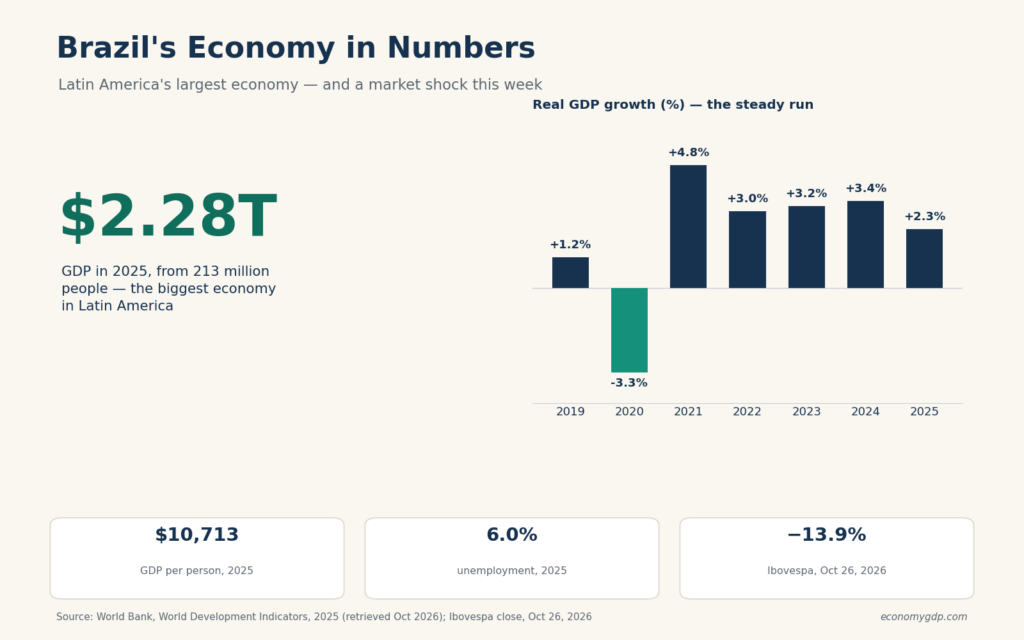
Strip away that one wild day, though, and Brazil is something markets keep underestimating: the largest economy in Latin America by a huge margin, producing about $2.28 trillion of output a year from a country of 213 million people. Per person, that’s about $10,713 — modest by rich-country standards, but spread across a continent-sized country that feeds and fuels much of the planet.
A giant built on farms, mines, and cities
Brazil’s economy looks nothing like the postcard version of the country. Services make up about 60% of output — the banks of São Paulo, the shops and restaurants of its megacities — while industry accounts for roughly 20% and agriculture about 6%. That last number is misleadingly small. Brazil is the world’s biggest exporter of soybeans and coffee, and one of the biggest of iron ore and beef. When harvests are good, the whole economy feels it.
The country also has a habit of swinging between boom and bust that its neighbours can only watch. Growth hit 4.8% in 2021 as the world reopened after the pandemic, then settled into a surprisingly steady run: 3.0% in 2022, 3.2% in 2023, 3.4% in 2024, and 2.3% in 2025. Inflation, which spiked to 9.3% in 2022, has cooled to 5.0%. Unemployment, at 6.0% in 2025, is down from 13.7% in 2020 — a transformation that matters more to ordinary Brazilians than any stock market chart.
The boom-and-bust habit
Still, Brazil has a long history of getting in its own way. The 2010s brought a deep recession, a corruption scandal that reached the top of business and politics, and a decade in which the economy barely grew at all. The rebound since 2021 has been real, but it was helped by bumper harvests and strong commodity prices — the kind of luck that doesn’t last forever.
Inequality is the other stubborn fact. Brazil has lifted millions of people out of poverty over the past two decades, yet it remains one of the most unequal big countries on earth. The gap between the gleaming towers of São Paulo and the poorer north-east is the backdrop to almost every election, and it helps explain why Brazilian politics keeps swinging so hard from one side to the other.
The question markets are really asking
That brings us back to October 26. The sell-off wasn’t really a verdict on Brazil’s farms or factories. It was a verdict on its public finances. Central government debt stood at about 82% of GDP in 2024, and investors worry that campaign promises will mean more spending, higher borrowing costs, and higher interest rates for longer. When traders fear that, they sell Brazilian stocks, sell the real — it fell more than 8% against the dollar that same day — and ask questions later.
Brazil has survived this kind of scare before, many times. Its economy is far more diversified than the commodity stereotype suggests, its farms feed a decent share of the world, and its domestic market of 213 million people is a prize in itself. The test for Lula’s new term is the same one every Brazilian government faces: can it keep the bills under control without choking off the growth that finally returned? The market’s answer, on Monday at least, was a loud no. The economy’s answer will take longer.