
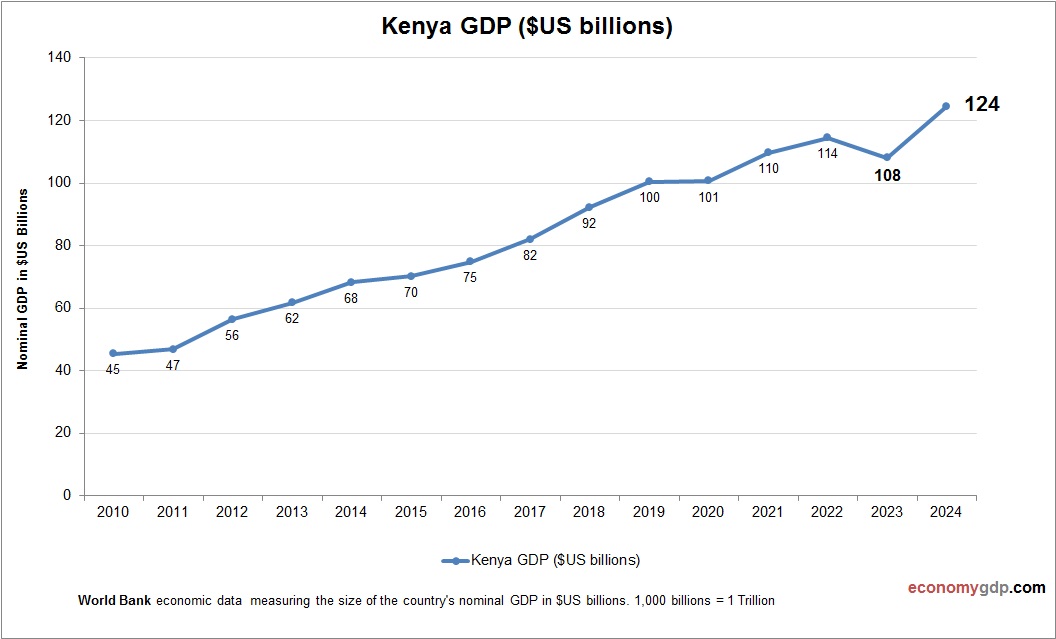
Kenya's economy is diverse, with agriculture, services, and industry contributing. Agriculture provides tea, coffee, and flowers for export, employing much of the population. Services, especially finance, ICT, and tourism, form a growing share of GDP. Nairobi is a regional tech hub, often called “Silicon Savannah,” attracting startups and investors. Industry includes food processing, textiles, and cement. Infrastructure projects like railways and energy development support growth. Challenges include poverty, inequality, and debt pressures. Still, Kenya's position as East Africa's economic hub, combined with its innovation in technology and agriculture, keeps GDP expanding steadily over the long term.
World Bank GDP economic data: 2010-2024. Last updated Apr 2026. See Kenya GDP per capita.
Kenya GDP Statistics by Year
| Year | GDP Size (in billions $) |
| 2025 (projected) | 135 |
| 2024 | 125 |
| 2023 | 108 |
| 2022 | 114 |
| 2021 | 110 |
| 2020 | 101 |
| 2019 | 100 |
| 2018 | 92 |
| 2017 | 82 |
| 2016 | 75 |
| 2015 | 70 |
| 2014 | 68 |
| 2013 | 62 |
| 2012 | 56 |
| 2011 | 47 |
| 2010 | 45 |