
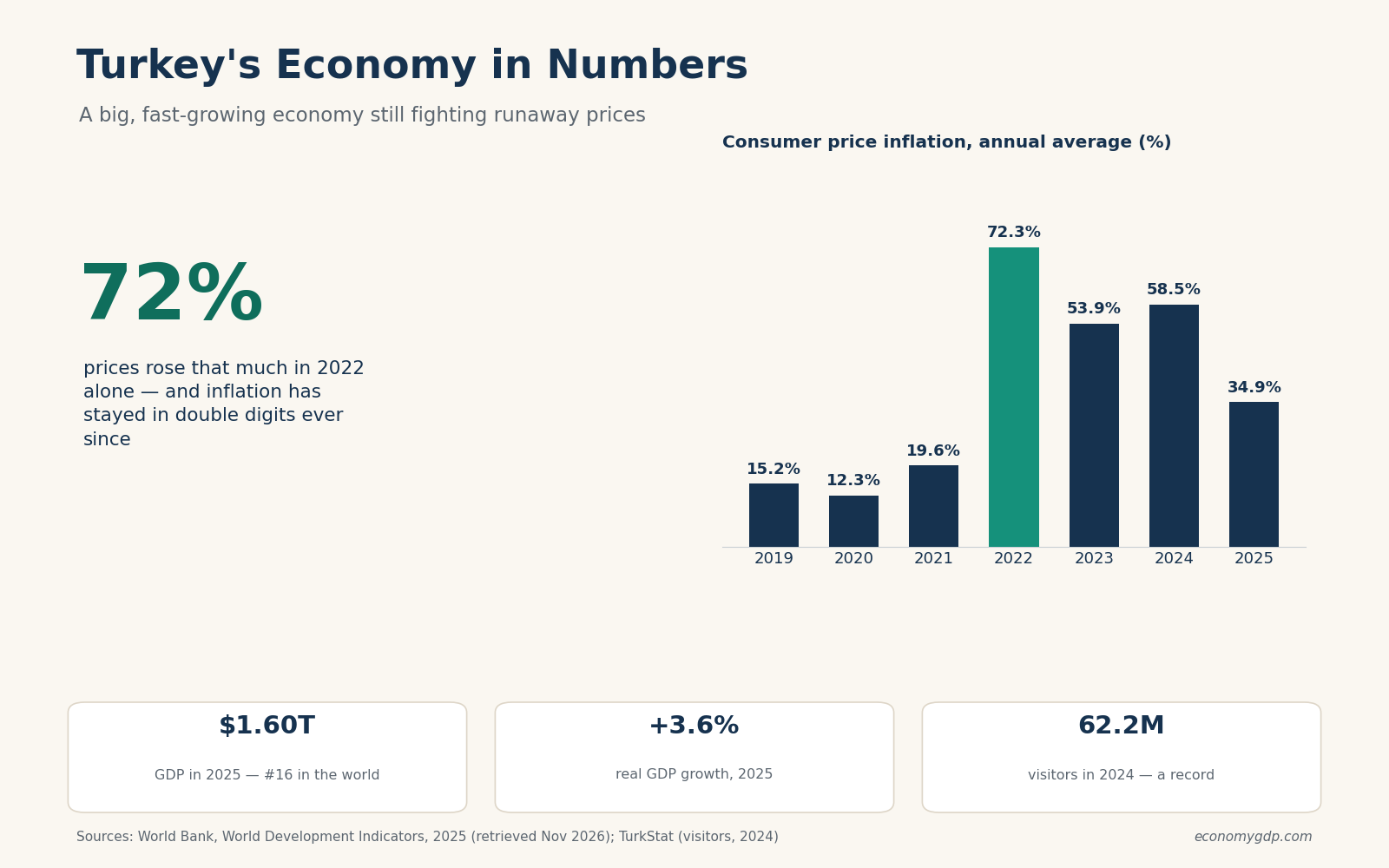
Turkey is the world’s 16th-largest economy, and by some measures it shouldn’t be this hard to run. It has 86 million people, a big industrial base, a location that straddles Europe and Asia, and beaches that draw tens of millions of visitors a year. It has also grown every single year since 2020 — sometimes fast. And yet ask almost anyone in Istanbul what the economy feels like, and they’ll talk about prices, not growth. That’s the Turkish paradox in one sentence: an economy that keeps getting bigger while its money keeps losing value.
The headline figures: Turkey produced about $1.60 trillion of output in 2025, up from $1.36 trillion the year before, according to the World Bank. That’s roughly $18,600 per person across a population of about 86 million. Adjust for what money actually buys inside the country, and the economy looks even larger — nearly $3.9 trillion on a purchasing-power basis, 11th in the world. Real growth was a solid 3.6% in 2025, after 3.3% in 2024 and 5.0% in 2023.
The inflation problem
Here’s the catch: a big chunk of that dollar jump is inflation, not extra output. Prices rose by an average of 34.9% in 2025, and that was an improvement. In 2022 they rose 72.3%. Turkey has now lived through five straight years of double-digit inflation, a run that would be a crisis anywhere else and has become almost routine there.
How did it get here? In 2021 and 2022, while inflation was climbing, the central bank cut interest rates — the opposite of what textbooks say to do. The idea, pushed by President Erdoğan, was that cheaper borrowing would fuel growth and somehow bring prices down. It didn’t. The lira collapsed, import costs soared, and inflation hit 85% on some measures in late 2022. Since mid-2023, a new economic team has been unwinding the experiment: rates went up sharply, the budget was tightened, and inflation has been grinding down. By September 2026 it had fallen to 29.7% a year — still high, but the lowest in nearly five years. The central bank cut its policy rate to 36% in October 2026, its first cut in nine months, betting the disinflation can continue.
What Turkey actually makes and sells
Strip out the monetary drama and there’s a real, diversified economy underneath. Services account for about 59% of output, industry 24%, and agriculture 5%. Turkey builds cars, appliances, and textiles, exports machinery and steel, and sells nearly a quarter of everything it produces abroad — exports were worth about 25% of GDP in 2025.
Tourism is a genuine pillar. A record 62.2 million visitors came in 2024, bringing in $61.1 billion — Turkey is one of the four most visited countries on Earth. Istanbul’s position helps too: the city sits on the strait between the Black Sea and the Mediterranean, and the country is a natural bridge for trade between Europe, the Middle East, and Central Asia.
The labour market has quietly improved as well. Unemployment fell to 8.5% in 2025, down from 13.7% in 2019. The economy has also proved resilient to shocks — including the devastating earthquakes of February 2023, after which reconstruction spending helped keep growth going.
The bet now
Turkey’s story in 2026 is really a race between two numbers. Growth is running at 3–4% a year, the economy is big and diversified, and foreign investors are starting to come back as policy looks more conventional. On the other side, inflation is still near 30%, and every time the central bank has declared victory too early in the past, prices have taken off again.
If the disinflation holds — rates high enough, for long enough, and the lira roughly steady — Turkey could finally get the boring, stable economy its size deserves, and growth would start showing up in living standards instead of just in the GDP tables. If it doesn’t, the country has shown it can keep growing anyway. That’s the strange thing about Turkey: even its crises come with growth attached. The question isn’t whether the economy can grow. It’s whether Turks can ever feel it.