
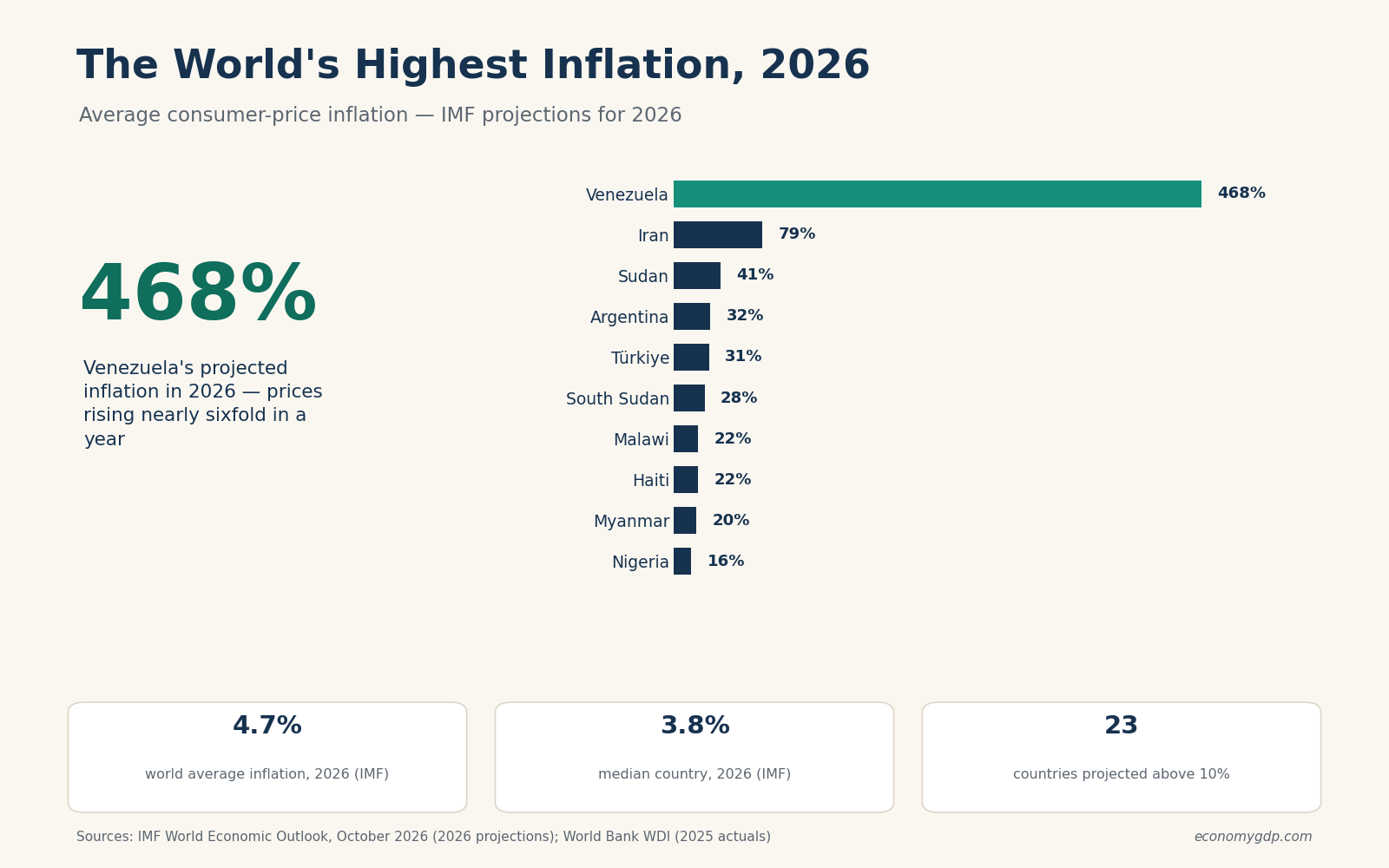
Here’s an inflation number that’s hard to picture: 468%. That’s the IMF’s projection for Venezuela in 2026 — prices rising nearly sixfold in a single year. Hold cash there and it loses half its value in under five months. Put another way, it’s about 16% a month, every month.
Nobody else is close. Iran, in second place, is projected at 79%. Venezuela’s rate is six times that, and roughly 100 times the world average of 4.7%. And yet the most interesting thing about this table isn’t who sits at the top. It’s which way everyone is moving.
The top of the table
On the IMF’s October 2026 projections — annual-average consumer prices, so forecasts rather than final readings — the ten highest rates for 2026 are Venezuela (468%), Iran (79%), Sudan (41%), Argentina (33%), Türkiye (31%), South Sudan (28%), Malawi (22%), Haiti (22%), Myanmar (20%) and Nigeria (16%).
That sounds like a world on fire. It isn’t. Only nine countries are projected above 20%, and just 23 above 10%. The median country sits at 3.8%. High inflation in 2026 is concentrated, not global — a short list of war zones and broken currencies, not a general fever.
The measured data tell a slightly different story, and the gap is worth flagging. In the World Bank’s figures for 2025, the highest actual rate is Iran’s 42%. Venezuela, Sudan and Argentina have no 2025 World Bank value at all. The IMF estimates Iran at 51% for 2025, so even the two big sources don’t quite agree. Treat the top of this table as estimates with wide error bars, because that’s what they are.
Why the top isn’t the story
Start with Venezuela itself. Awful as 468% is, it’s a shadow of what came before. The IMF reported inflation of 929,790% in 2018 — prices doubling every few weeks. By that standard, Venezuela has been disinflating for years. It just disinflated from catastrophe to merely terrible.
Iran is the one moving the wrong way. It’s the only country near the top where inflation is sharply accelerating — from about 51% in 2025 to a projected 79% in 2026, as war, sanctions and a sliding currency feed into prices. The IMF itself flags that forecast as unusually uncertain. Everyone else at the top is cooling, at least on paper: Sudan from roughly 100% in 2025 to 41%, Argentina from 42% to 33%, Türkiye from 35% to 31%.
Argentina deserves a second look. The World Bank put its average inflation at 220% in 2024, the highest measured rate in the world that year. Getting from there to the low 30s in two years is one of the fastest disinflations on record — brutal for living standards along the way, but real. Türkiye is a different case: at $1.8 trillion, it’s by far the biggest economy in the top group, so its 31% touches far more people than Sudan’s 41%.
And rankings churn fast. Zimbabwe, which averaged 81% inflation in 2025 on IMF estimates, is projected at just 4% in 2026 after a new currency and tight monetary policy. Lebanon went from 221% in 2023 to about 15% in 2025 in the World Bank data. A country can fall off this table as quickly as it climbed on.
What normal looks like in 2026
For most of the world, 2026 inflation is unremarkable. The IMF puts the global average at 4.7%, up from the World Bank’s 3.0% for 2025, with the energy shock from the Strait of Hormuz disruption doing much of the lifting. The US is projected at 3.6%, Canada at 2.8%, the UK at 3.3%, Germany at 2.7% and Japan at 2.0%. China, at 1.0%, still has the opposite problem. India is the notable riser among the big economies, from 2.0% to 5.0%. At the very bottom, Niger is projected to see prices fall 1.9%.
So read the league table upside down. The headline rate tells you where the damage already happened — war in Sudan, currency collapse in Venezuela, sanctions and conflict in Iran. The direction tells you whether it’s healing. In 2026, most of the worst cases are slowly healing. Iran is the exception, and that’s the story worth watching.