
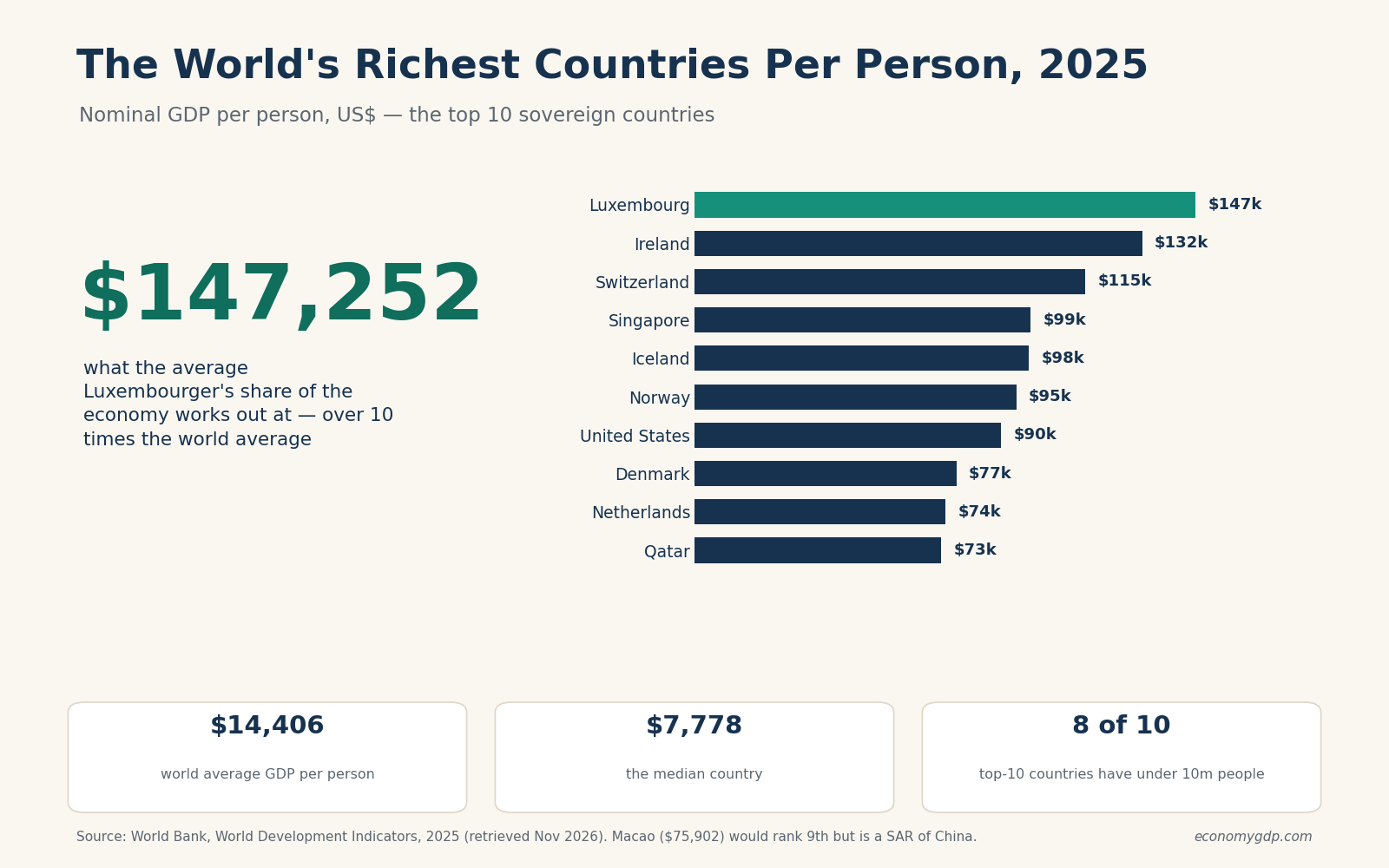
Here’s a number to sit with: the average person in Luxembourg produced $147,252 of economic output last year. Not earned — produced, in the national-accounts sense. Still, that’s the figure the World Bank puts on Luxembourg’s GDP per person for 2025, and it’s more than ten times the world average of $14,406. The typical country, the median one, sits at $7,778. Luxembourg is nearly nineteen times that.
The richest-per-person list is a strange one. It isn’t topped by the biggest economies, or the most powerful ones. It’s topped by places most people couldn’t find on a map without squinting, and the United States is the only genuinely large country anywhere near the top.
A very small club
The top ten, in order: Luxembourg ($147,252), Ireland ($131,592), Switzerland ($114,769), Singapore ($98,814), Iceland ($98,323), Norway ($94,594), the United States ($90,027), Denmark ($76,970), the Netherlands ($73,684) and Qatar ($72,525). Macao would slot in ninth at $75,902 if you counted it — it’s a special region of China, so it sits just outside the sovereign ranking.
Eight of the ten have fewer than 10 million people. Luxembourg has about 687,000; Iceland fewer than 400,000. The Netherlands, at 18 million, is the second-biggest after the US, and even that’s a rounding error next to America’s 342 million. Smallness helps here in a specific way: a country can get very rich per person by doing one extremely profitable thing very well — finance in Luxembourg, pharmaceuticals and banking in Switzerland, shipping and finance in Singapore, oil and gas in Norway and Qatar — and spreading the proceeds across a small population.
Luxembourg is the purest version of the trick. Finance generates roughly a quarter of everything the country produces, and the sector’s exports are worth far more than the domestic economy could ever absorb. Nearly half the workforce commutes in from France, Belgium and Germany each morning, which flatters the numbers further: their output counts in Luxembourg’s GDP, but they don’t count in its population.
The asterisks
Before anyone takes the ranking at face value, it needs two caveats, and Ireland is both of them at once.
Ireland sits second at $131,592, but its own statisticians would tell you not to believe that number. Multinationals park intellectual property in Ireland, and the profits booked there inflate GDP far beyond what the domestic economy actually generates. The Central Statistics Office publishes a cleaned-up measure, modified GNI, and on that basis Ireland’s 2025 figure is €61,183 per person — about 55% of the headline number. Still rich, nowhere near second in the world.
Then there’s the price problem. These are nominal dollars, converted at market exchange rates, so a strong franc or a weak krone can move a country up or down the list without anything changing on the ground. Adjust for what money actually buys — purchasing-power parity — and the order scrambles: Singapore jumps to first at $163,354, Qatar leaps to $128,883 (against $72,525 nominal, because gas is cheap at home and so is almost everything else), and the US, at $90,027, is the same either way, because the dollar is the yardstick.
The other end of the scale
The gap at the bottom is the part that sticks. Burundi’s GDP per person in 2025 was $234. Luxembourg’s figure is about 630 times that. The Central African Republic ($556), Madagascar ($599) and Mozambique ($627) aren’t much higher. These aren’t rounding errors; they’re the same measure, the same year, the same planet.
None of this is a league table of happiness, and GDP per person isn’t anyone’s paycheque — it says nothing about how the money is shared out, what things cost, or whether people feel well off. Norway’s oil wealth sits in a sovereign wealth fund rather than in pay packets, and Qatar’s average is flattered by a large expatriate workforce on modest wages. But as a rough map of where the world’s output is concentrated, the picture is clear enough: the richest places per person are small, open, and specialised — and the distance between the top and the bottom is wider than most people imagine.