
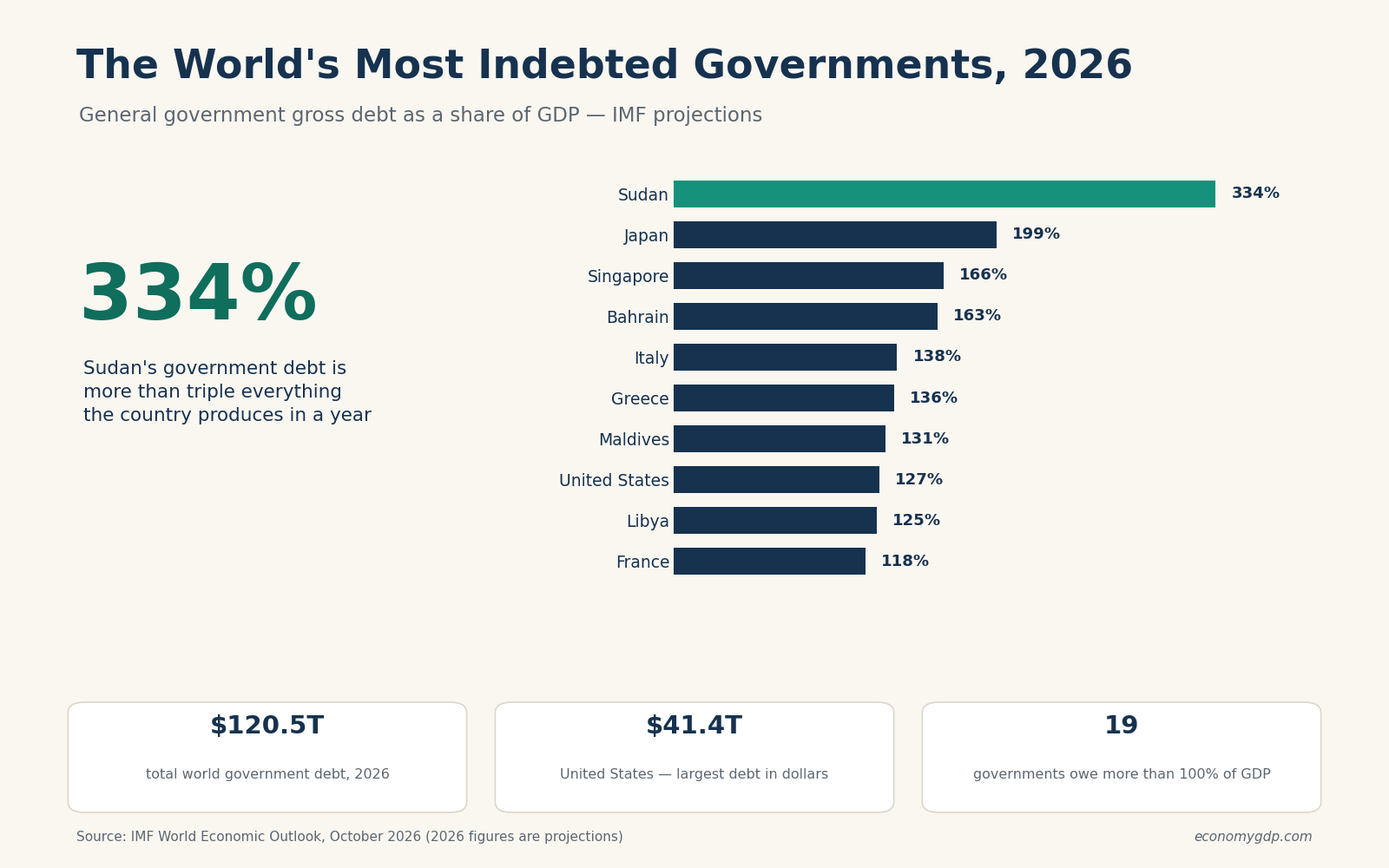
Here’s a debt figure that barely makes sense until you unpack it: Sudan’s government owes 334% of everything the country produces in a year — more than triple the size of the economy itself. That’s the IMF’s projection for 2026, far ahead of every other government on Earth.
Second place is almost as startling. Japan owes 199% of its GDP. The United States owes 127% — a smaller share, but a far bigger pile: about $41 trillion, a third of all government debt in the world. Governments everywhere owe roughly $121 trillion between them, about 95% of global output.
The top of the table
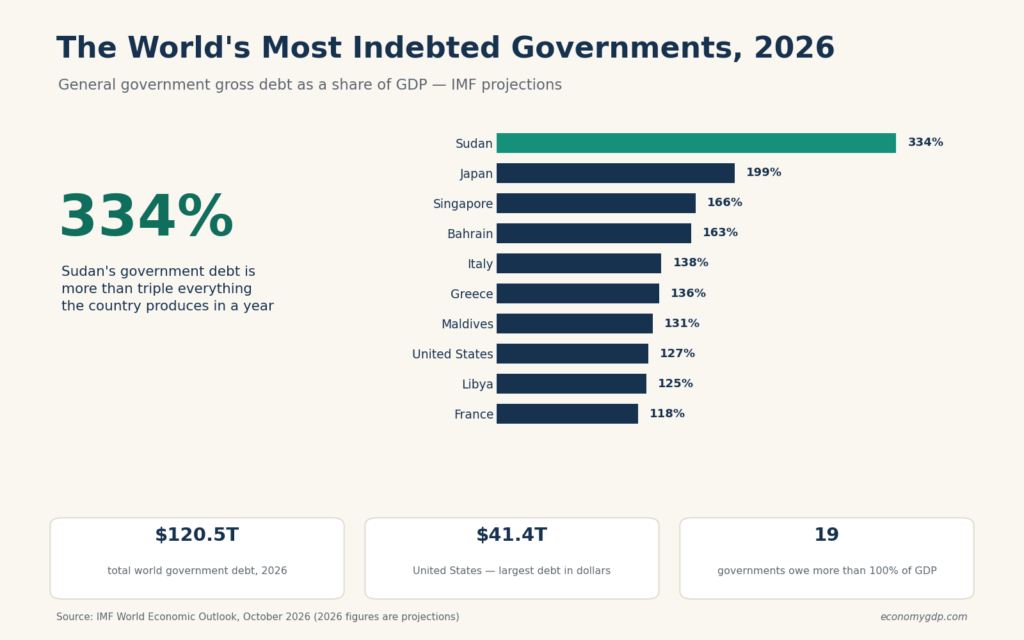
Ranked by debt as a share of GDP, on the IMF’s October 2026 projections, the top ten runs: Sudan (334%), Japan (199%), Singapore (166%), Bahrain (163%), Italy (138%), Greece (136%), the Maldives (131%), the United States (127%), Libya (125%) and France (118%). Bhutan and Canada (both 116%) sit just behind. In total, 19 governments owe more than 100% of GDP.
Two familiar names are missing, and the gap says a lot. Lebanon (139% in 2025) and Senegal (128% in 2025) have no 2026 projection in the IMF’s table, and Venezuela — deep in default, its obligations contested — has no figure at all.
Sudan’s number needs a health warning, too. Its economy shrank by roughly 29% in 2023 and another 14% in 2024 as civil war tore through it, and unpaid bills have piled penalty interest onto old loans. The IMF put Sudan at 204% in 2025; the leap to 334% mostly reflects a collapsing economy and growing arrears, not fresh borrowing.
Why the league table lies a little
This ranking measures gross debt — everything a government owes, before subtracting what it owns. That makes some countries look far worse than they are. Singapore sits third at 166%, yet its finance ministry points out that government financial assets are well in excess of its debt. It issues bonds largely to invest the proceeds and to give its pension system somewhere to put money. Net of assets, Singapore owes nothing.
Canada is the same trick in a different accent. At 116% gross, it ranks third-highest in the G7. Net off the Canada and Quebec pension plan assets, the way the IMF does, and Canada drops to about 9% — the lowest in the G7. Whether pension savings should count is debatable. But the gap between 116% and 9% shows how much the answer depends on the question.
Japan’s 199% comes with cushions of its own. About 92% of its bonds are held at home, nearly half by the Bank of Japan itself, and all of it is borrowed in yen. Greece, at 136%, got there the hard way — crisis, bailouts and a restructuring in 2012 — but its loans now run roughly 18 years on average, so refinancing pressure is gentler than the headline suggests. Who holds the debt, in what currency, and for how long matters at least as much as how much there is.
Where the bill actually lands
The real weight of debt shows up in the interest bill. In the fiscal year that ended in September 2026, the US government paid more than $1 trillion in net interest — more than it spent on defence, and the first time interest has crossed that line. Bahrain’s interest reached about 6.5% of GDP in 2024. The Maldives faces external repayments of about $1.7 billion in 2026, nearly triple the $630 million due the year before, against thin foreign reserves.
The direction of travel is just as telling. China crossed the 100% line this year, reaching 104% — up from 60% in 2019, the steepest climb among the big economies, driven heavily by local-government borrowing. World government debt has grown by roughly $48 trillion since 2019. At the other end, Liechtenstein owes 0.5% of GDP and Brunei 1.3%.
None of this makes 100% a magic danger line. Japan has lived above 200% without a crisis, while other countries have defaulted at a fraction of that. What decides whether debt is a tool or a trap is the interest rate against the growth rate, the currency it’s owed in, and whether anyone will refinance it.