
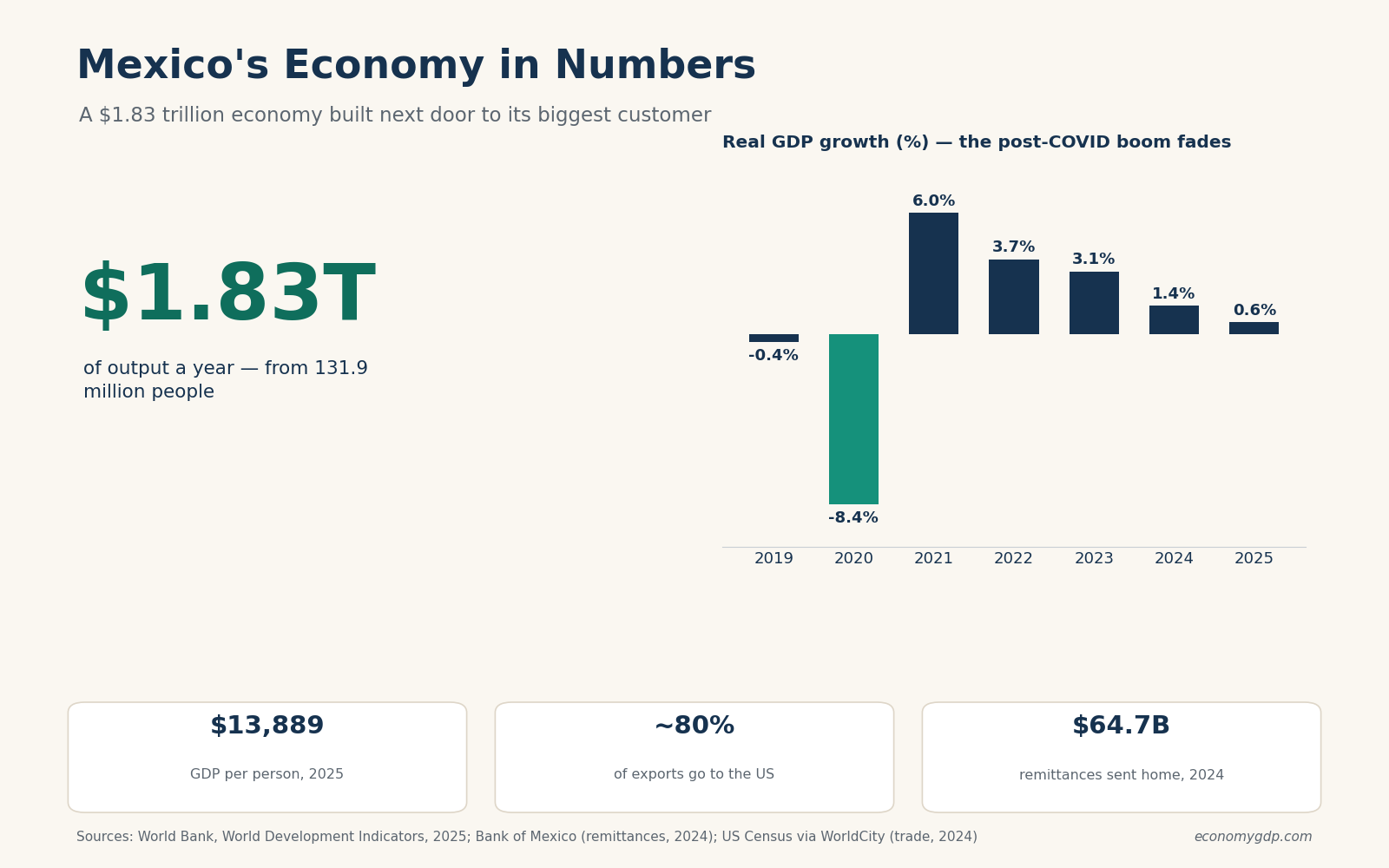
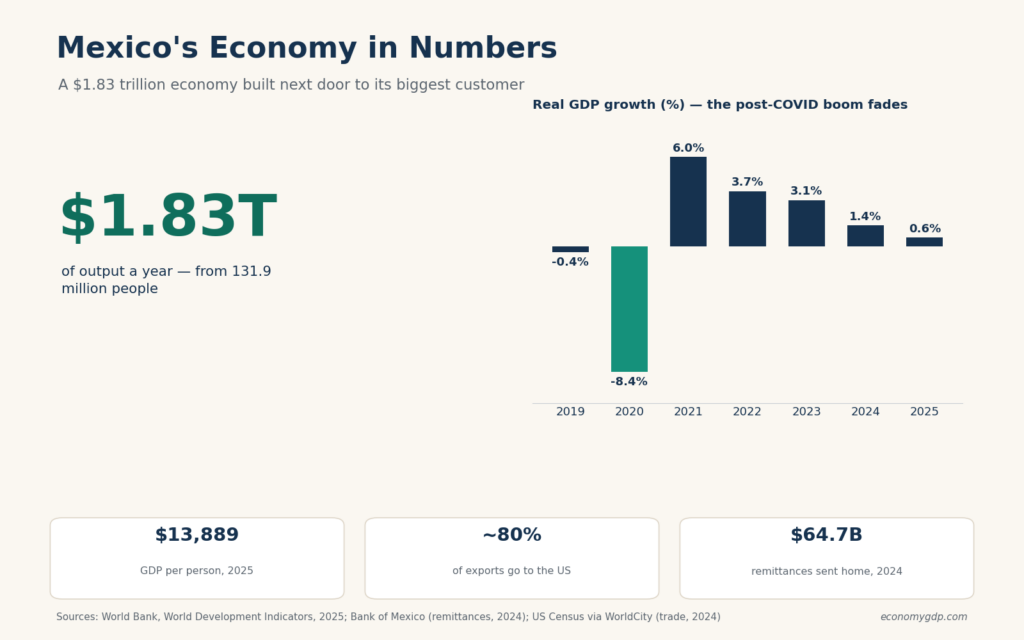
Mexico is the world’s 14th-largest economy, and one of the hardest to sum up in a sentence. It’s a $1.83 trillion economy with 131.9 million people, which works out to about $13,889 of output per person — far below the United States next door, but enough to make it Latin America’s second-biggest economy and a manufacturing power in its own right. Growth, though, has run out of steam: just 0.6% in 2025, down from 3.1% two years earlier.
The factory next door
Mexico’s great advantage is geography, and it has spent three decades cashing it in. Factories across the north build cars, auto parts, electronics and appliances, mostly for buyers across the border. Roughly four-fifths of Mexico’s exports go to the United States — in 2024 the two countries traded a record $840 billion worth of goods, with $506 billion flowing north. Manufacturing alone accounts for about a fifth of GDP, and services for close to three-fifths.
That closeness is also the risk. When Washington talks tariffs, factory orders in Monterrey and Tijuana feel it within weeks, and investment decisions get put on hold. The 2025 slowdown had a lot to do with exactly that kind of uncertainty, on top of weaker spending at home. Nearshoring — companies moving production out of Asia and into Mexico to be nearer US customers — is still real, but it hasn’t been enough to carry growth on its own.
The money that comes home
There’s a second flow of money across the border that rarely makes headlines, and it matters enormously to ordinary families. Mexicans working abroad sent home a record $64.7 billion in 2024, according to the Bank of Mexico, and almost all of it came from the United States. That’s roughly 3.5% of GDP, more than Mexico earns from oil exports, and it lands directly in household budgets — food, school fees, a new roof — in towns that factories never reached.
It’s a strange kind of safety net: built on people who left, and exposed to whatever US immigration and tax policy does next. A proposed tax on remittances in Washington has already had Mexican researchers running the numbers on what it would cost.
Rich on paper, tight in practice
Here’s the puzzle. Unemployment sits at just 2.7%, one of the lowest rates in the world, yet plenty of Mexicans feel squeezed. Part of the answer is that the headline rate hides a huge informal sector — street vendors, day labourers, small traders — working without contracts or benefits. Part of it is that wages, while rising, started from a low base, and prices for food and housing have outpaced them for years.
So Mexico sits in an odd spot: big enough to matter to the whole North American economy, productive enough to build the cars Americans drive, and still waiting for that scale to turn into faster growth and fatter pay packets at home. The factories are there. The workers are there. The question for the next few years is whether the economy can grow fast enough to keep both.