
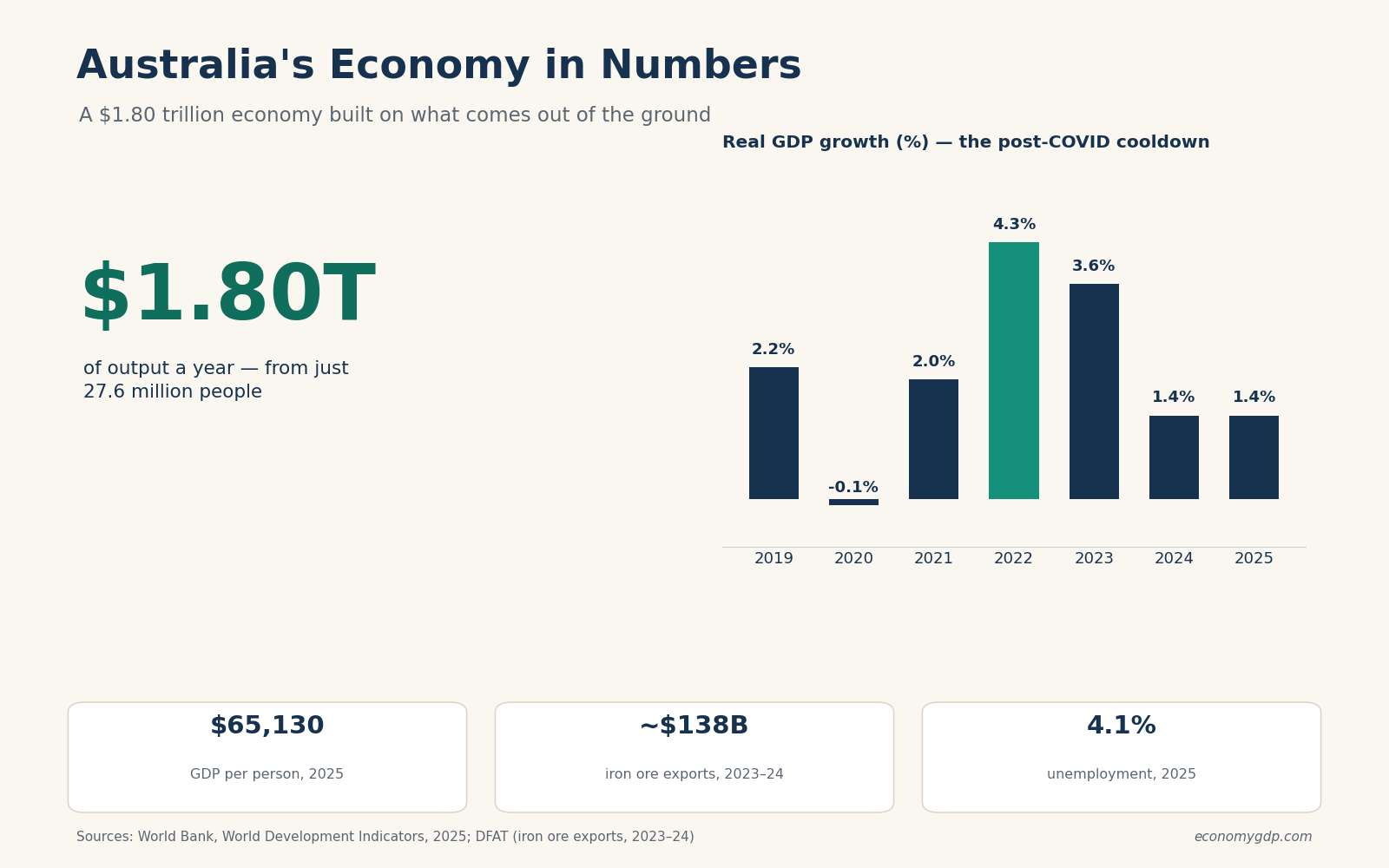
Australia is one of those economies that looks calm from the outside and turns out to be anything but simple underneath. It’s a $1.80 trillion economy — one of the 15 largest in the world — built by just 27.6 million people, which works out to about $65,130 of output per person. That’s richer per head than Germany or the UK, and it comes mostly from digging things out of the ground and selling them to Asia.

A mining economy that never really stopped growing
Australia famously went nearly three decades without a recession, from 1991 until COVID finally broke the run in 2020. The economy bounced back fast after that: growth hit 4.3% in 2022 as borders reopened and commodity prices surged. Since then it’s cooled a lot, to about 1.4% in 2025, but it hasn’t tipped over. Unemployment sits around 4.1%, which by Australian standards is still pretty tight.
The engine room is the Pilbara, a vast red desert in Western Australia where some of the world’s biggest iron ore mines run around the clock. Iron ore alone brought in roughly $138 billion in export earnings in 2023–24, and coal and liquefied natural gas add tens of billions more on top. Put together, minerals and energy make up close to four-fifths of what Australia ships overseas by sea.
One customer matters more than all the rest
Here’s the catch: an awful lot of that cargo goes to one place. China takes around 85% of Australia’s iron ore exports and roughly two-fifths of its seaborne export earnings overall. Japan and South Korea are the next biggest buyers, but they’re a long way behind. That concentration has bitten before — Beijing slapped bans on Australian wine, barley, coal and lobsters in 2020–21 after a diplomatic falling-out — and most of those bans have since been lifted, but nobody in Canberra has forgotten the lesson.
Exports overall are worth about 23% of GDP, which is a middling figure globally: far less exposed than a place like Singapore, far more than the United States. The flip side is that when China’s steel mills slow down, or when iron ore prices slide, Australia feels it in the budget within months, because mining royalties and company taxes are a big chunk of government revenue.
The part of the economy you don’t see in photos
For all the mining headlines, most Australians actually work in services — health care, education, finance, construction and retail. Sydney and Melbourne are the real population centres, and housing in both cities is famously expensive, which is one reason the Reserve Bank’s interest-rate decisions get watched so closely. Inflation ran hot after the pandemic but has come back down toward the bank’s 2–3% target range, and the IMF estimates growth picking up to around 2% in 2026.
So Australia is a rich, slow-growing, commodity-heavy economy with a very good standard of living and one very large vulnerability: what it sells, and who it sells it to, hasn’t changed much in decades. The long game is whether it can turn its other advantages — sun, space, and some of the world’s best lithium and rare-earth deposits — into something beyond the next shipload of iron ore.