
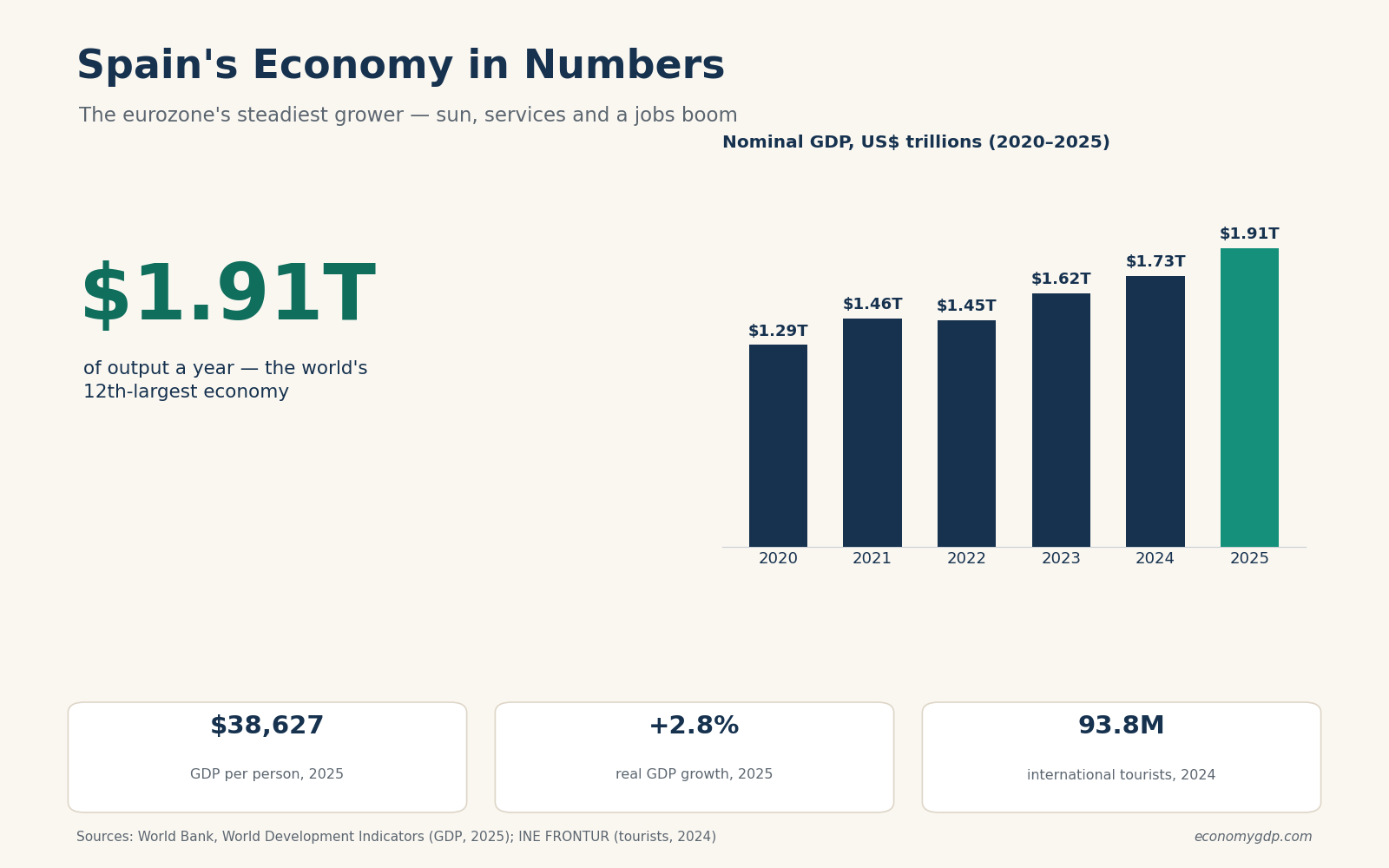
Spain is the country Europeans go to on holiday, and lately it’s also the country Europe’s economy leans on. It’s a $1.91 trillion economy — the 12th-largest in the world — built by 49.4 million people, and it has spent the last few years growing faster than almost every other big economy in Europe. Not bad for a place still carrying an unemployment rate above 10%.
The headline number hides a neat trick. Spain’s economy is now bigger, in real terms, than it was before the pandemic, and it got there without the usual engines. There’s no giant manufacturing base like Germany’s and no financial centre like London’s. What Spain has instead is services — hotels, restaurants, banks, telecoms — which make up about 69% of everything the country produces, plus a construction sector that never really went away and an export machine in cars, food, and pharmaceuticals.
The tourism machine — and its limits
Start with the obvious one. Spain welcomed 93.8 million international tourists in 2024, a record, and they spent €126 billion while they were there. The British came in the largest numbers, followed by the French and the Germans, and the money lands hardest in Catalonia, the Balearic Islands, and the Canary Islands. Tourism directly accounts for roughly 12% of GDP, and plenty more once you count the bars, cleaners, and taxi drivers who live off it indirectly.
That success has a sharper edge now. In 2024 and 2025, residents in Barcelona, Palma, and Málaga took to the streets to protest against over-tourism and the housing squeeze it feeds — short-term rentals pushing up rents in cities where locals already struggle to buy. The government has started cracking down on unlicensed holiday lets, and several cities have capped new ones. Spain wants the visitors; it’s just working out how many it can take, and on whose terms.
Growth that outran the eurozone
The more surprising story is the growth itself. Spain’s economy expanded 2.8% in 2025, after 3.5% in 2024 — more than double the eurozone’s pace. A big part of that is people: immigration has surged, pushing the population past 49 million and filling jobs in hospitality, construction, and care work. Employment has hit record levels, which is one reason unemployment, while still high at 10.4%, is the lowest Spain has seen in well over a decade.
There are still weak spots, and they’re familiar ones. Public debt sits near 100% of GDP, productivity growth has been sluggish for years, and the housing shortage is real — Spain builds far fewer homes than it needs. But the mix Spain has landed on, sun plus services plus a steady flow of newcomers, has turned it from the eurozone’s problem child of the 2012 debt crisis into its steadiest grower. At $38,627 of output per person, it’s not the richest country in Europe. It might, right now, be one of the most interesting.
Sources: World Bank, World Development Indicators (GDP, GDP per capita, growth, population, services share, unemployment, 2024–2025, retrieved November 2026); IMF World Economic Outlook, October 2026 (cross-check: Spain’s 2025 nominal GDP $1.909 trillion); Spain’s National Statistics Institute (INE), FRONTUR (93.8 million international tourists and €126.3 billion in spending, 2024).