
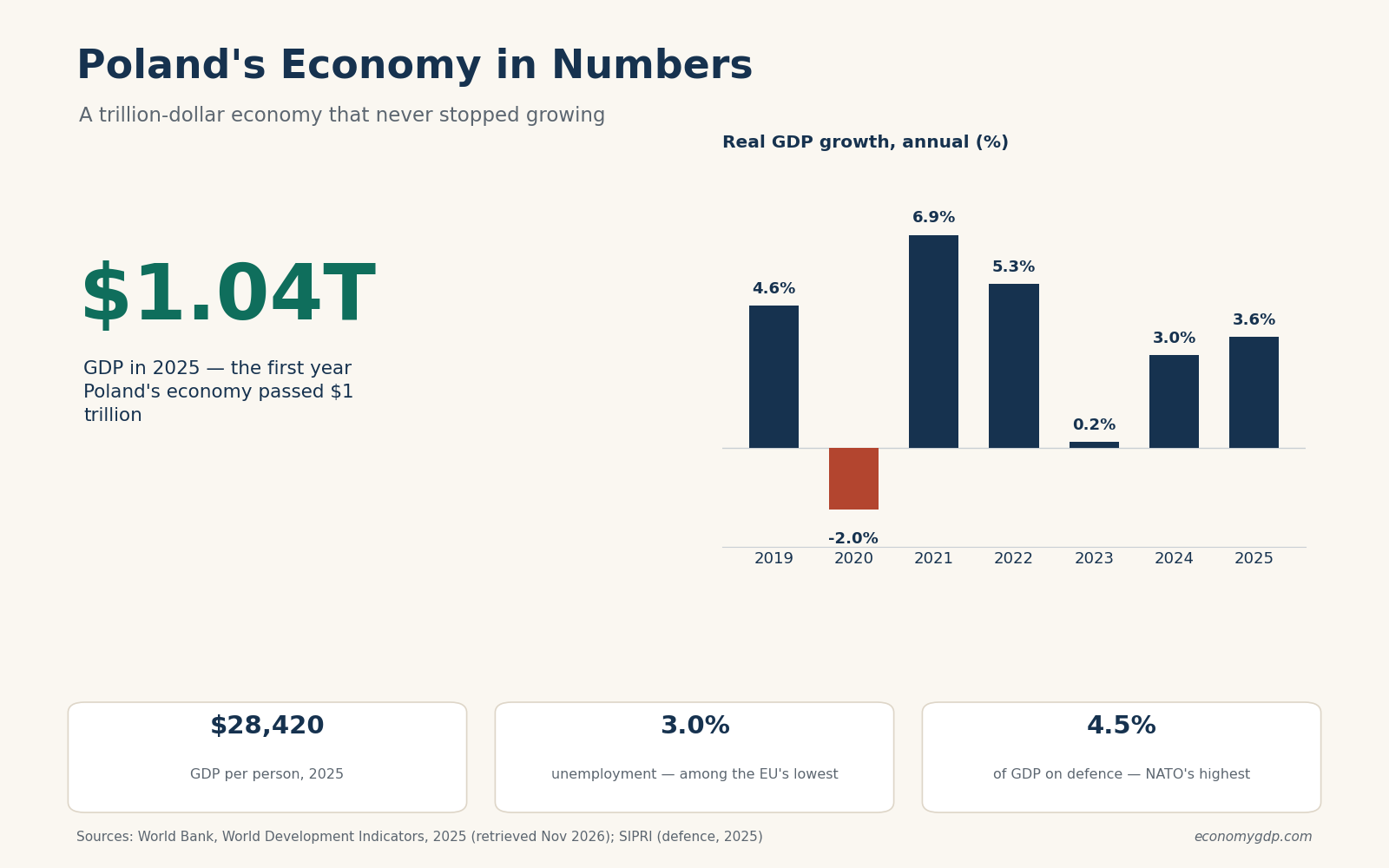
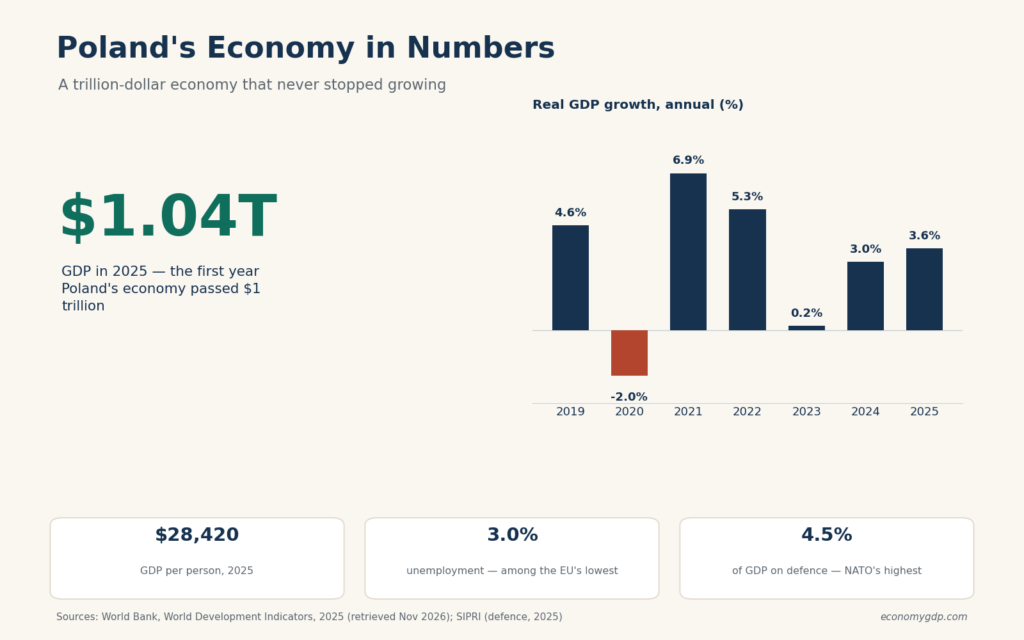
Poland just joined a club with only about twenty members. In 2025 its economy passed $1 trillion for the first time — $1.035 trillion, according to the World Bank — making it roughly the 20th-largest economy on Earth. That’s a remarkable place for a country that, barely a generation ago, was emerging from central planning. Today the average Pole produces about $28,420 a year, and the economy grew 3.6% in real terms in 2025, one of the faster rates in the European Union.
The dollar figure got a lift from a strong złoty, so the real growth number is the honest one: 3.6%, after 3.0% in 2024 and a near-standstill 0.2% in 2023. Adjust for what money actually buys inside Poland and the economy is worth nearly $1.98 trillion — about $54,000 per person on a purchasing-power basis.
The green island that never stopped growing
Poland has a party trick no other EU country can match: it never had a recession in 2009. While the rest of Europe shrank through the global financial crisis, Poland kept growing — about 1.6% that year, then around 4% in 2010 and 2011. Polish officials at the time called it the “green island” on a map of red economies, and the nickname stuck.
It wasn’t luck. Poland entered the crisis with low debt, a big domestic market that didn’t depend on exports the way its neighbours did, and a floating currency that could absorb the shock. EU membership since 2004 helped too: a steady flow of EU funds rebuilt roads and railways, and reassured investors.
The pattern held through the pandemic as well — a 2% contraction in 2020, then a 6.9% rebound in 2021.
The long-run numbers are striking. GDP per person has nearly doubled since 2019, from about $15,900 to $28,400, and Poland has narrowed the gap with Western Europe sharply since the 1990s. Unemployment sits at 3.0%, among the lowest in the EU.
What Poland actually makes and sells
Services now account for about 60% of output, industry 26%, and agriculture just 2.5%. But don’t let the services number fool you — Poland is a serious manufacturing country. It builds cars, appliances, electronics, and furniture, and exports are worth about half of GDP. Factories that once served the domestic market now supply all of Europe, and nearshoring has brought more: Western firms moving production closer to home have found Poland’s wages, skills, and location hard to beat.
That export muscle comes with a vulnerability: a slowdown in Germany, Poland’s biggest trading partner, hits Warsaw fast. The saving grace is size — with 36 million consumers, domestic spending can cushion blows that would sink a smaller, more export-dependent country.
The bill for being on the front line
Poland’s location has always shaped its economy; since 2022 it has shaped its budget. Sharing a border with Russia’s ally Belarus and with Ukraine, Poland now spends about 4.5% of GDP on defence — the highest share in NATO, ahead even of the United States, and roughly $47 billion in 2025, according to SIPRI. The army is being rebuilt and expanded, with plans to make it the largest conventional force in Europe.
That spending has a cost. The budget deficit is running far above the EU’s 3% limit, and Warsaw is under the bloc’s excessive-deficit procedure. The government says the security situation leaves it no choice; for now, markets seem to agree.
Poland also faces a quieter problem: its population is shrinking, from 38.0 million in 2019 to 36.4 million in 2025. Fewer workers, an ageing population, and a tight labour market are already pushing wages up — good for workers, tricky for the factories that depend on them.
Still, the direction of travel is hard to argue with. A country that spent the 1990s rebuilding from scratch is now a trillion-dollar economy, the EU’s steady grower, and — by IMF estimates — on course to keep growing around 3.4% in 2026. Poland’s bet is that the growth can pay for the guns, the deficits, and the demographic squeeze all at once, and so far that bet keeps paying off.