
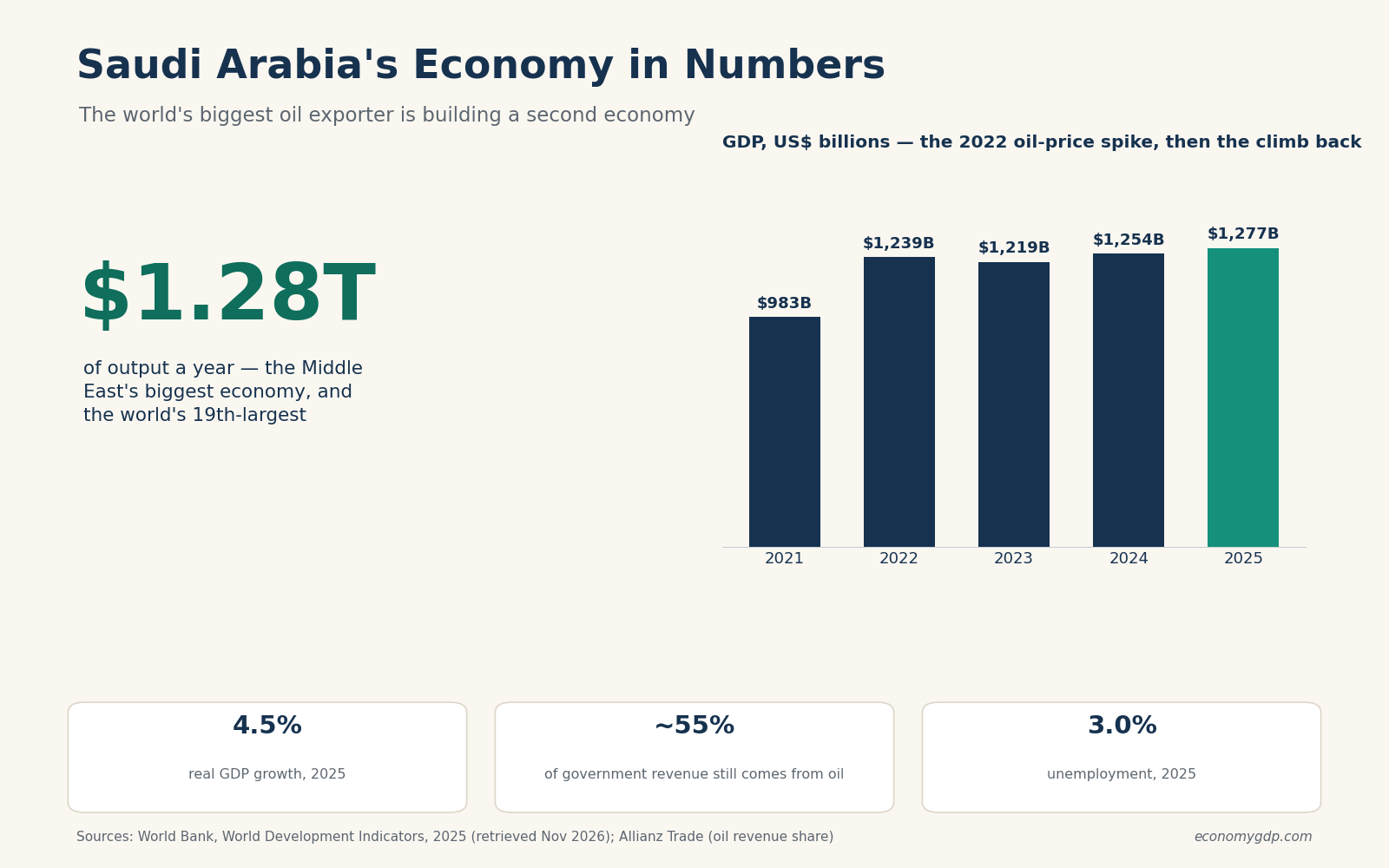
Saudi Arabia is the world’s biggest oil exporter, and for most of its modern history that one fact has explained almost everything about it. The kingdom pumps roughly 10 million barrels of crude a day, and the money from it has built highways, whole cities, and one of the largest sovereign wealth funds on the planet. But the more interesting number in 2025 isn’t about oil at all. It’s 4.5% — the rate the whole economy grew, with the non-oil half doing most of the running.
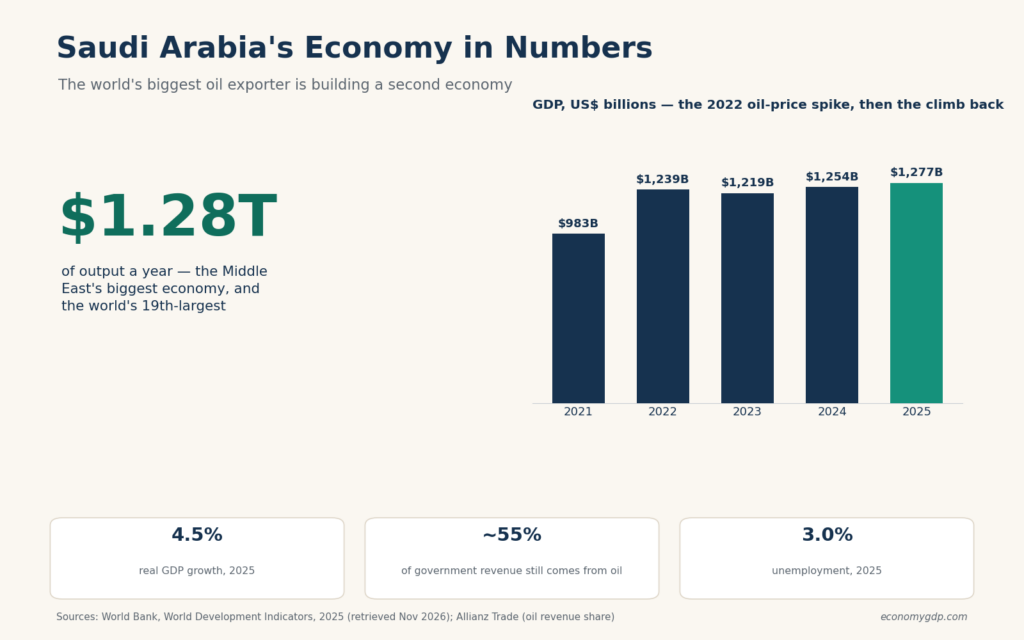
The headline figures: Saudi Arabia produced about $1.28 trillion of output in 2025, making it the 19th-largest economy in the world and easily the biggest in the Middle East. Spread across roughly 37 million people, that’s about $34,500 per person — and adjusted for what money actually buys at home, closer to $74,000.
Oil still pays the bills
Let’s not kid ourselves about how far the transformation has gone. Oil and gas still bring in around 55% of government revenue and roughly two-thirds of export earnings, according to Allianz Trade’s 2025 figures. When crude prices fall, the budget feels it within months; the government ran a deficit of roughly 5% of GDP in 2025 even in a decent year for prices.
That’s the old pattern, and the kingdom knows it. The growth record tells the story in one glance: the economy surged 12% in 2022, when oil prices spiked after Russia invaded Ukraine, then barely grew at all in 2023 (+0.5%) as the kingdom cut production to prop up prices, before recovering to 2.6% in 2024 and 4.5% in 2025 as output rose again. When your growth chart tracks the oil price that closely, you don’t really control your own economy.
The structure shows it too. Industry — dominated by oil, gas, and petrochemicals — still accounts for 43% of output, services 49%, and agriculture just 2.6%. Exports are worth about 30% of GDP, and most of what leaves the country is still something that came out of the ground.
The non-oil half is doing the growing
This is where Vision 2030 comes in — the plan launched in 2016 to build an economy that doesn’t need $100 oil to function. The non-oil economy now accounts for just over half of output, and it’s grown at 4% or better every year since 2021, even while the oil side shrank or stalled. Tourism is the most visible piece: new resorts on the Red Sea coast, a push to draw pilgrims beyond Mecca and Medina, and a target of far more visitors than the kingdom used to welcome. Mining, logistics, tech, and entertainment are all getting the same treatment, funded largely by the Public Investment Fund, the sovereign fund that’s become the country’s main venture capitalist.
The jobs picture has quietly improved alongside it. Unemployment fell to 3.0% in 2025, down from 7.7% in 2020 — though that headline rate hides a long-standing problem: getting Saudi nationals, especially young graduates and women, into private-sector jobs rather than comfortable government posts. Inflation, meanwhile, is a non-story at 2.0%.
The bet
Strip away the megaprojects — the futuristic city in the desert, the ski resort in the mountains, the world’s tallest tower — and the bet is simple: can a country that got rich selling one commodity build a second economy before the first one stops paying? The IMF expects growth of around 4% in 2026, with the non-oil side still carrying it. Public debt is modest, roughly a third of GDP, so the kingdom can afford to keep spending while the answer comes in.
The risk is the same one it’s always been. If oil prices slide and stay down, the deficit widens, the spending slows, and Vision 2030’s timetable slips. But for the first time, the non-oil economy is big enough that the question isn’t whether Saudi Arabia can survive cheap oil — it’s whether it can keep growing through it. The 4.5% in 2025 suggests it might.