
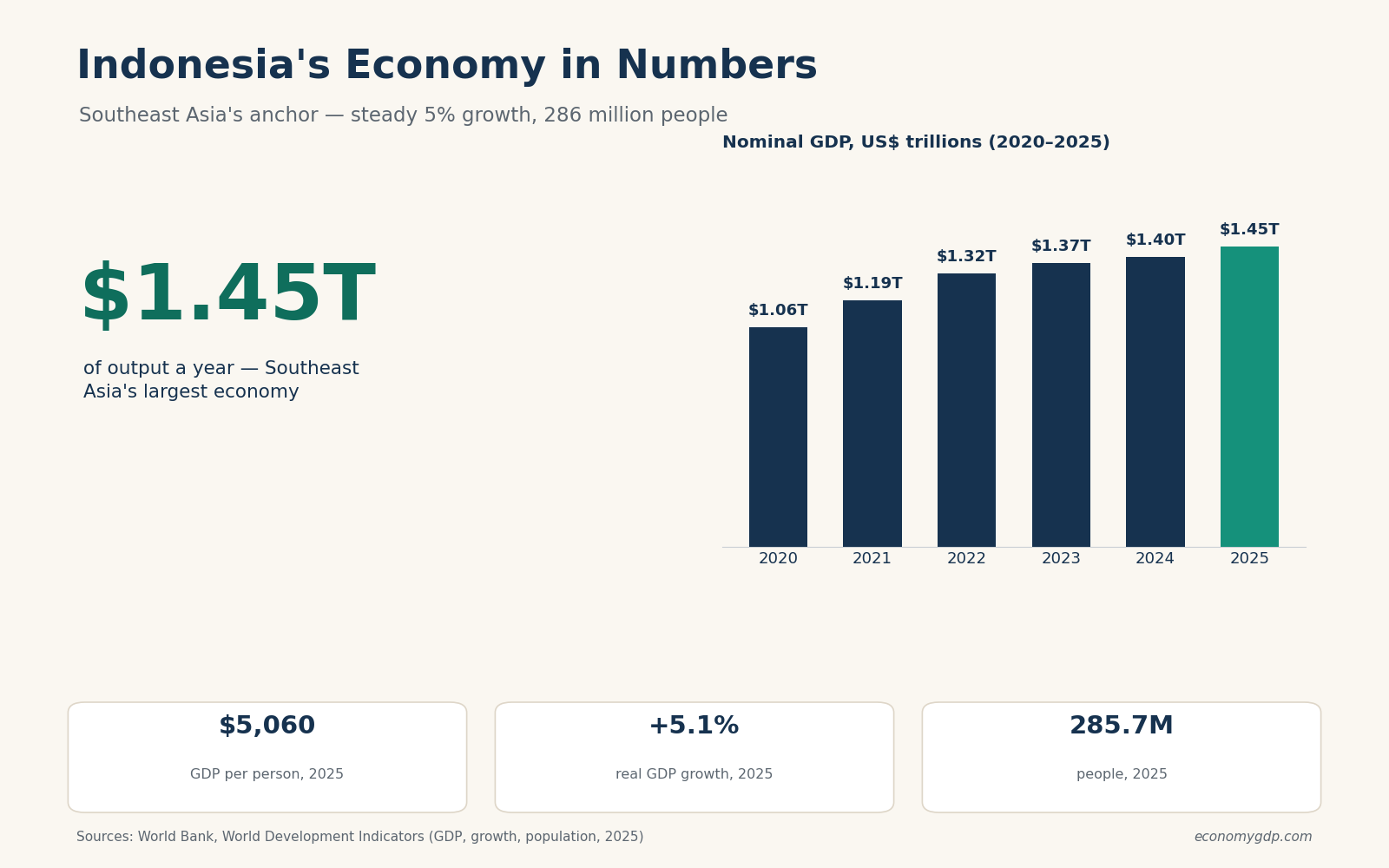
Indonesia is the economy most people underestimate. It’s a $1.45 trillion economy — the largest in Southeast Asia and one of the 20 biggest in the world — built by 285.7 million people, the fourth-largest population on Earth. And it has a habit other big economies would kill for: it grows at about 5% a year, almost every year, rain or shine.
That steadiness is the story. Indonesia grew 5.1% in 2025, after 5.0% in 2024 and 5.1% in 2023. The only break in recent years was 2020, when the pandemic knocked it back 2.1%. Otherwise, the line barely wobbles. Inflation was just 1.9% in 2025, unemployment sat at 3.2%, and the engine underneath it all is the least glamorous one there is: Indonesians buying things from other Indonesians. Household spending, not exports, does most of the heavy lifting.
The growth machine that barely blinked
Part of that resilience is sheer size. With nearly 286 million people spread across more than 17,000 islands, Indonesia’s domestic market can absorb shocks that would flatten a smaller, export-dependent economy. Services now make up about 44% of output — shops, transport, telecoms, finance — while industry accounts for roughly 39% and agriculture 13%. Exports, at about 23% of GDP, matter, but they don’t decide the country’s fate the way they do in South Korea or Vietnam.
There’s a catch hiding in the headline numbers, though. Divide that $1.45 trillion by 285.7 million people and you get about $5,060 per person — a fraction of what the average Spaniard or Korean produces. Indonesia is big because it has a lot of people, not because each person produces a lot. Closing that gap is the whole economic project: better schools, better roads between islands, and jobs that pay more than subsistence farming or informal street trade.
Nickel, palm oil, and a bet on processing
The most interesting bet Indonesia has placed is on what comes out of the ground. The country holds the world’s largest nickel reserves and is now the dominant producer of the metal, which sits at the heart of electric-vehicle batteries. Instead of shipping raw ore abroad, Jakarta has pushed — sometimes by banning raw exports outright — to force smelting and battery plants to be built on Indonesian soil. It’s a strategy with an Indonesian name, downstreaming, and it has pulled in billions in investment from Chinese, Korean, and Western firms alike.
Palm oil and coal still bring in serious money too, which gives the economy a commodity edge and a commodity risk in equal measure. When global prices are high, the trade balance looks great. When they fall, growth has to lean harder on that domestic consumer. So far, the consumer has held up.
Indonesia won’t be the world’s next China — its per-person income is too low and its geography too scattered for that. But an economy that grows 5% a year, keeps inflation near 2%, and sits on the metals the energy transition needs doesn’t have to be. It’s already Southeast Asia’s anchor. The question now is whether it can turn scale into prosperity, one better-paid job at a time.
Sources: World Bank, World Development Indicators (GDP, GDP per capita, growth, population, sector shares, exports, unemployment, inflation, 2020–2025, retrieved November 2026); IMF World Economic Outlook (cross-check: Indonesia’s 2025 nominal GDP $1,445.6 billion); Indonesia Investments / Statistics Indonesia reporting on nickel reserves and the downstreaming strategy.