
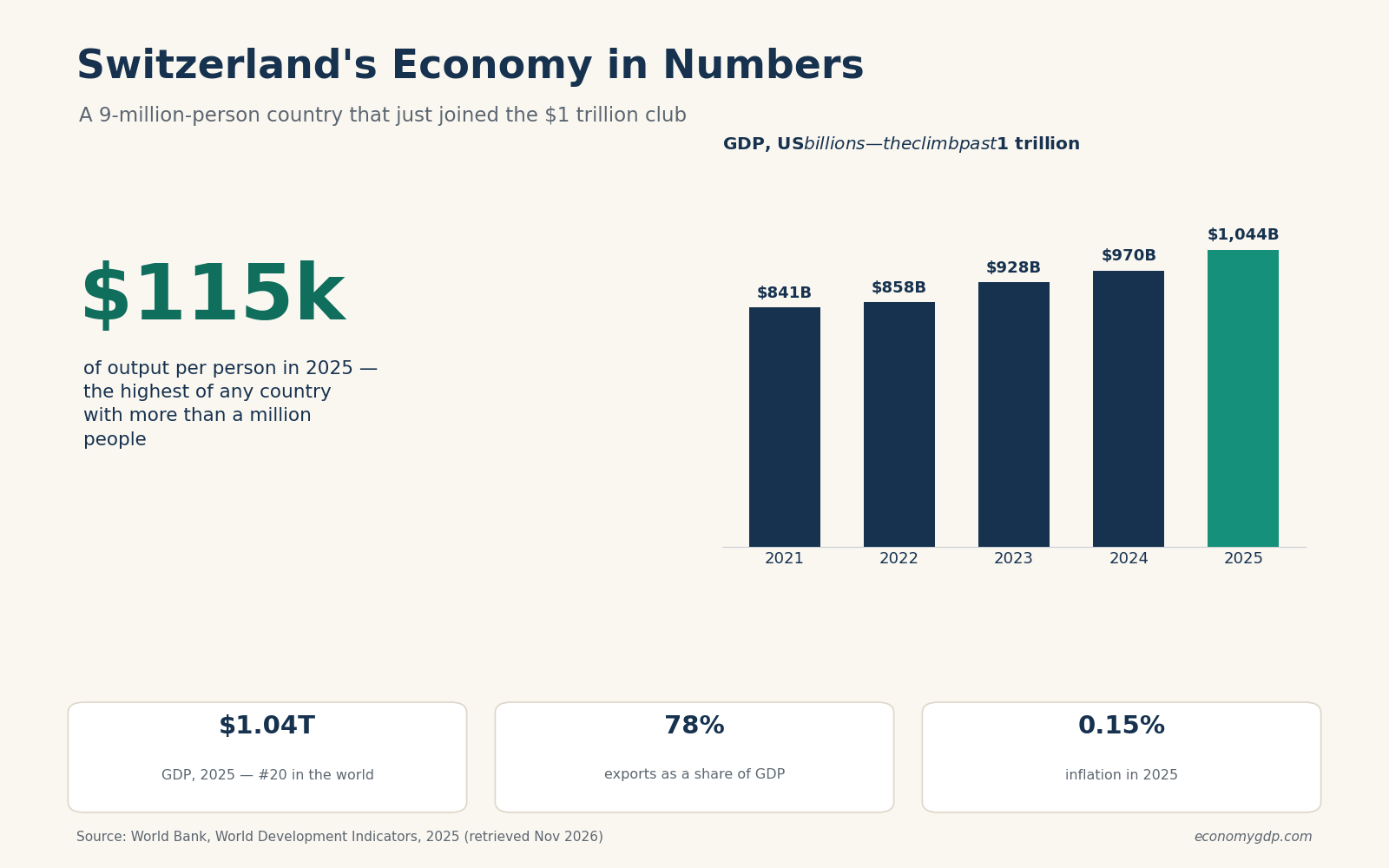
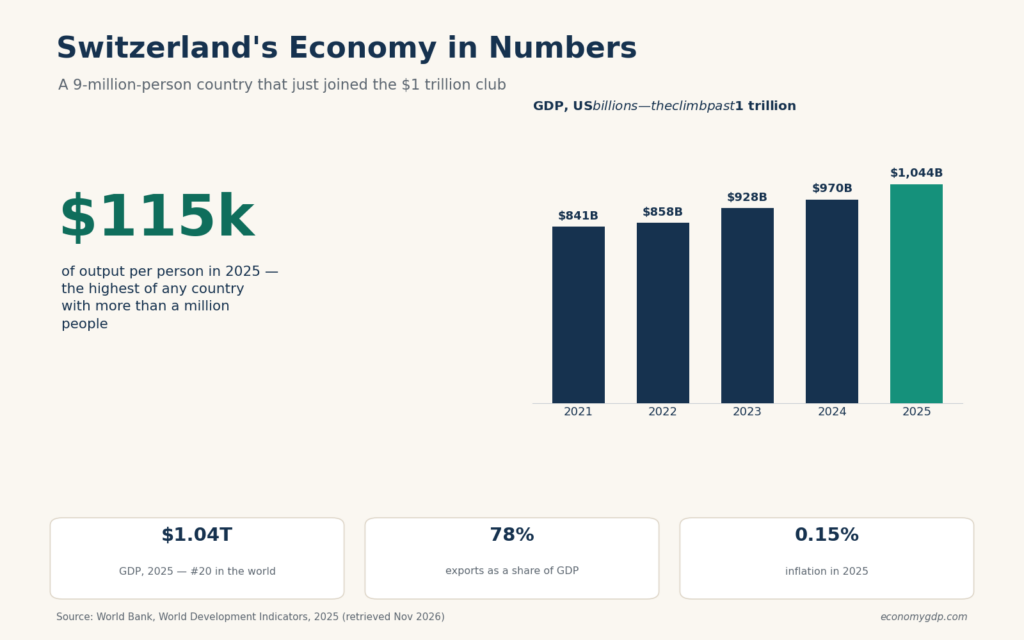
Switzerland has about 9.1 million people — roughly the population of New York City, spread across a country smaller than West Virginia. Yet it produces about $1.04 trillion of output a year, which puts it just inside the world’s 20 biggest economies. And per person, it’s in a league of its own: roughly $115,000 a year, the highest of any country with more than a million people.
That combination — small, rich, and stubbornly steady — is the whole story. Switzerland doesn’t grow fast. It grows a little, almost every year, and compounds.
What the Swiss actually sell
Services generate about 72% of output, and the mix is about as high-margin as it gets. Two of the world’s biggest drugmakers, Roche and Novartis, are Swiss, and medicines are the country’s single biggest export. Then there’s banking and wealth management — the business Switzerland is most famous for — plus insurance, precision engineering, and watches, the luxury good that somehow survived the smartphone.
Industry still accounts for a quarter of the economy, which is a lot for a rich country. The Swiss make things other countries can’t easily copy: the machines that make chips, the turbines, the medical devices. Agriculture, meanwhile, is a rounding error at 0.6% of output, despite the postcard cows.
Here’s the number that frames all of it: exports are worth about 78% of GDP. Almost nothing the Swiss make is for the Swiss. It’s an economy built to sell to the world — which is why the exchange rate matters so much. The franc is the classic safe-haven currency, so whenever the world gets nervous, money floods into Switzerland, the franc strengthens, and Swiss exporters wince.
Slow growth, zero inflation, no drama
The growth record is almost boring. Real GDP rose 1.3% in 2025, after 1.4% in 2024 and 0.8% in 2023. No booms, no busts — just a steady tick upward that most big economies would trade for. The trade-off is that Switzerland rarely gets the surge years either.
What it does get is price stability that borders on the surreal. Consumer prices rose just 0.15% in 2025. In a world where most central banks spent the last few years fighting inflation, Switzerland barely had any to fight. The Swiss National Bank has spent decades keeping the franc from getting too strong and prices from rising too fast, and lately the problem has tilted the other way — flirting with deflation rather than inflation.
That stability is the product. Companies park their headquarters in Switzerland, investors park their money there, and highly paid specialists move there, all for the same reason: nothing dramatic ever seems to happen. The cost is that everything is expensive — Zurich and Geneva regularly top the world’s cost-of-living tables — and the strong franc keeps squeezing exporters.
The IMF estimates Switzerland’s economy at about $1.06 trillion in 2025, making it the world’s 20th-largest, just ahead of Poland. The question hanging over it is the same one that hangs over every rich, slow-growing country: can a place that perfected the art of being safe and expensive keep getting richer without growing faster? For now, the answer is the one Switzerland always gives — quietly, competently, and a little richer than last year.