
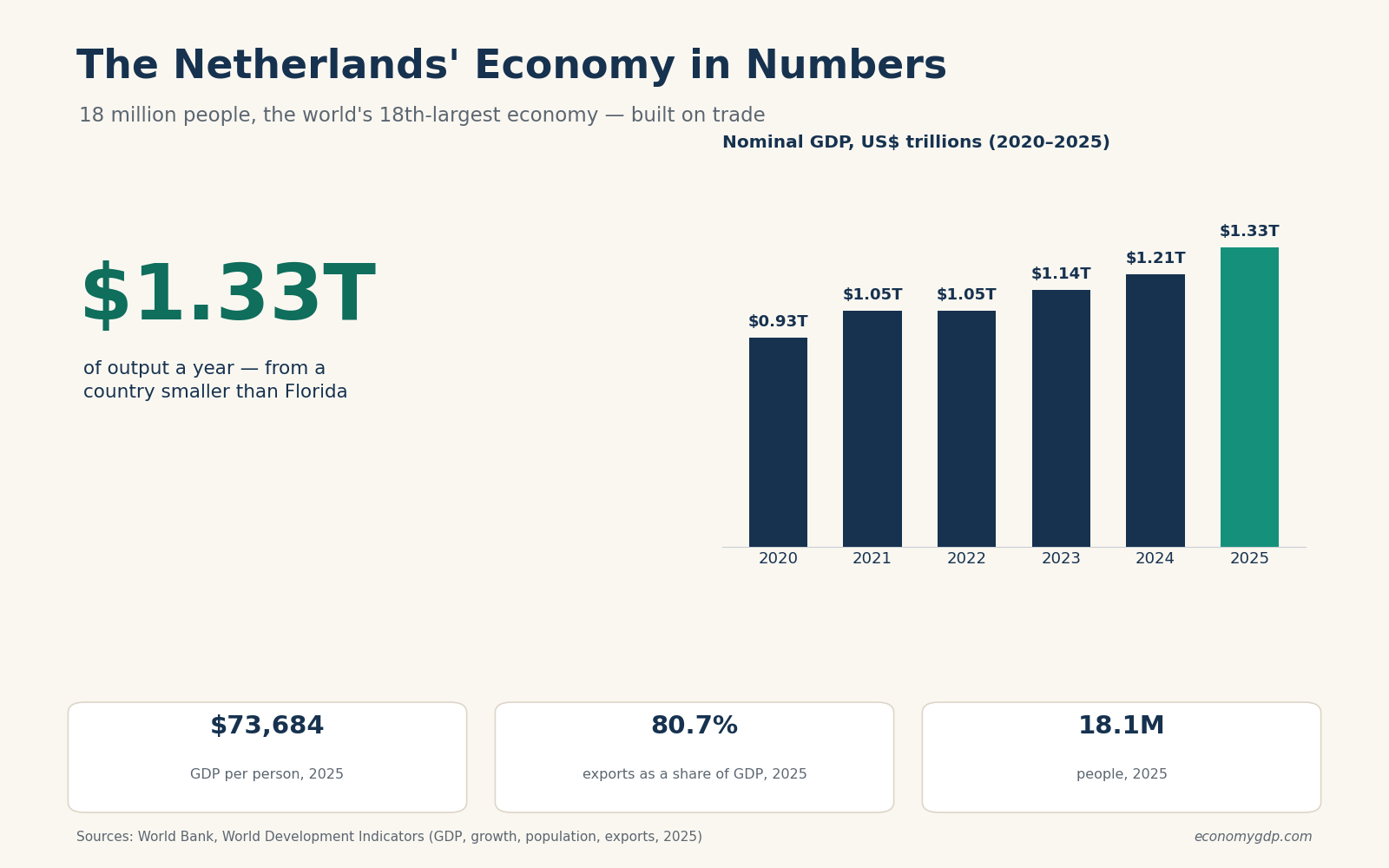
The Netherlands is the economy that shouldn’t be as big as it is. It’s a country of 18.1 million people — smaller than Florida, flatter than a pancake, and about a quarter of it sits below sea level. Yet it produces $1.33 trillion of output a year, making it the world’s 18th-largest economy. Divide that by its population and you get $73,684 per person, one of the highest figures of any large economy on Earth. Small country, very large wallet.
It got there by selling things to everyone else. Exports of goods and services equalled 80.7% of GDP in 2025, which puts the Netherlands among the most trade-dependent rich economies anywhere. Rotterdam is Europe’s biggest port — the place where a huge share of the continent’s cargo comes ashore — and Schiphol is one of the busiest airports in the world. Then there’s the quirk no other country can claim: ASML, based in the town of Veldhoven, is the only company on Earth that makes the extreme ultraviolet machines chipmakers need for their most advanced chips. Without Dutch machines, there are no cutting-edge semiconductors.
A small country with an outsized wallet
The money doesn’t just come from moving boxes around. The Netherlands is also the world’s second-largest exporter of farm goods by value, despite being roughly the size of Maryland — high-tech greenhouses and intensive farming squeeze an astonishing amount of food out of very little land. Add in a big financial sector, a chemicals industry, and a gas business that once bankrolled the state, and you get an economy that’s far more varied than the tulips-and-bicycles cliché suggests.
Growth, though, has been sluggish lately. The economy shrank 0.6% in 2023, managed 1.1% in 2024, and picked up to 1.8% in 2025. Inflation ran at 3.2% in 2025, still above the European Central Bank’s 2% target, and unemployment, while low at 3.9%, has drifted up from 3.7% a year earlier. This is not an economy in crisis. It’s an economy idling — rich, stable, and growing more slowly than it used to.
The catch: when the world sneezes
The flip side of all that trade is exposure. When global demand wobbles, the Netherlands feels it fast, because four-fifths of its economy’s worth of exports has to find buyers somewhere else. The Groningen gas field, once a cash machine, was shut down in 2024 after decades of earthquakes it caused in the region — a deliberate decision to give up revenue for safety. And the housing market in Amsterdam and the other big cities has become one of the least affordable in Europe, which makes it harder for the workers the economy needs to actually live there.
None of that changes the basic fact, though. The Netherlands took a small, soggy patch of land and turned it into a trading machine that punches far above its weight — the port, the airport, the chip machines, and the greenhouses all doing the same job they’ve done for centuries: buying low, selling high, and moving things faster than anyone else. The question for the next decade is whether a country this open to the world can keep growing when the world itself is slowing down.
Sources: World Bank, World Development Indicators (GDP, GDP per capita, growth, population, exports, unemployment, inflation, 2020–2025, retrieved November 2026); IMF World Economic Outlook, October 2026 (cross-check: Netherlands’ 2025 nominal GDP about $1.32 trillion; GDP in purchasing-power terms about $1.52 trillion, an IMF estimate).