
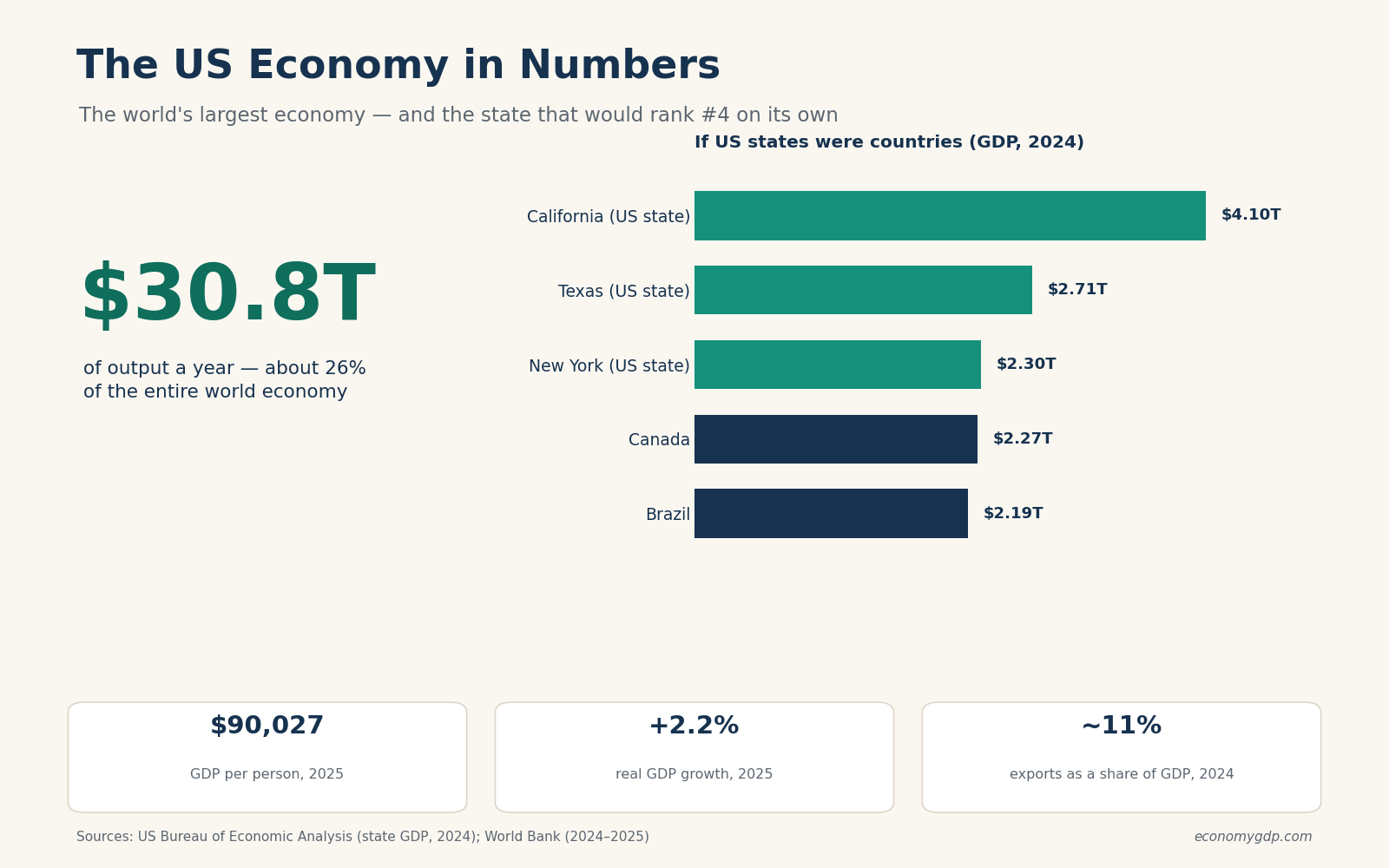
Start with the scale, because the scale is the story. The United States produces about $30.8 trillion of output a year — roughly 26 cents of every dollar earned on Earth, from a country holding about 4% of the world’s people. GDP per person works out near $90,000, among the highest of any large country. No other economy pairs this size with this wealth. It isn’t close.
An economy that runs on shoppers
The US doesn’t make its money the way most people picture. Manufacturing accounts for only about a tenth of output these days. Services — health care, finance, tech, law, logistics, restaurants, streaming — generate the bulk of it, well over three-quarters of the economy on World Bank measures.
The engine underneath is the American consumer. Household spending drives a bit more than two-thirds of GDP, which is why economists watch US retail sales the way pilots watch the weather. When Americans keep spending, the economy grows; when they stop, the world feels it. That engine has been running hot: the economy grew 2.8% in 2024 and 2.2% in 2025, a pace most rich countries would happily take. Germany, for comparison, barely grew at all.
The flip side of a consumer economy is a trade gap. The US buys far more from the rest of the world than it sells — exports are only about 11% of GDP, the lowest share of any major economy. It can get away with that because the dollar is the world’s reserve currency and global investors queue up to lend to Washington.
The California trick
Here’s the fact that breaks people’s intuition. If US states were countries, one of them would rank near the top of the world table on its own.
California’s GDP hit $4.1 trillion in 2024, according to the Bureau of Economic Analysis. In April 2025, the state’s governor announced that California had passed Japan to become the world’s fourth-largest economy, using the IMF’s country figures of the time. One state — 39 million people, Silicon Valley, Hollywood, the Central Valley’s farms — outproducing all of Japan.
Texas, at about $2.7 trillion, would sit in the same league as Italy and Canada. New York, at roughly $2.3 trillion, matches Canada too. Add the three together and you get an economy bigger than Germany and Japan combined, inside one country.
What could actually slow it down
The honest worries are familiar ones. The federal government borrows heavily year after year, and the debt keeps climbing. Housing is painfully expensive in the productive coastal cities where the jobs are. And an economy built on consumer spending is only as sturdy as the consumer’s paycheck.
So far, none of it has knocked the US off its perch. A deep bench of tech giants, the world’s deepest capital markets, cheap energy, top universities and a steady flow of immigrants and ideas keep the machine compounding. Explaining the US economy mostly means explaining why that combination is so hard for anyone else to copy.