
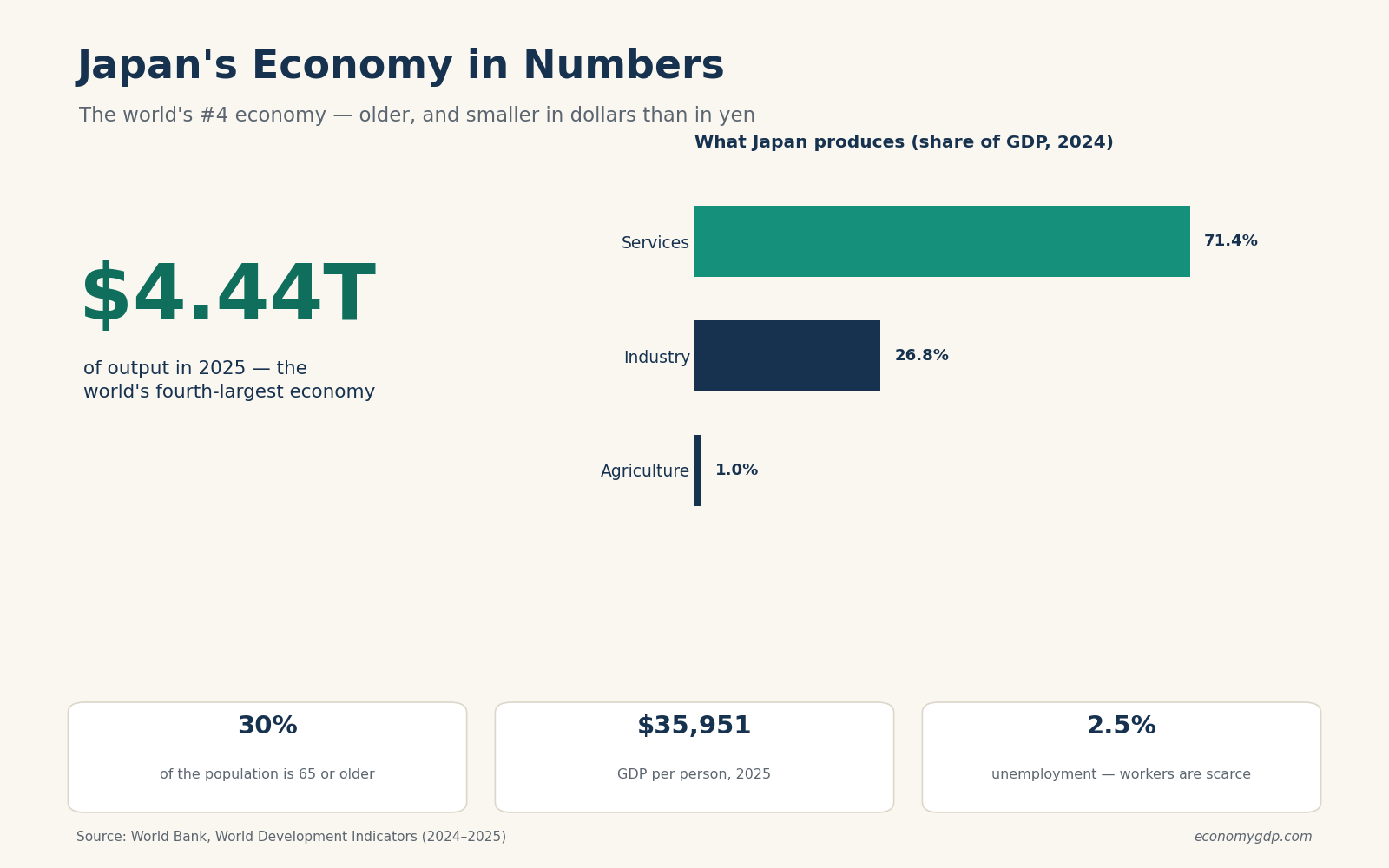
Japan is the world’s fourth-largest economy, and also one of its strangest. It produces about $4.44 trillion of output a year — more than the UK, more than India — yet ask a Japanese person how the economy feels and you’ll hear a different story. Wages barely moved for thirty years. Prices only recently started rising again. And the population is shrinking by hundreds of thousands of people a year.
The strangest part is that Japan’s economy hasn’t actually shrunk. Measured in yen, it’s bigger than ever: nominal GDP hit 666 trillion yen in 2025, up roughly a third since 2012. Measured in dollars, it’s down over the same period, from about $6.2 trillion to $4.4 trillion. Nothing in the factories changed. The yen did. Japan is a reminder that exchange rates can make a whole country look like it’s fading when it mostly isn’t.
The oldest country on Earth
Japan’s defining fact isn’t its debt or its exports. It’s its age. Almost 30% of the population is now 65 or older — the highest share anywhere — and the average woman has just 1.15 children. The population fell from 125.1 million in 2022 to 123.4 million in 2025, and the decline is speeding up.
This shapes everything. Pensions and healthcare eat a growing share of the budget. Companies struggle to hire, which is one reason unemployment sits at just 2.5% — there simply aren’t enough workers to go around. And it explains why Japan, famously closed to immigration for decades, has quietly started letting more foreign workers in: convenience stores, factories and care homes now depend on them.
Yet the labour shortage has a silver lining. With workers scarce, wages are finally rising, and after decades of deflation, inflation came back — 3.2% in 2025. For most countries that would be a problem. For Japan, after thirty years of falling prices, it’s almost a relief.
Still a manufacturing heavyweight
Services dominate, as they do in every rich country — about 71% of output. But Japan’s factories still matter far more than Britain’s or America’s do. Industry is roughly 27% of GDP, and the names are the ones you know: Toyota, Sony, Honda, the machine-tool makers that supply factories everywhere else.
Exports are about 22% of GDP — cars, electronics, machinery — and Japan runs a healthy current-account surplus, around 4% of GDP, because its companies earn so much abroad. Tourism has become a surprise second engine: a record 36.9 million visitors arrived in 2024, drawn by a cheap yen, and their spending now props up hotels, restaurants and shops from Kyoto to Sapporo.
The debt that isn’t quite what it looks like
Then there’s the number everyone quotes: government debt of roughly 207% of GDP, the highest in the developed world. It sounds like a crisis waiting to happen. It mostly isn’t, for one simple reason — Japan owes the money overwhelmingly to itself. The debt is held by domestic banks, insurers and the Bank of Japan, not by foreign creditors who might panic and sell.
That doesn’t make it free. Interest payments will grow as rates rise, and the debt leaves little room for big new spending. But Japan has carried a debt load like this for years without a crisis, which is why markets mostly shrug. The real constraint on Japan isn’t money. It’s people — and whether an ageing, shrinking country can keep growing when every year there are fewer of them.