
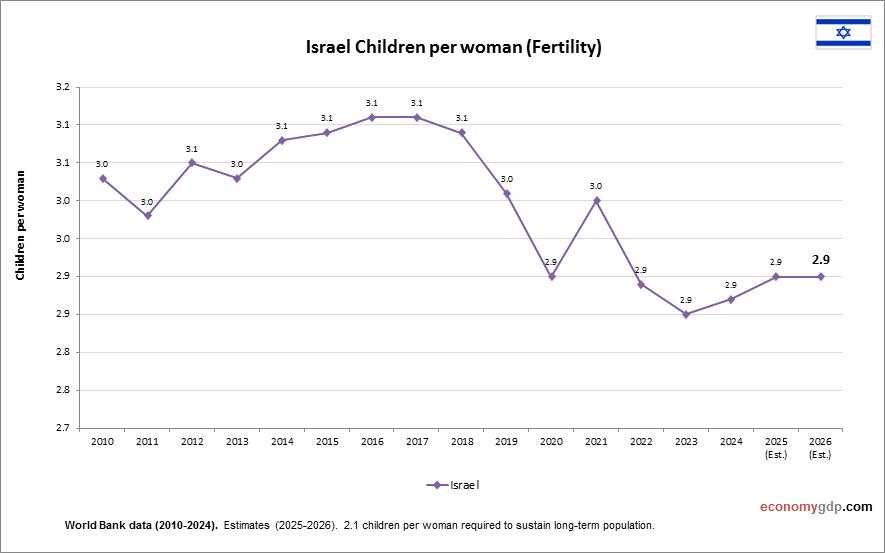
Chart above demonstrates Israel Children Per woman. The fertility rate statistics are compiled by World Bank. Based on the latest available information for Israel.
Israels fertility rate remains relatively high compared to other developed countries, driven by cultural and religious factors that emphasize larger families. Supportive social policies also encourage childbearing, keeping the rate above the global average.
Israel Children Per woman (Fertility Rate) Statistics by Year
| Year | Children per woman (fertility rate) |
| 2000 | 2.95 |
| 2001 | 2.92 |
| 2002 | 2.89 |
| 2003 | 2.95 |
| 2004 | 2.90 |
| 2005 | 2.84 |
| 2006 | 2.88 |
| 2007 | 2.90 |
| 2008 | 2.96 |
| 2009 | 2.96 |
| 2010 | 3.03 |
| 2011 | 2.98 |
| 2012 | 3.05 |
| 2013 | 3.03 |
| 2014 | 3.08 |
| 2015 | 3.09 |
| 2016 | 3.11 |
| 2017 | 3.11 |
| 2018 | 3.09 |
| 2019 | 3.01 |
| 2020 | 2.90 |
| 2021 | 3.0 |
| 2022 | 2.89 |
| 2023 | 2.85 |
| 2024 | 2.87 |
| 2025 (Est.) | 2.90 |
| 2026 (Est.) | 2.90 |