
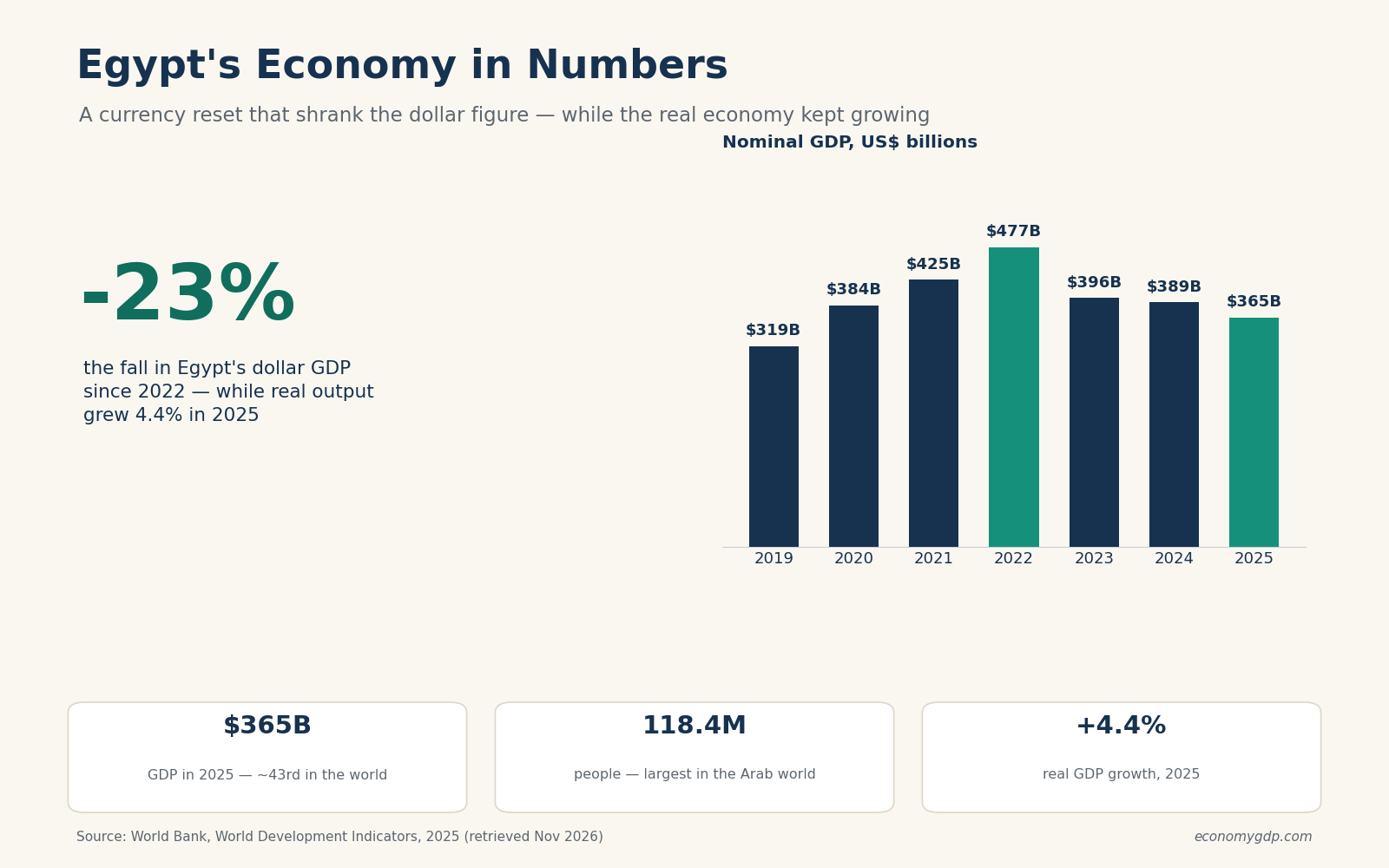
Here’s a riddle: how does an economy shrink by almost a quarter in three years and still grow? Egypt did it. In 2022, the country’s output was worth $477 billion. By 2025 it was $365 billion, according to the World Bank — a drop of 23%, the kind of collapse you’d expect from a deep recession. Except Egypt didn’t have one. Real output grew 6.6% in 2022 and 4.4% in 2025, and the population kept growing — it’s now 118.4 million people, the largest in the Arab world.
What changed was the measuring stick. Egypt’s currency, the pound, lost most of its value against the dollar, so the same economy measured in dollars suddenly looked much smaller. Divide $365 billion by 118.4 million people and you get $3,086 per person, down from $4,233 in 2022. But adjust for what money actually buys in Cairo and the picture flips: the IMF puts Egypt’s economy at roughly $2.38 trillion in purchasing-power terms, the 18th-largest in the world.
The float that changed everything
For years, Egypt kept the pound artificially strong and burned through foreign currency defending it. By early 2024 the system had run out of road: a parallel market flourished, imports stalled, and inflation was running above 30%.
In February 2024, Abu Dhabi’s ADQ agreed to invest $35 billion developing Ras El-Hekma, a stretch of Mediterranean coast, into a new resort city — the biggest foreign investment in Egypt’s history. On March 6, the central bank let the pound float and raised interest rates by six percentage points in a single day. The same day, the IMF agreed to expand its lending programme from $3 billion to about $8 billion. The pound fell from around 31 to the dollar to roughly 48, and has drifted weaker since, to about 56 by late 2026.
The medicine worked, slowly. Inflation averaged 33.9% in 2023 and 28.3% in 2024; by 2025 it was down to 14.1%, and the monthly rate fell from a peak of 38% in September 2023 to around 10% by the end of 2025. Growth picked up to 4.4% in 2025 after 2.4% in 2024. The cost was real — two years of brutal price rises — but the black market for dollars is gone, and so is the pretence that the old exchange rate was sustainable.
Three lifelines: the canal, the diaspora, and the tourists
Egypt’s foreign currency comes from three places, and in the last few years each has told a different story.
The Suez Canal was the first to break. It earned a record $10.2 billion in the year to June 2023. Then Houthi attacks in the Red Sea forced ships around the Cape of Good Hope, and canal revenue collapsed by about two-thirds, to roughly $3.9 billion — around $10 billion lost by mid-2026.
The diaspora did the opposite. Egyptians working abroad — mostly in Saudi Arabia, the Gulf states, and Jordan — sent home $29.6 billion in 2024, and $41.5 billion in 2025, according to the World Bank. Once the exchange rate was unified, there was no longer any reason to send money through informal channels, and recorded remittances surged. At 11.4% of GDP, they’re now worth roughly twice the canal and tourism combined.
Tourism, the third leg, is recovering. The sector earned $14.4 billion in 2024, and the Grand Egyptian Museum — decades in the making — finally opened in 2025, giving visitors a new reason to linger in Cairo. Tourism revenue reached $18.4 billion in the fiscal year to June 2026.
What comes after the IMF
The IMF programme that steadied Egypt runs out in December 2026, and Prime Minister Mostafa Madbouly has said there won’t be another one. Government debt sits at about 87% of GDP, and interest payments eat a huge share of the budget.
But the pieces are there: a currency that finally reflects reality, inflation roughly halved from its peak, a diaspora sending home record sums, and tourism with genuine momentum. Services account for about 47% of output, exports for about a fifth, and unemployment sits around 7%. Whether the reset turns into lasting growth depends on what comes next — above all, whether private businesses, not the state, start doing the hiring in an economy of 118 million people that adds roughly two million more every year.