
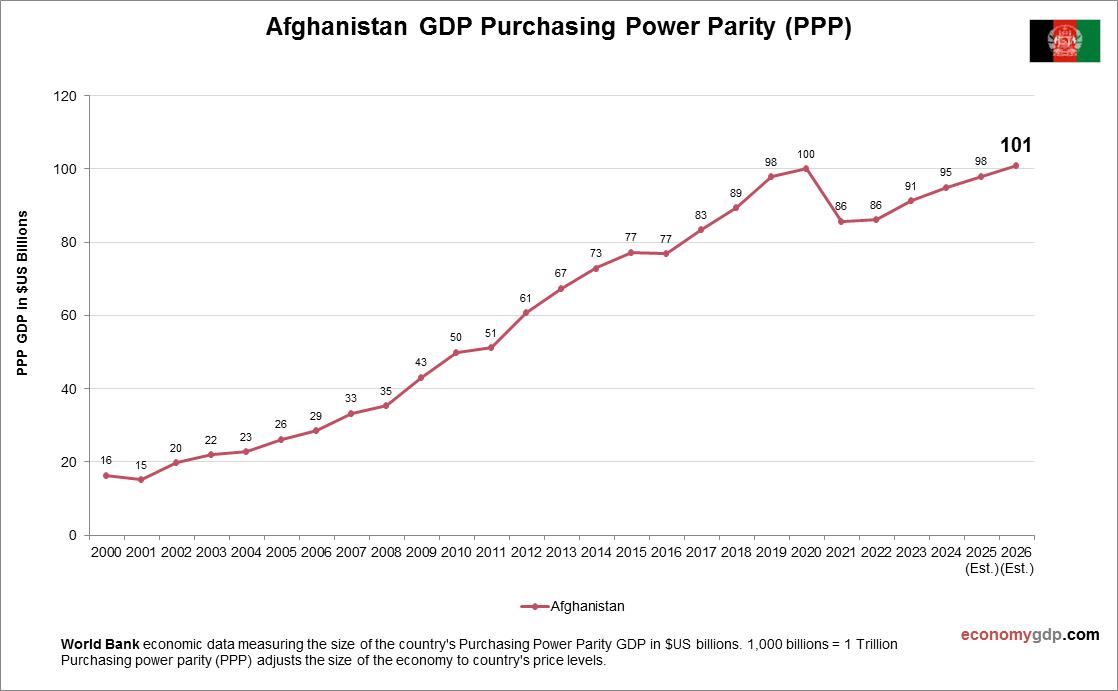
Estimated at $81.9 billion in 2023, Afghanistans economy relies heavily on agriculture (opium, wheat) and foreign aid. GDP per capita (PPP) is around $2,000. Political instability, conflict, and sanctions since 2021 have stifled growth, exacerbating poverty. Droughts and weak infrastructure worsen food insecurity, with over half the population below the poverty line. Remittances and informal trade offer some stability, but unemployment remains high. Economic recovery depends on restoring governance and international support to rebuild infrastructure and stabilize markets.
Afghanistan GDP PPP Statistics by Year
| Year | GDP, Purchasing Power Parity (PPP) |
| 2000 | 16.4 |
| 2001 | 15.2 |
| 2002 | 19.8 |
| 2003 | 22.0 |
| 2004 | 22.9 |
| 2005 | 26.3 |
| 2006 | 28.5 |
| 2007 | 33.3 |
| 2008 | 35.3 |
| 2009 | 43.1 |
| 2010 | 49.9 |
| 2011 | 51.2 |
| 2012 | 60.8 |
| 2013 | 67.5 |
| 2014 | 72.9 |
| 2015 | 77.3 |
| 2016 | 76.8 |
| 2017 | 83.4 |
| 2018 | 89.4 |
| 2019 | 97.8 |
| 2020 | 100.1 |
| 2021 | 85.8 |
| 2022 | 86.1 |
| 2023 | 91.3 |
| 2024 | 95.0 |
| 2025 (Est.) | 98.0 |
| 2026 (Est.) | 101.0 |