
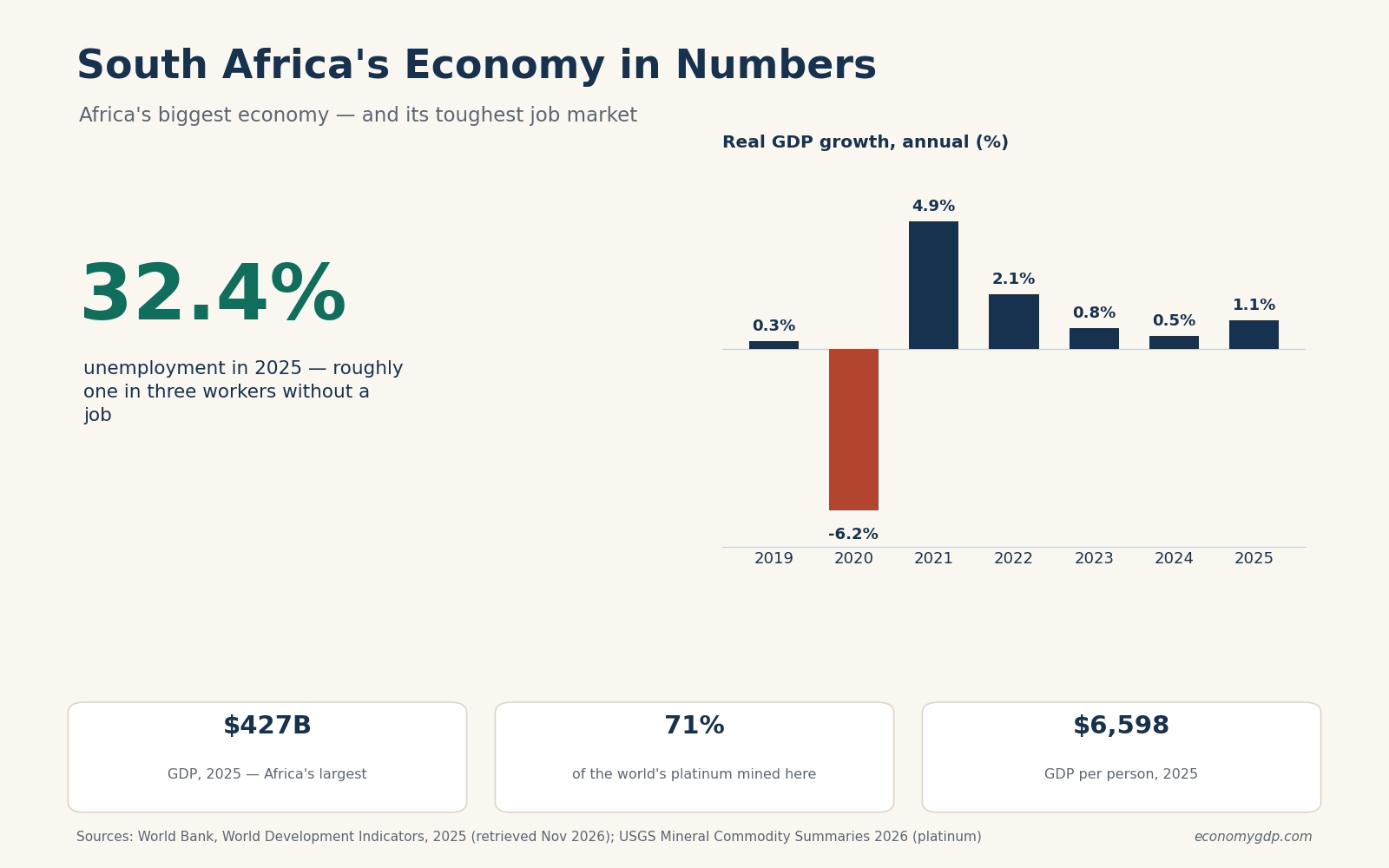
South Africa has the biggest economy in Africa and one of the strangest mismatches in the world economy: ground stuffed with platinum, gold, and chrome, and a third of its workers without a job. In 2025 the economy was worth $427 billion, according to the World Bank — ahead of Egypt at $365 billion and Nigeria at $291 billion, and roughly the 40th-largest economy on the planet. But divide that by 64.7 million people and you get about $6,600 per person. Adjust for what money actually buys inside the country and the figure is closer to $15,900 — better, but still a middle-income number, not a rich one.
The growth story is the problem. South Africa’s economy grew just 1.1% in real terms in 2025, after 0.5% in 2024 and 0.8% in 2023. Add up the years since 2019 and the economy is only about 3% bigger in real terms than it was before the pandemic. For a country with millions of young people entering the workforce every year, that isn’t growth — it’s standing still.
The platinum in the ground
If any country owns a single commodity, it’s South Africa and platinum. The country mined about 120,000 kilograms of platinum in 2025 — roughly 71% of world output, according to the US Geological Survey — and holds about 83% of the world’s known platinum-group metal reserves. It also produces around 45% of the world’s chromium and 38% of its manganese. The Bushveld Complex, a slab of ancient rock in the north of the country, is the richest platinum deposit on Earth, and the metal ends up in catalytic converters, jewellery, and increasingly in the hydrogen equipment of the energy transition.
Mining still matters, but it no longer runs the economy. Services account for about 63% of output, industry 24%, and agriculture under 3%. Exports of goods and services are worth about 31% of GDP, and the country has a modern financial sector, a big retail industry, and the continent’s busiest container port at Durban. The economy is far more diversified than the stereotype of a mining camp — which is exactly why its failure to grow is so puzzling.
One in three workers without a job
The number that defines South Africa’s economy is 32.4% — the unemployment rate in 2025, according to the World Bank’s modelled estimates. Roughly one in three people who want work can’t find it, the highest rate of any large economy. The causes pile up: an education system that leaves many school-leavers without the skills employers need, a labour market where hiring is expensive and firing is hard, and an economy that hasn’t grown fast enough to absorb new workers.
It hasn’t always been this way. Unemployment was in the low twenties in the early 2000s and under 25% as recently as 2014. The pandemic pushed it past 30%, and it has never come back down. Every year of 1% growth makes the maths worse, because the working-age population keeps expanding while the economy barely does.
What might finally move
There are reasons to think the worst is over, even if the turnaround is slow. The rolling blackouts — load shedding — that shut mines and factories for years have effectively ended, with Eskom’s power system more stable in 2025 than at any point in the previous five years. The government has opened the freight rail network to private operators and brought in a private company to run Durban’s main container terminal. South Africa came off the global financial crime grey list in October 2025, and S&P raised its credit rating to BB with a positive outlook.
Politics helped too. After the ANC lost its parliamentary majority in the 2024 election, a coalition government took over — the first of its kind in democratic South Africa — and it has so far held together around a reform programme. The IMF expects growth of only about 1% in 2026, an estimate that underlines how modest the recovery still is, and public debt sits near 77% of GDP, so there isn’t much room for the government to spend its way out of trouble.
The platinum isn’t going anywhere. The jobs are the question.