
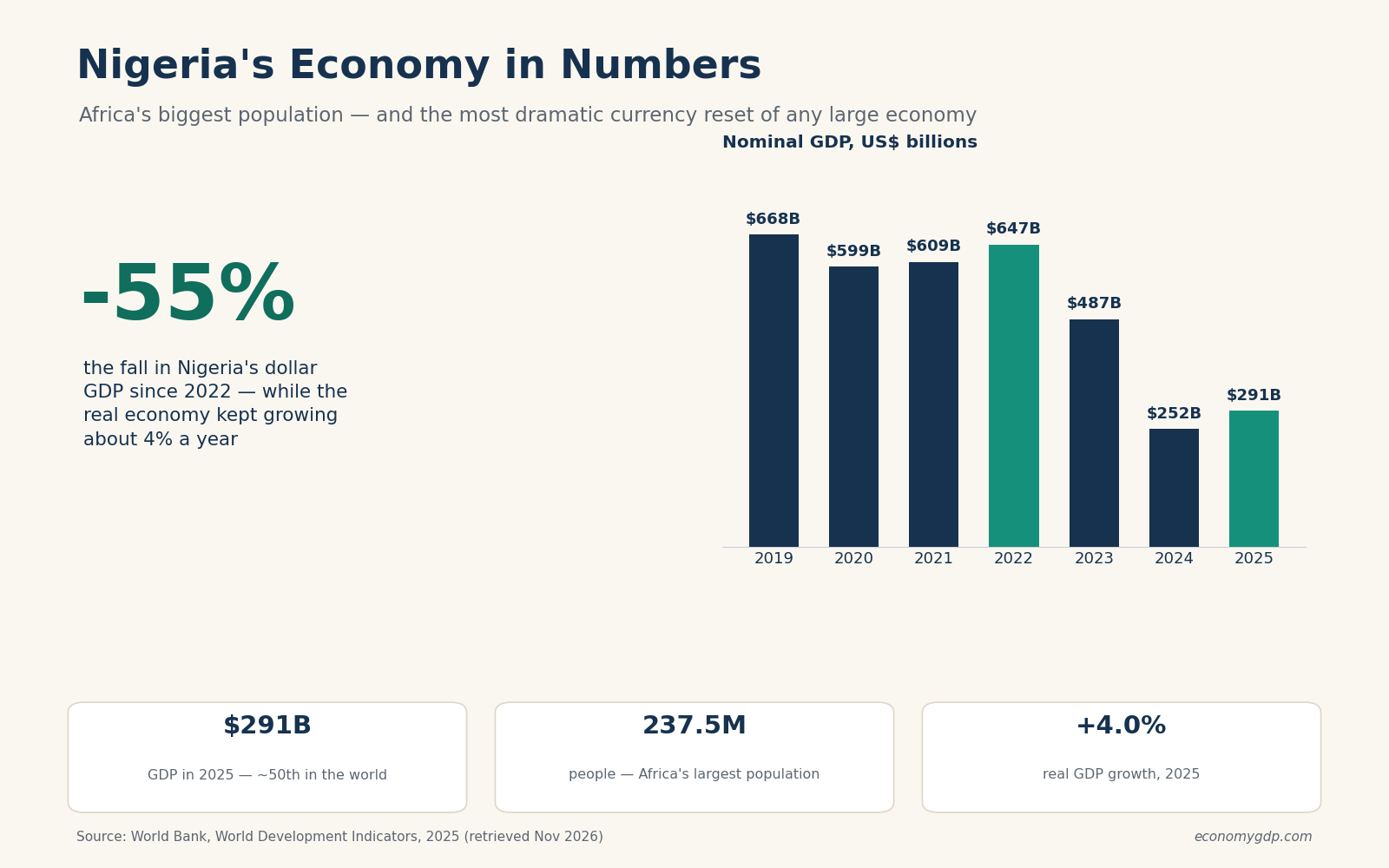
Nigeria is the hardest economy in the world to put a price on. On paper, it shrank by more than half in three years: $647 billion in 2022, $291 billion in 2025, according to the World Bank. But nothing about the real economy shrank. Output grew about 4% in both 2024 and 2025, and the 237.5 million people — Africa’s biggest population — kept working. What changed was the measuring stick. In June 2023, President Bola Tinubu let the naira float, and the currency lost roughly 70% of its value against the dollar. Measured in dollars, Nigeria suddenly looked half the size. Measured in naira, in jobs, in barrels, it never stopped growing.
That gap between the dollar figure and the real one is the whole story of Nigeria right now. It is roughly the world’s 50th-largest economy in dollars, yet adjusted for local prices its output is worth about $2.26 trillion — nearly eight times the headline number. Divide the $291 billion by 237.5 million people and you get $1,224 per person, one of the lowest figures of any large economy. Adjust for what money buys in Lagos rather than London and it’s closer to $9,500.
The reform that halved the economy — on paper
Tinubu moved fast. On his first day in office, May 29, 2023, he declared the fuel subsidy gone. It had cost about $10 billion in 2022 alone, and petrol prices more than doubled overnight. Two weeks later, on June 14, the central bank scrapped the multiple exchange rates and let the naira trade freely. It fell from around 460 to the dollar to roughly 1,500 within about eighteen months.
The pain was immediate. Inflation averaged 33.2% in 2024, peaking above 34% that June. The naira’s collapse also did something strange to the statistics: dollar GDP fell from $487 billion in 2023 to $252 billion in 2024, even as real output grew 4.1%. The economy didn’t shrink. The ruler did.
Inflation has since cooled — the annual average was 23.0% in 2025 — and the IMF expects dollar GDP to bounce back to about $387 billion in 2026, an estimate that depends on the naira holding its ground. The reforms ended two of the biggest distortions in Nigerian economic life: subsidised petrol and a rigged exchange rate.
Oil still pays the bills — but less than it used to
Nigeria is Africa’s largest oil producer, pumping about 1.5 million barrels a day, and crude has always been the country’s foreign-exchange machine. As recently as early 2024, crude oil made up over 80% of everything Nigeria exported. By mid-2025 that share had fallen to about 53%, according to the National Bureau of Statistics — more crude stayed home, and the rest of the export basket grew.
The reason it stayed home is a single building on the Lagos coast. The Dangote refinery — 650,000 barrels a day, the largest single-train refinery in the world, built for about $20 billion — started operations in 2024. By April 2026 it was meeting nearly 80% of Nigeria’s domestic petrol demand, and petrol imports had fallen from around 500,000 barrels a day in early 2023 to about 88,000 in early 2025.
Oil’s grip on the rest of the economy is looser than the export numbers suggest. Services account for about 58% of output and agriculture for 23% — a strikingly high share for a country of Nigeria’s size — while industry, including oil, is only about 16%. Most Nigerians still work in farming or the informal economy.
What the reset is supposed to buy
Strip away the oil and the currency drama and Nigeria’s real asset is the obvious one: 237.5 million people, with a median age under 20. Lagos has become Africa’s biggest startup hub, and Nollywood turns out more films than Hollywood. The diaspora sends home billions every year.
None of that guarantees the reset works. Inflation is still far above the central bank’s comfort zone, and the benefits accrue slowly while the costs hit households immediately. But the petrol subsidy and the rigged exchange rate are both gone. What remains is an economy that looks small in dollars, grows at 4% a year in real terms, and sits on the largest market in Africa. The next decade will show whether that market finally starts paying off.