
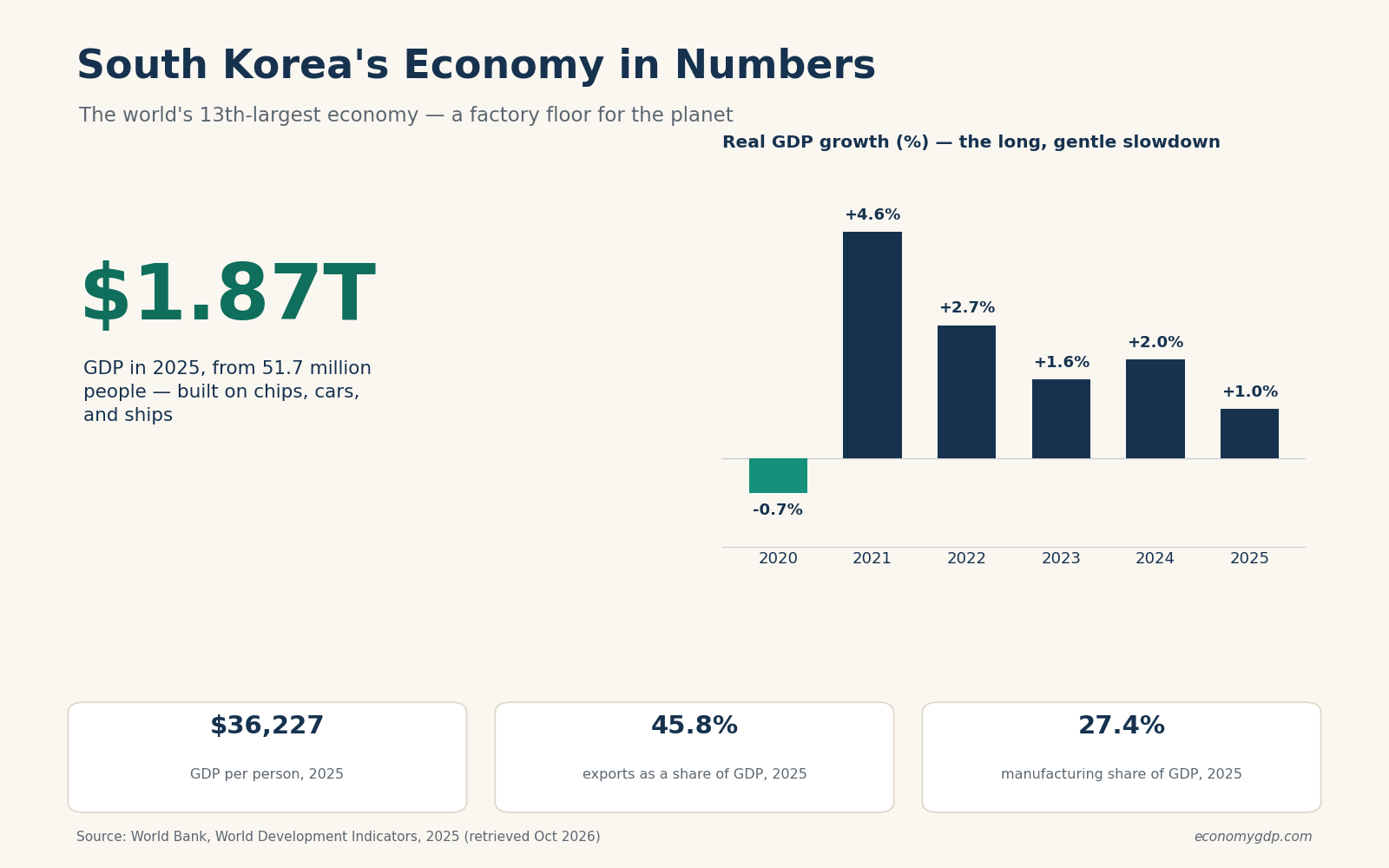
South Korea is the world’s 13th-largest economy, and one of the most remarkable turnaround stories in modern history. In a single lifetime it went from one of the poorest countries on earth to a $1.87 trillion economy that builds the phones, cars, and computer chips the rest of the world runs on. Per person, that’s about $36,227 a year — comfortably rich-country territory, earned in roughly sixty years.
It’s also an economy that has started to feel its age. Growth has slowed, the population is shrinking, and a country that sells so much abroad is exposed whenever the world stops buying.
From rice paddies to semiconductors
The speed of the transformation is hard to overstate. In the 1960s, South Korea was poorer than many African countries, a war-scarred peninsula with almost no natural resources. The government bet everything on exports: cheap loans and protection for a handful of big family-owned conglomerates, the chaebols, in exchange for hitting export targets. Samsung, Hyundai, and LG grew out of that bargain, and they still dominate the economy today.
That bet paid off in a way few development plans ever have. Manufacturing now accounts for 27.4% of GDP, an unusually high share for a rich country, and exports of goods and services are worth 45.8% of GDP. South Korea is one of the world’s great factory floors: it builds cars, ships, and steel, and it sits at the heart of the global semiconductor industry, with Samsung and SK Hynix making the memory chips that go into nearly every device with a screen.
The flip side of an export machine is dependence. When global demand for chips and electronics cools, or when a big trading partner slows down, South Korea feels it fast. Roughly half its output is tied, one way or another, to selling things abroad.
Growth that keeps getting slower
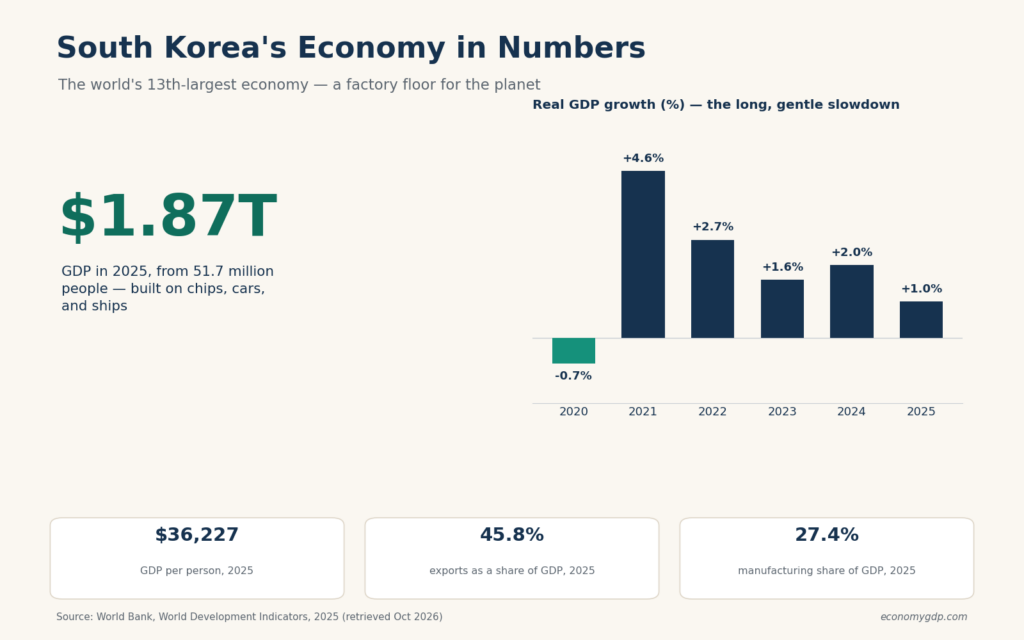
The numbers trace a long, gentle slowdown. After shrinking 0.7% in 2020, the economy rebounded 4.6% in 2021, then grew 2.7% in 2022, 1.6% in 2023, 2.0% in 2024, and just 1.0% in 2025. That’s not a crisis — it’s the pattern of a country that has caught up and now has to grow the hard way, through productivity rather than by copying what richer countries already do.
There’s also a quieter problem underneath the growth figures: people. South Korea’s population slipped from 51.75 million in 2024 to 51.68 million in 2025, and its birth rate is the lowest in the world. Fewer workers, more retirees, and a housing market in Seoul that prices young families out of having children in the first place — it’s a loop the government has spent billions trying to break, with little to show for it so far.
What comes next
South Korea’s strengths are real and hard to copy: world-class factories, a highly educated workforce, and a grip on the chip supply chain that the United States, China, and Europe are all trying to loosen. Its weaknesses are just as clear: an economy built around a few giant firms, a birth rate that points to a much smaller country, and a neighbourhood — China, Japan, and an unpredictable North Korea — that never lets it relax.
The question for the next decade isn’t whether South Korea is rich. It is. It’s whether a country that got rich by making things for everyone else can keep growing when its own workforce is shrinking and the world is getting more protectionist. Sixty years ago, nobody would have bet on this peninsula at all. Betting against it now would be a braver call than it looks.