
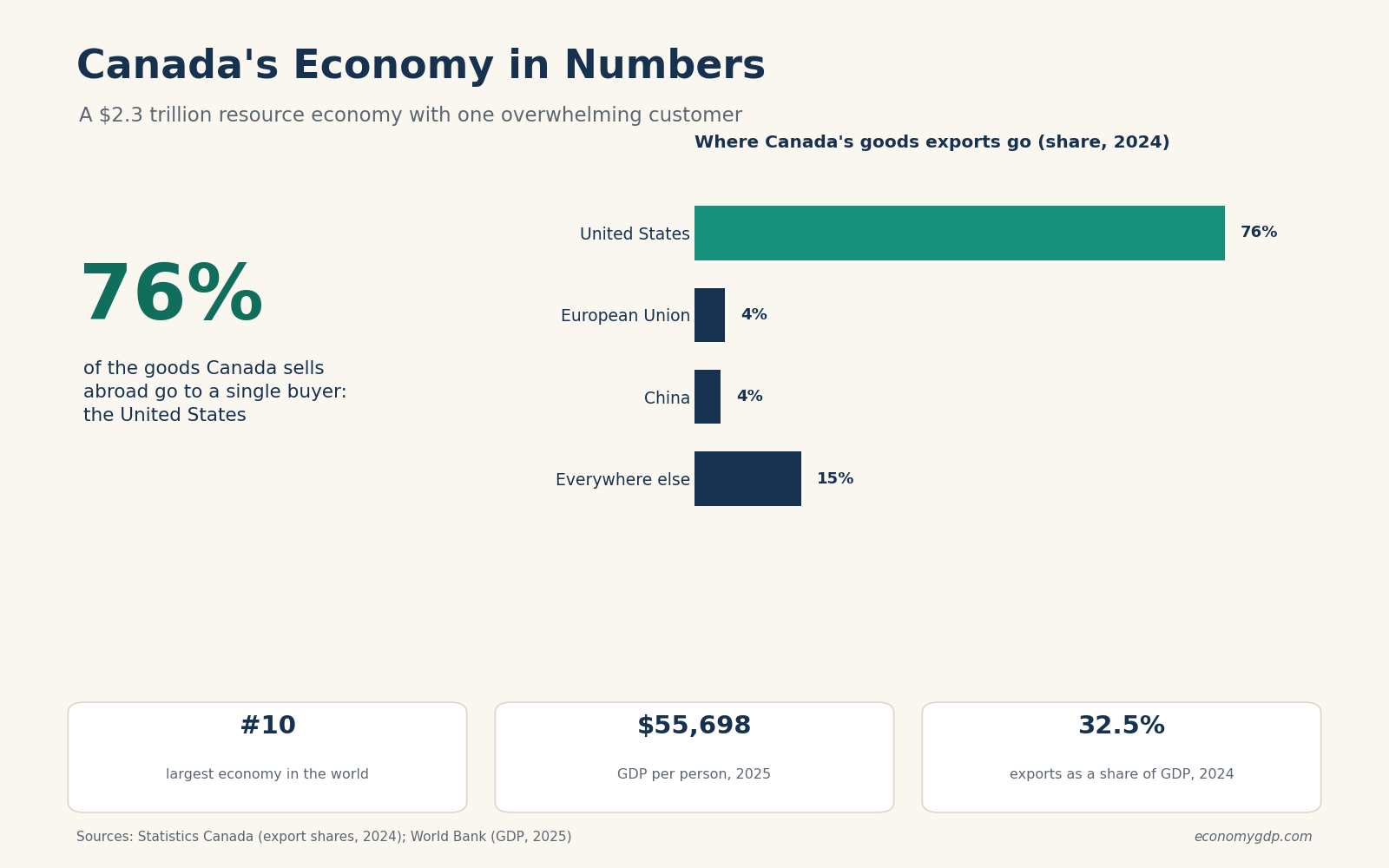
Canada is the world’s tenth-largest economy: about $2.3 trillion of output a year, $55,700 per person, 41.7 million people. On paper it looks like a smaller, calmer version of its southern neighbour. Underneath, it’s a very different machine — one built on resources, and pointed almost entirely at a single customer.
Built on stuff in the ground
Canada’s foundation is what it can dig, pump and grow. Alberta’s oil sands hold some of the largest petroleum reserves on the planet, and Canada is one of the world’s top oil and gas producers. Add Saskatchewan potash and uranium, BC timber, Ontario’s auto plants (woven into the US car industry for sixty years), Quebec aerospace and hydroelectricity, Prairie wheat and canola, and mining operations scattered across the north.
On top of that sits a modern services economy — Toronto is a genuine financial centre, and the big Canadian banks are famously sturdy; none of them failed in 2008. Services quietly account for most jobs and most output, the same as in other rich countries. But the resource sector shapes Canada’s fortunes and its currency far beyond its size: when oil prices jump, the loonie usually jumps with them.
One customer takes three-quarters of everything
Here’s the number that defines Canadian economic life. Exports of goods and services equal about a third of Canada’s GDP (32.5% in 2024, World Bank), and roughly 76% of the goods Canada sells abroad go to one buyer: the United States. Statistics Canada’s figures imply that something like a quarter of everything Canada produces is ultimately bought by Americans.
No other big economy is wired into a single market like this. It has been a sweet deal for decades — the richest consumer market on Earth, right next door, under a free-trade agreement. It’s also a standing vulnerability, as the recent tariff fights made plain. When Washington sneezes, Canada doesn’t just catch a cold; it has built its house in the sneeze’s path.
The dependence runs both ways, which is Canada’s best protection. In 2024, Canada supplied 61% of all the crude oil the United States imported — more than every other country combined (US EIA data). American refineries are literally plumbed for Canadian heavy crude.
The quiet problem: output per person
Canada’s recent growth looks fine until you divide by people. The population surged from 40.0 million in 2023 to 41.7 million in 2025, one of the fastest increases in the developed world, driven by immigration. The headline economy grew 1.7% in 2025 — but spread over millions of new residents, output per person has been flat to falling in real terms. GDP per capita, at $55,700, badly trails the American $90,000, and the gap has been widening.
That’s the argument dominating Canadian politics now: housing that young people can’t afford, business investment that lags the US, and an economy that grows by adding people faster than it grows more productive. Canada’s wealth is real. Turning it into rising living standards is the unfinished part.