
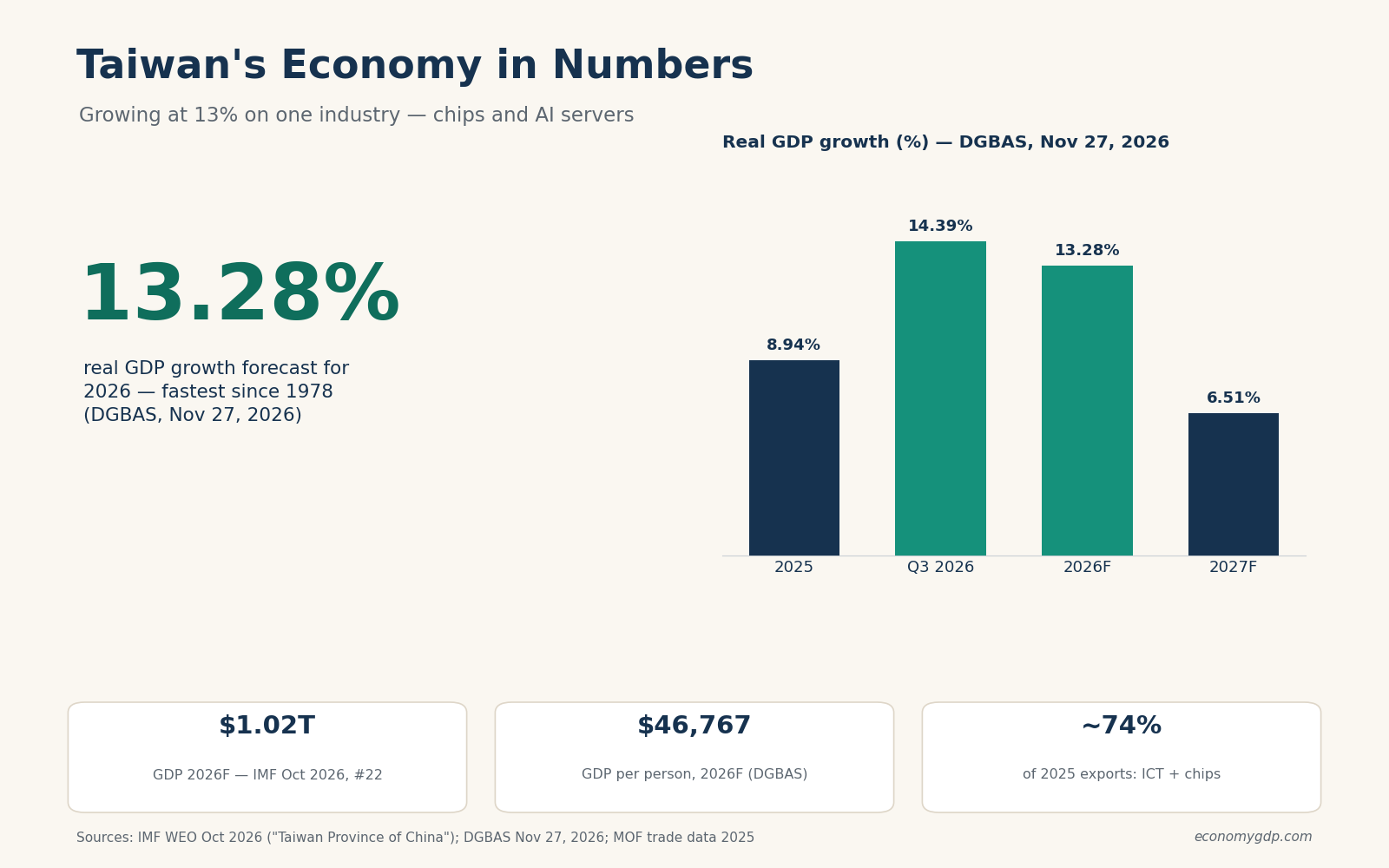
Taiwan is about to join the trillion-dollar club. The IMF’s October 2026 outlook puts nominal GDP at $1.02 trillion for 2026 — $1,019.6 billion, to be exact — which ranks it 22nd in the world, just above the line. The IMF lists it as “Taiwan Province of China,” and the World Bank doesn’t carry it as a separate economy at all, which is why this post leans on IMF and Taiwan’s own statistics.
For 2025, the IMF puts output at $920.6 billion, or $39,512 a person for 23.3 million people. Taiwan’s Directorate General of Budget, Accounting and Statistics — DGBAS for short — puts per-person GDP a touch higher, at $39,580 in 2025, and expects it to jump to $46,767 in 2026. Different agencies, slightly different maths. Both agree on the direction: straight up.
Growth like it’s 1978
Rich economies don’t usually grow 13% in a year. Taiwan is about to.
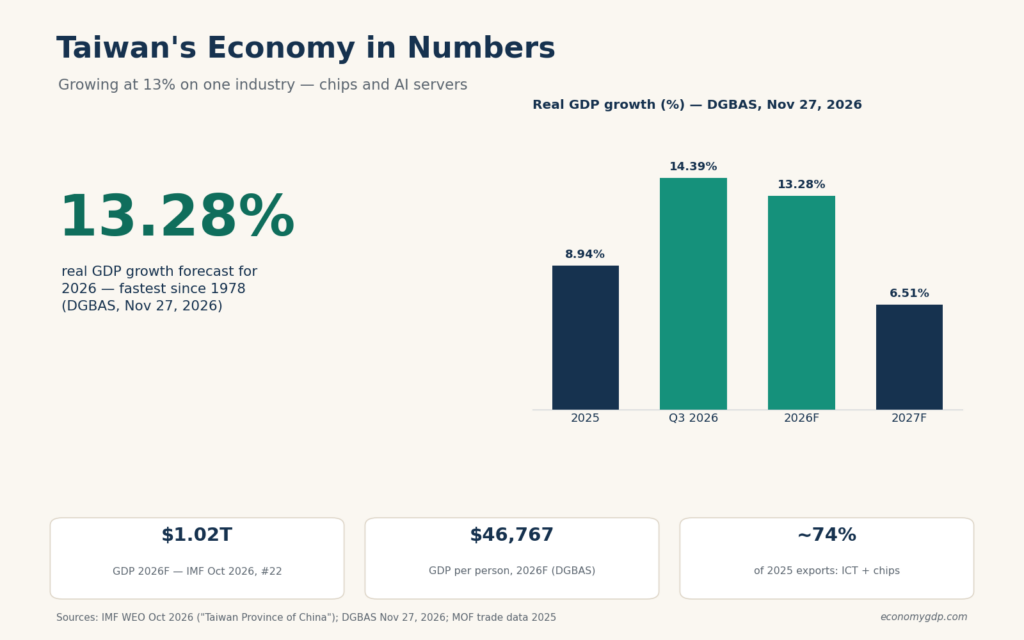
DGBAS said on November 27, 2026 that real GDP will grow 13.28% in 2026. That’s its fastest pace since 1978 — 48 years ago — and it’s a forecast that has been revised up again and again: 7.71% in February, 9.64% in May, 11.05% in August, now 13.28%. The IMF’s October 2026 outlook, published before the latest upgrade, projects 10.7% for 2026. Label the vintages and both numbers are honest; the DGBAS one is simply newer.
The quarterly figures are wilder still. Output grew 14.39% year on year in the third quarter of 2026, DGBAS said, after 15.44% in the first quarter and 13.31% in the second. For 2025 as a whole, DGBAS revised growth up to 8.94% in its November release. Even the slowdown looks fast: DGBAS expects 6.51% in 2027, and inflation is forecast at just 2.07% in 2026. This is not a boom with prices running away. It’s a boom with order books full.
One island, one industry
Here’s the catch. Almost all of this is chips and the machines they go into.
Taiwan’s exports hit a record $640.7 billion in 2025, up 34.9% on the year, according to the Ministry of Finance. Two categories did the heavy lifting: information, communication and audio-video products — servers and computers, in plain English — at $251.2 billion, or 39.2% of everything shipped, and electronic components, chiefly chips, at $222.9 billion, or 34.8%. Together that’s roughly three-quarters of all exports. DGBAS now expects exports to reach about $938.6 billion in 2026, up nearly 47%.
At the top of that pile sits one company. TSMC, the world’s largest contract chipmaker, reported October 2026 revenue of NT$586.89 billion — up 59.7% on a year earlier and the biggest month in its history. January to October revenue reached NT$4.49 trillion, up 43.3%. When the big cloud firms order AI servers, the order lands in Hsinchu first.
The customer has changed, too. The United States took 30.9% of Taiwan’s exports in 2025, $198.3 billion worth, making it the biggest market for the first time in 26 years. Mainland China and Hong Kong together took 26.6%, down from 44% in 2020. Taiwan is selling more to America and less, relatively, to China — which is exactly why Washington’s export controls and tariff talk show up in DGBAS’s own list of risks.
Rich, concentrated, exposed
None of this makes the boom fake. Factories are busy, wages and dividends are rising, and DGBAS expects private consumption to grow 4.74% in 2026. The trade surplus hit a record $157.1 billion in 2025. For an economy of 23 million people, these are enormous numbers.
But concentration cuts both ways. DGBAS itself flagged tighter US AI regulation, rising financing costs and tariff uncertainty as risks for 2027, when growth is expected to cool to 6.51%. The IMF, more cautiously, projects 4.3% for 2027. Either way, the story is the same: one industry, effectively one company at the top, carrying a whole economy to growth rates it hasn’t seen in half a century.
Taiwan is growing at 13% on one industry. Right now, that industry can’t make product fast enough. The question hanging over every forecast is what happens when it can.