
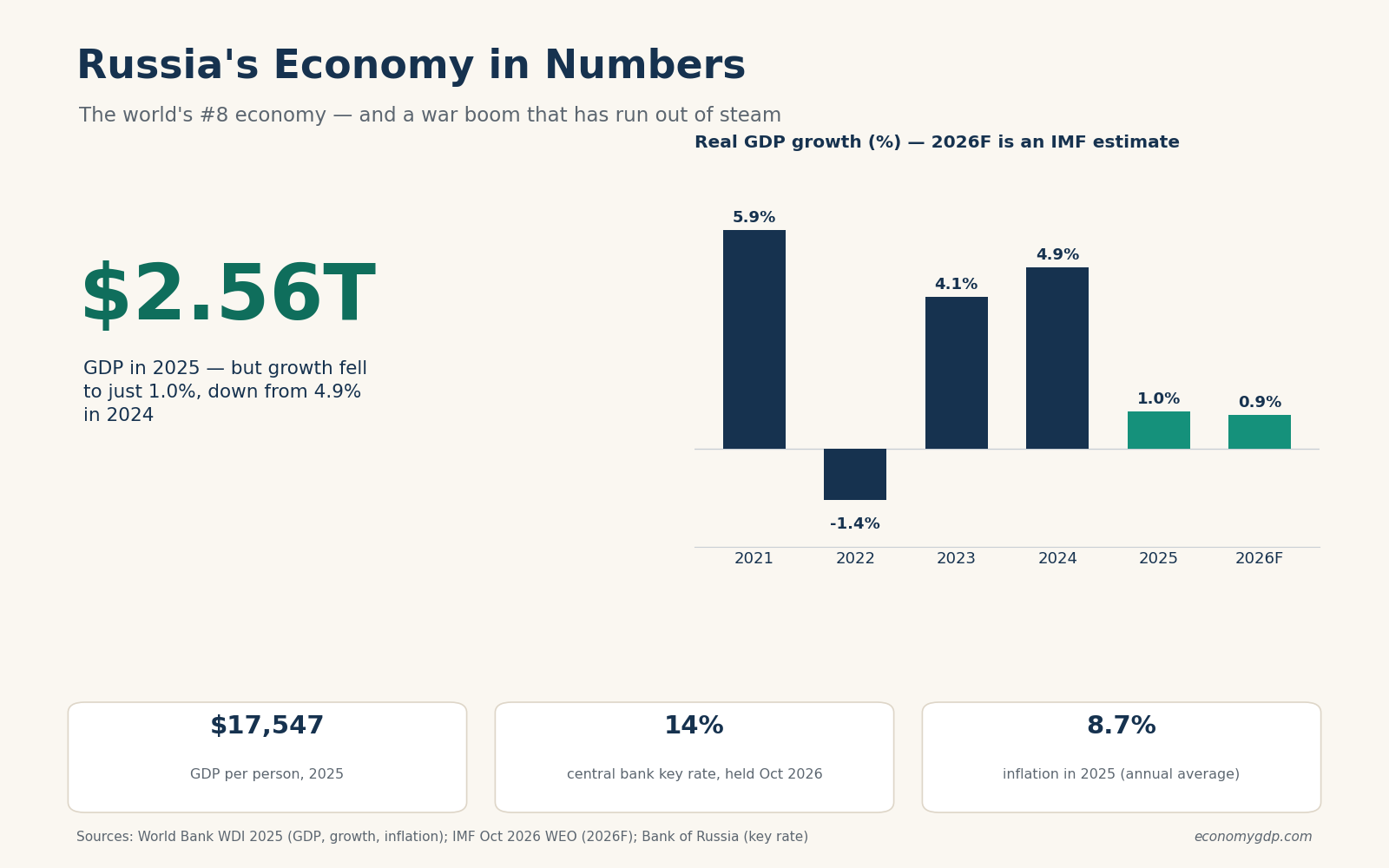
Russia is the world’s eighth-largest economy, worth $2.56 trillion in 2025, according to the World Bank. That’s bigger than Italy and Canada in dollar terms, and it’s home to 143.5 million people — the ninth-largest population on Earth.
Divide that output by the people and you get $17,547 a person. Adjust for what money actually buys inside Russia and the picture changes a lot: at purchasing power parity the economy is worth $7.24 trillion, fourth in the world behind China, the United States and India. A haircut in Novosibirsk simply costs less than one in New York.
The boom that faded
For two years Russia grew like a country on a spending spree. After shrinking 1.4% in 2022, the year the full-scale war in Ukraine began, real GDP jumped 4.1% in 2023 and 4.9% in 2024, according to the World Bank.
Then the engine spluttered. Growth fell to 1.0% in 2025. The World Bank’s April 2026 outlook puts it plainly: fiscal stimulus faded, and tight money squeezed shoppers and businesses at the same time.
The quarterly numbers for 2026 tell the same story. Output slipped 0.2% year on year in the first quarter, recovered to 1.3% in the second, and grew about 1.0% in the third on Rosstat’s preliminary estimate. Nobody is forecasting a bounce. The Bank of Russia expects 0.5% to 1.0% for 2026 as a whole, and the IMF’s October 2026 outlook projects 0.9% — labelled here as an IMF estimate, not a result.
Unemployment, oddly, is at a record low of 2.1%. That doesn’t mean everyone is thriving. It means factories, the army and construction sites are all competing for the same shrinking pool of workers, and wages get bid up even as output stalls.
Prices the central bank can’t quite tame
Inflation is why borrowing stays painfully expensive. On an annual-average basis, consumer prices rose 8.7% in 2025, according to the World Bank, up slightly from 8.4% in 2024. On an end-year basis the rate cooled to 5.6% in 2025 from 9.5% in 2024 — still well above the Bank of Russia’s 4% target.
The central bank pushed its key rate to 21% in late 2024 to break the price spiral, then cut in steps. It has stood at 14% since July, and policymakers held it there again on October 23, 2026. The next decision is December 18.
Fourteen percent is not a normal interest rate. It is a signal that the bank would rather choke off lending than let inflation settle in. The bank now expects inflation of 7.1% to 7.6% at the end of 2026, and says it will only get back to 4% in 2027. Annual inflation was estimated at 6.8% as of October 19, so prices are picking up again, not fading away.
Big, rich in resources, stuck in place
Russia’s size has never been the question. Oil, gas, metals and grain still pay the bills, and the state can direct spending on a scale few countries can match. The IMF’s October 2026 projections put nominal GDP at $2.86 trillion for 2026 — again, an IMF estimate — but that dollar jump mostly reflects prices and the exchange rate, not more real output. Real growth is projected at 0.9% in both 2026 and 2027.
That is the trap. A war economy can run hot for a while by paying soldiers, building weapons and keeping factories busy. It struggles to grow once there are no spare workers left, imported technology gets harder to replace, and the central bank has to keep rates in double digits to hold prices down.
Russia hasn’t collapsed, and forecasts that it would have been wrong before. But the numbers now describe an economy that is large, expensive to borrow in, and barely moving. At 1% growth, with inflation still near 7% and money at 14%, running out of steam is not a metaphor. It is the official forecast.