
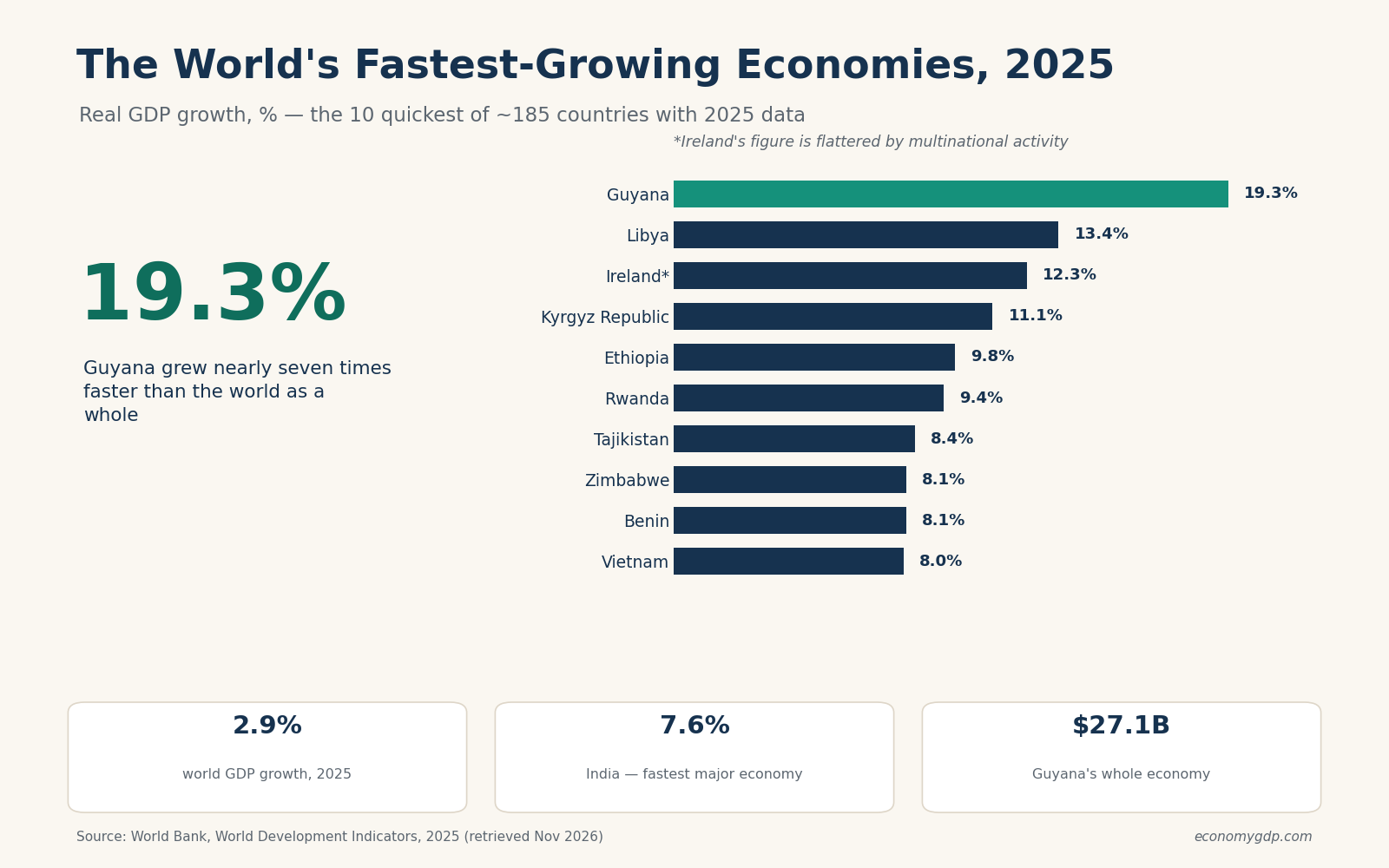
The world economy grew 2.9% in 2025, according to the World Bank. That’s the slowest kind of normal — not a crisis, just a world trudging along. But averages hide the outliers. One country grew nearly seven times that fast. Three grew more than four times as fast. And the names at the top of the list will surprise you: no China, no India, no United States. The fastest-growing economies in 2025 are mostly small, mostly poor, and mostly riding one big thing — oil, a rebound, or both.
Guyana is in a league of its own
Guyana grew 19.3% in 2025. That’s not a typo, and it’s not even the country’s best year lately. Guyana’s economy expanded 62% in 2022, then averaged about 40% a year across 2023 and 2024, according to the IMF. The cause is simple: oil. ExxonMobil found a giant offshore field in 2015, production started in late 2019, and output passed 900,000 barrels a day by the end of 2025 — up 35% on the year before.
What’s interesting is that it’s not only oil anymore. The non-oil economy grew about 14% in 2025, led by construction, agriculture and mining, as oil money poured into roads, houses and power. The IMF expects growth of around 22% in 2026, its latest estimate, with oil production still climbing toward a peak around 2031.
The catch is scale. Guyana’s whole economy is worth $27.1 billion — smaller than the city budget of some American states — spread across just 836,000 people. That small base is exactly why the percentages look so wild. Still, the money is real: GDP per person has reached about $32,000, and the government’s Natural Resource Fund is banking oil revenues for the future. The question now is whether Guyana can turn a decade of oil into something that lasts after the wells run dry.
Rebounds, not just booms
Second place belongs to Libya, up 13.4% — but read that number as a recovery, not a boom. Libya grew just 1.9% in 2024 after a fight over the central bank’s leadership shut oil fields for two months. Once the taps reopened, production averaged 1.3 million barrels a day, up from 1.1 million, and oil output jumped 17.4%. The non-oil economy grew 6.9% too. Libya’s lesson is that a big percentage can just mean you fell hard the year before.
Then there’s Ireland, third at 12.3% — a number that comes with an asterisk the size of the country. Ireland’s GDP is famously flattered by multinational companies parking intellectual property there, which is why we wrote about it as being twice as rich on paper. Strip out that distortion and Ireland looks like a normal, solid European economy, not a rocket ship.
Fourth is the Kyrgyz Republic at 11.1%, its second straight year above 11%, powered by gold, construction and spending fuelled by remittances. Nobody outside Central Asia talks about Kyrgyzstan’s economy. At this rate, they might have to start.
The steady growers underneath
Below the headline acts sits a quieter group that might matter more. Ethiopia grew 9.8% and Rwanda 9.4% — two East African economies that have now put together years of near-double-digit growth on farming, services and construction rather than a single commodity. Tajikistan managed 8.4%, Zimbabwe bounced back to 8.1% after a drought-hit 1.7% in 2024, Benin hit 8.1%, and Vietnam — the factory floor we covered last week — grew 8.0%.
For scale, the fastest-growing major economy was India at 7.6%, well ahead of China at 5.0% and the United States at 2.2%. The gap between the top of this list and the biggest economies is the story: the world’s growth in 2025 came from the edges, not the centre.
There’s a warning buried in the ranking, though. Fast growth and prosperity aren’t the same thing. Ethiopia grew 9.8% and its average citizen still earns about $933 a year. Rwanda’s is about $1,100. A growth rate is a speedometer, not a destination — and for the countries at the top of this list, the hard part is turning a hot year into a higher standard of living that sticks.