
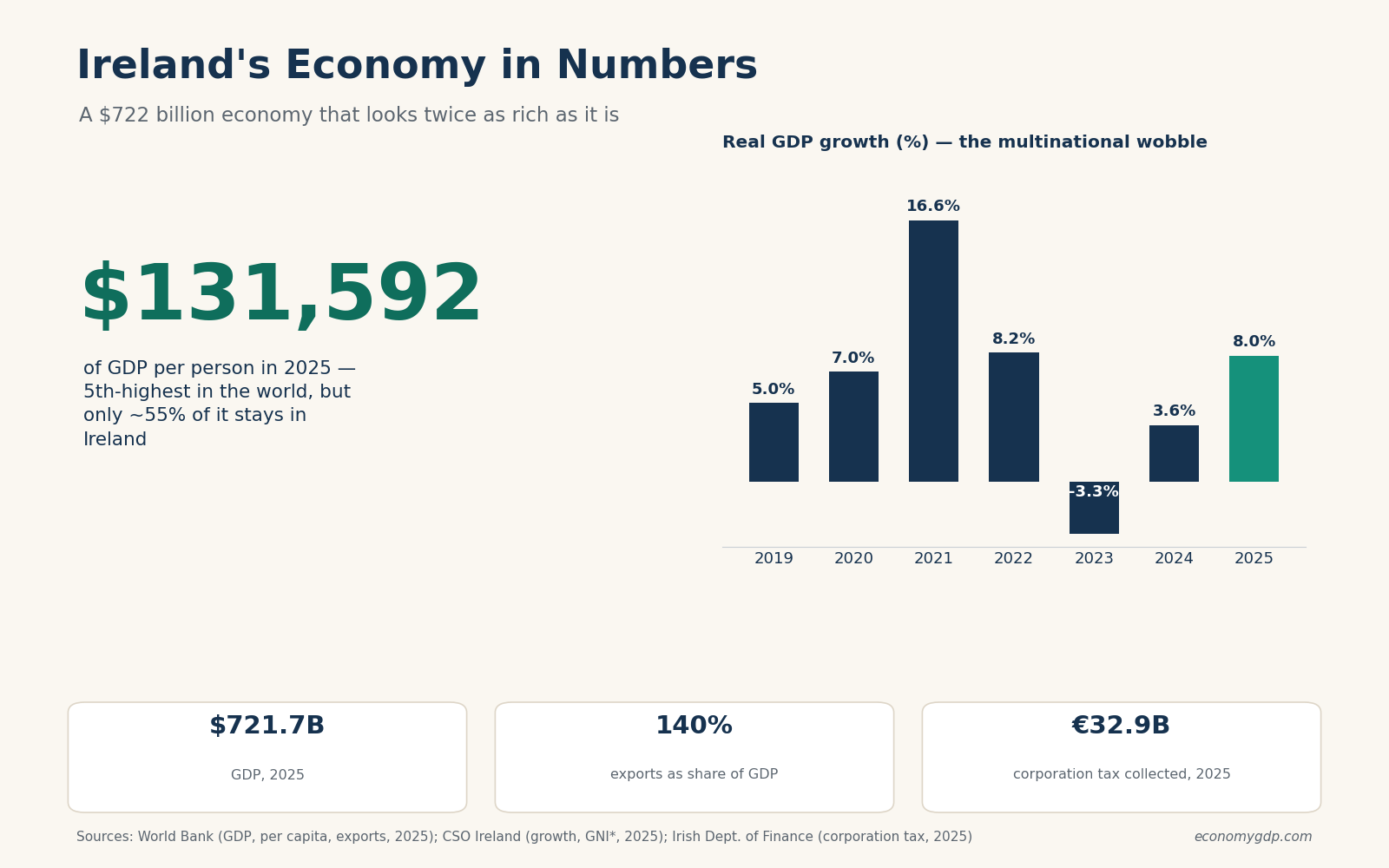
On paper, Ireland is one of the richest countries on the planet. Its GDP per person hit $131,592 in 2025 — fifth-highest in the world, ahead of the United States and more than double the UK. The economy grew 8% last year, the fastest in the European Union. If you stopped there, you’d picture a small island living very large.
Ask an Irish household, though, and the number feels like it belongs to somebody else. That’s because, in large part, it does. Ireland’s economy comes with a footnote no other rich country needs: about half of what it produces is booked there by companies that are Irish only on paper.
The number that lies (gently)
Ireland’s GDP was $721.7 billion in 2025, according to the World Bank — up from $609 billion the year before, and more than triple the $222 billion it produced in 2010. But GDP counts everything produced inside Ireland’s borders, and Ireland’s borders happen to hold an extraordinary share of the world’s pharmaceutical and tech profits. Foreign-owned multinationals generated 50.4% of the country’s value added in 2025, and pharmaceuticals make up roughly two-thirds of its goods exports.
So Ireland’s own statistics office publishes a second number: modified gross national income, or GNI*, which strips out the globalisation effects. In 2025 GNI* was €334 billion against GDP of €602 billion — just 55% of it. Per person, that’s about €61,000 of income that actually stays in the country, versus roughly €110,000 of GDP per head. Still a very good living, just not the fantasy the headline number suggests.
This isn’t a new quirk. In 2015 Ireland’s GDP jumped 24.6% in a single year — not because the country suddenly got a quarter richer, but because a handful of multinationals moved intellectual property onto Irish books. Economists dubbed it “leprechaun economics,” and the CSO invented GNI* precisely so the country could talk about itself honestly.
The tax machine
The engine behind all of this is famously simple: a 12.5% corporate tax rate, an English-speaking workforce, and full access to the EU single market. It worked almost too well. Corporation tax brought in €32.9 billion in 2025 — about a third of everything the Irish state collects, and triple what it raised in 2019. Just three companies account for nearly half of that haul, according to the Irish Fiscal Advisory Council, and Apple alone pays roughly $5 billion a year in regular Irish tax.
Then there was the windfall. After a decade-long fight, the EU’s top court ruled in 2024 that Apple owed Ireland €13 billion in back taxes, plus interest — €14.1 billion in total, finally collected in 2024 and 2025. Combined with the corporation-tax boom, it has left Ireland running a budget surplus of 1.8% of GDP with government debt down to 32.9% of GDP. In 2012, at the depth of the bailout years, debt was about 120% of GDP. The turnaround is real — it just rests on a very narrow base.
The ground is shifting, though. The OECD’s 15% global minimum tax now applies to the big groups that built Ireland’s model, and Washington’s tariff threats hang over an economy where exports equal 140% of GDP. The IMF expects Irish growth to turn slightly negative in 2026 — an estimate, but a reminder of how quickly the music can stop.
The part that’s actually Irish
Strip out the multinationals and the picture gets steadier and more ordinary. The domestic economy — the shops, builders, farmers and services that employ about nine in ten Irish workers — grew a solid 4.7% in 2025. Unemployment sits at 4.6%, inflation cooled to 2.2%, and the population has swelled past 5.5 million, growing faster than almost anywhere in Europe.
That’s the real story of Ireland’s economy: a genuinely prosperous small country with a full-employment domestic economy, sitting underneath a multinational machine roughly its own size again. The headline figures will keep making jaws drop. The honest ones — GNI*, the domestic economy, the tax base — are the ones worth watching.