
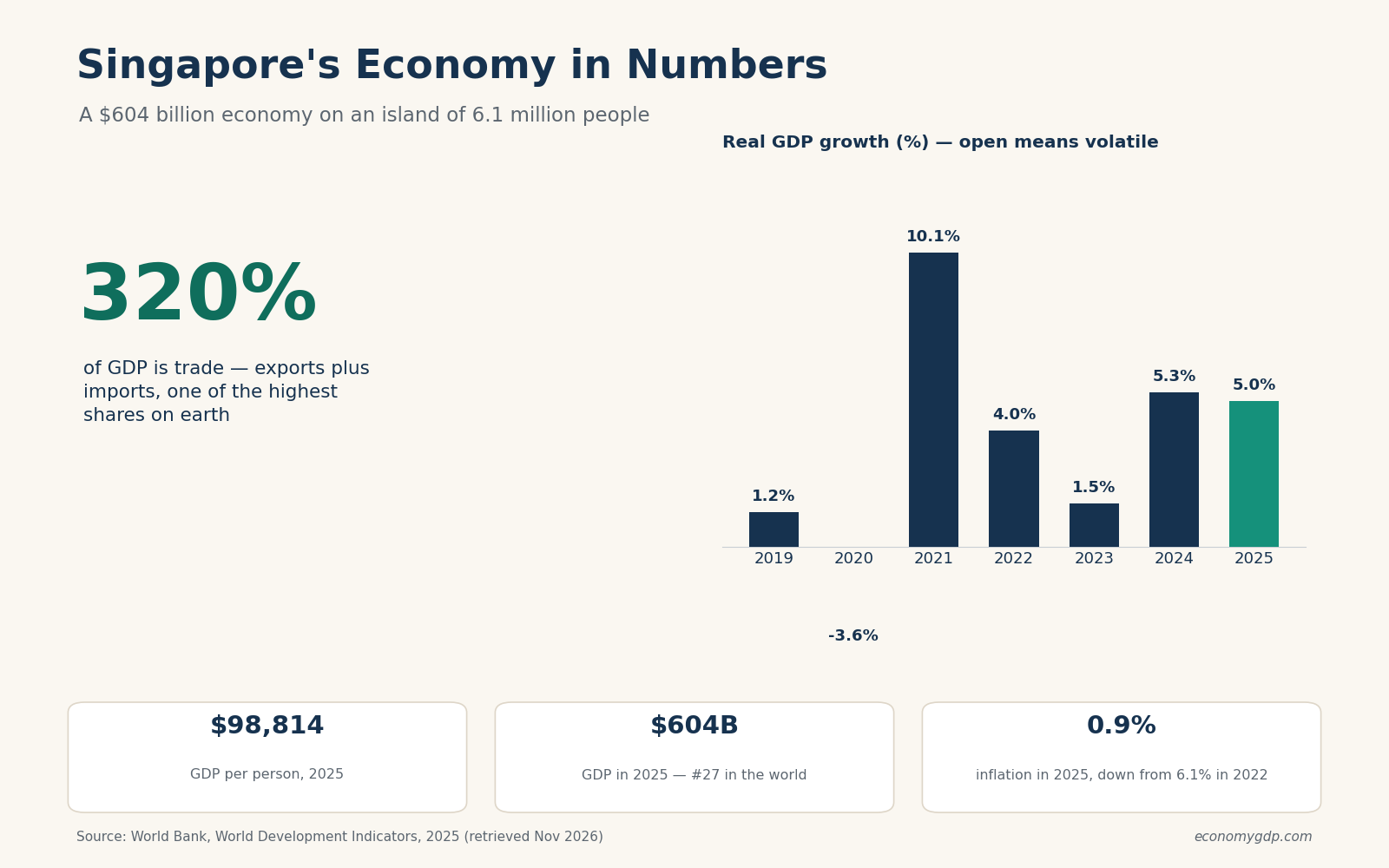
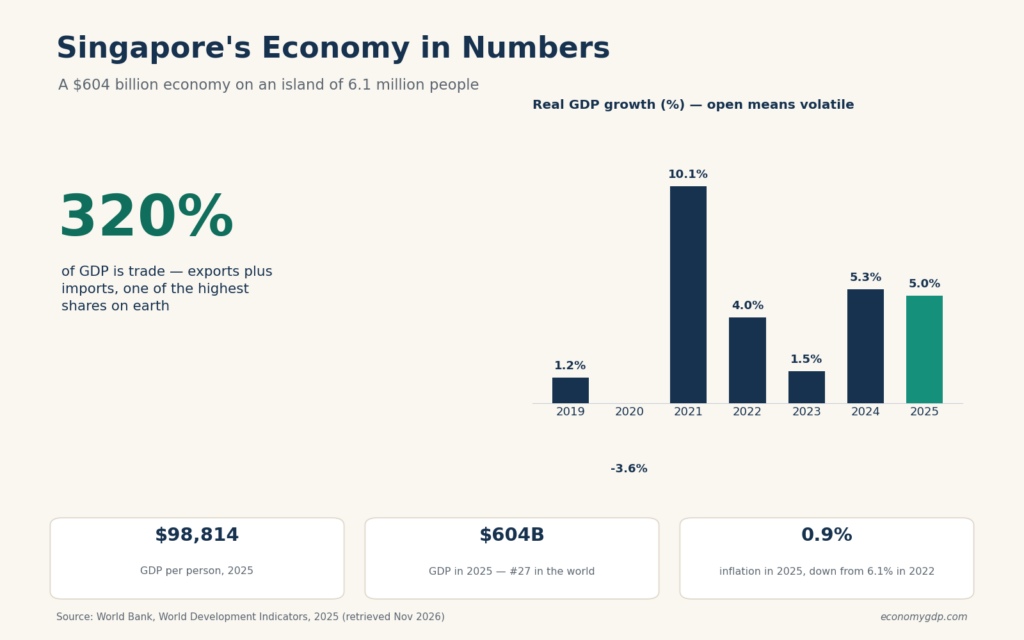
Singapore is a city-state of 6.1 million people on an island you can drive across in under an hour. Its economy is worth $604 billion, the 27th-largest in the world. Do the division and you get $98,814 per person — one of the highest figures on earth, ahead of the United States. And it grew 5% in 2025, after 5.3% in 2024.
Sixty years ago that would have sounded like a joke. When Singapore became independent in 1965, income per person was about $500, unemployment ran near 14%, and the island had almost no natural resources — it even imported much of its drinking water. The bet the new government made was simple: if you can’t sell to your own tiny market, sell to everyone else’s.
A country built on selling to everyone else
No rich country trades like Singapore. Exports plus imports add up to 320% of GDP — for comparison, the world average is under 60%. Goods exports alone were worth about $567 billion in 2025, and services exports another $422 billion, leaving a trade surplus worth 35% of GDP.
The port is the machine at the centre of it. Singapore sits on the Strait of Malacca, the shipping lane between the Indian Ocean and the South China Sea, and its port is one of the busiest in the world. Containers come in, get sorted, and go straight back out. Around that, the island built the rest: wholesale trade is about a fifth of the economy, manufacturing just under a fifth — chips, pharmaceuticals, refined oil — and finance and insurance about 14%.
Services dominate overall, at 71.6% of GDP, with industry at 22.7%. Unemployment sits at 2.8%, and inflation, which spiked to 6.1% in 2022, cooled to just 0.9% in 2025.
The catch: small, open, and exposed
Being this open has a price. When the world catches a cold, Singapore gets pneumonia. Growth collapsed to −3.6% in the pandemic year of 2020, then bounced 10.1% in 2021, then slowed to 1.5% in 2023 as global demand cooled. A country that trades three times its own GDP can’t hide from a trade war or a shipping slump.
There’s a second catch. Much of the export machine belongs to foreign multinationals, not Singaporean firms. The island courts them deliberately — low taxes, clean courts, a port that works — but it means a good share of the profits made in Singapore eventually leaves it. And the domestic market is so small that almost nothing is built for Singaporeans alone; every industry lives or dies on foreign demand.
The cost of living is the part locals feel most. Housing is famously expensive, and the government has spent decades managing it through public housing that most Singaporeans live in. The workforce is ageing, and the island leans heavily on foreign workers to keep the cranes and kitchens running — a political tension that never quite goes away.
What comes next
Singapore’s answer, as always, is to move upmarket. Semiconductors are the current bet: the island already makes a meaningful share of the world’s chips, and it’s pouring money into AI infrastructure, data centres and advanced manufacturing. Finance is the other pillar — private banking and wealth management have boomed as money flows into Asia, and the sovereign wealth funds, Temasek and GIC, invest Singapore’s savings all over the world.
In purchasing-power terms the economy is worth about $998 billion, which is a reminder that money stretches further there than the dollar figures suggest. But the real story is simpler. A country with no oil, no farmland and no hinterland got rich by being the place the world passes through — and by being very, very good at it. Sixty years after independence, the $500 island is a $99,000-a-head economy. Not bad for a port with nowhere to sell to but everywhere.