
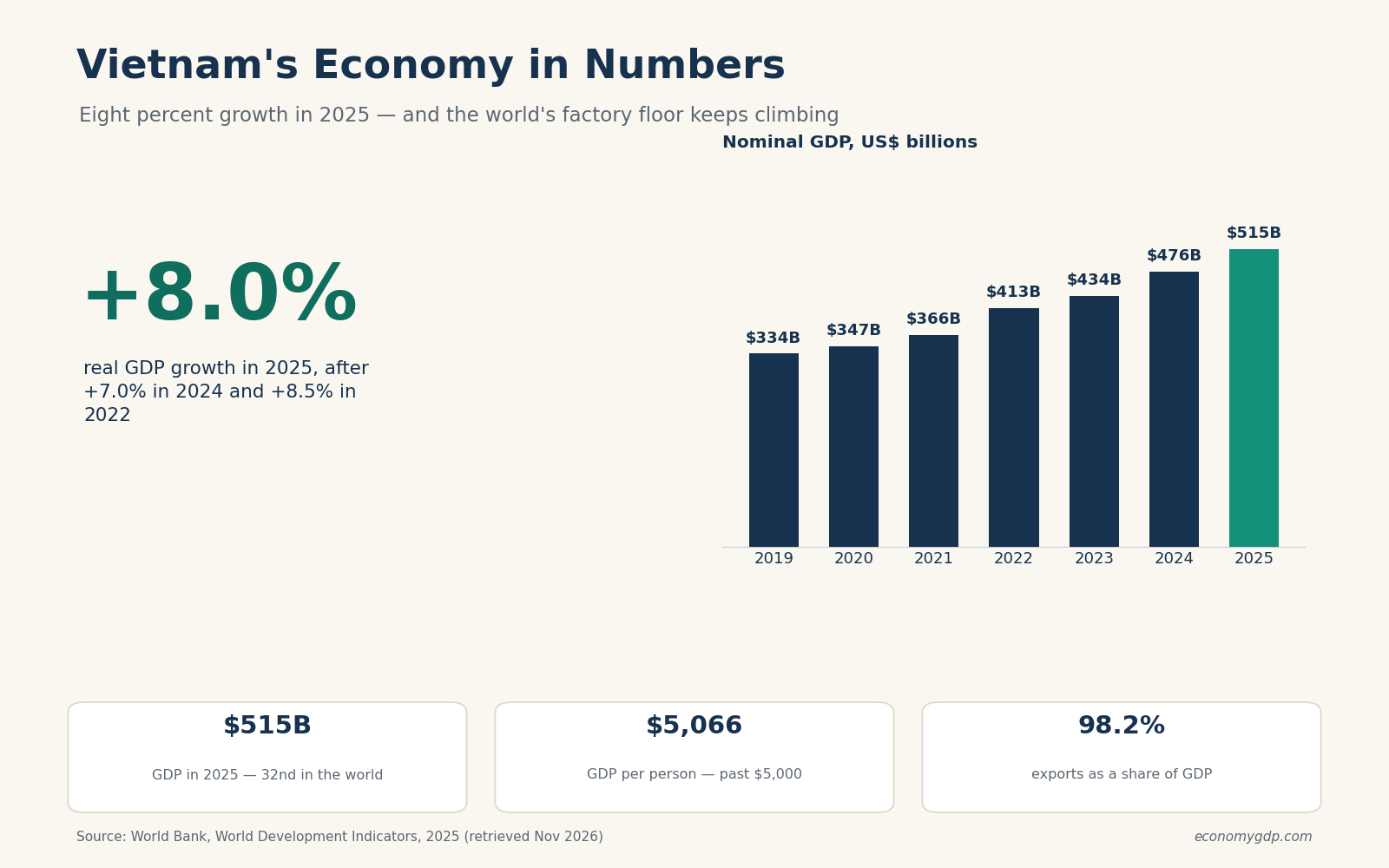
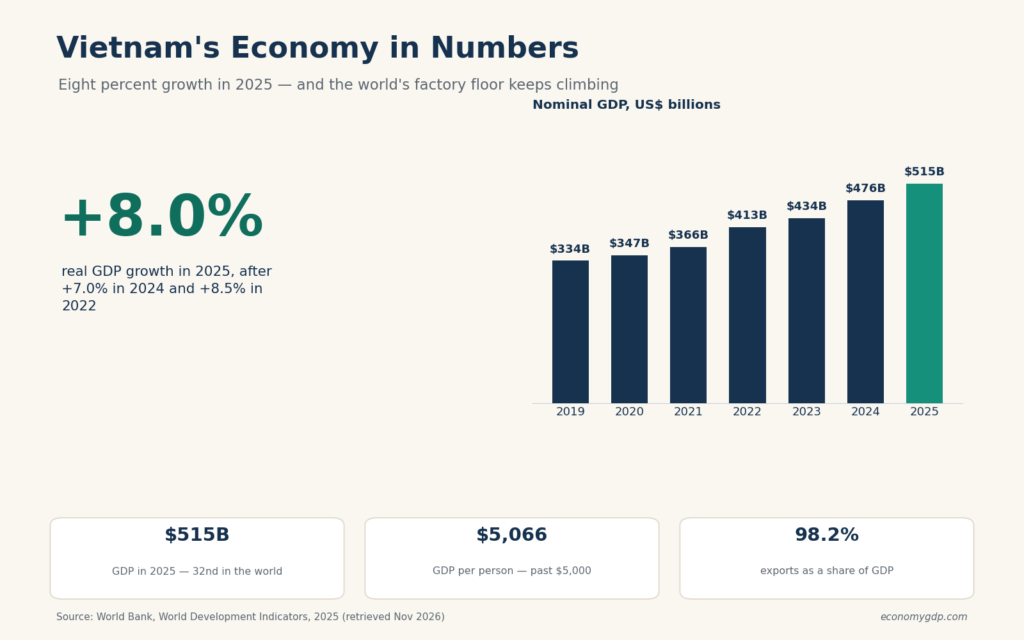
Vietnam grew 8% in 2025. That’s not a one-off spike — it’s 8% after 7% in 2024 and 8.5% in 2022, a run of growth most countries can only envy. The World Bank puts the economy at $515 billion now, the 32nd-largest in the world, up from $334 billion as recently as 2019. Divide that by 101.6 million people and you get $5,066 per person — past $5,000 for the first time, and nearly 50% higher than it was six years ago.
How a poor country became the world’s workshop
Forty years ago Vietnam was one of the poorest countries on earth, still rebuilding after decades of war. Then, in 1986, the government launched Doi Moi — “renovation” — opening the economy to private business and foreign investment. The bet paid off slowly, then all at once.
Today Vietnam is one of the most trade-exposed economies anywhere. Exports of goods and services are worth 98% of GDP, a ratio only a handful of countries match. Merchandise exports hit roughly $475 billion in 2025, up 17% on the year, and electronics, computers and phones make up about a third of everything shipped. More than half of all Samsung phones are made in Vietnam, in giant plants north of Hanoi. Samsung’s four Vietnamese subsidiaries took in $62 billion in revenue in 2025 — about 13% of everything the country exported.
Services are the biggest slice of the economy at about 43% of GDP, with industry and construction close behind at 38% and farming down to 12%. Inflation is a tame 3.3%, and the official unemployment rate sits at just 1.5%.
The catch: most of the boxes aren’t really Vietnam’s
Here’s the awkward part. Roughly three-quarters of Vietnam’s export dollars are shipped by foreign-owned firms, not Vietnamese ones. A phone assembled in Bac Ninh counts as a Vietnamese export, but the chips, the screens and much of the profit belong to somebody else. Domestic exporters actually saw their shipments fall in 2025, while foreign firms carried all the growth.
That shows up in the pay packets. Income per person has caught up with Indonesia’s — $5,066 against $5,060 — but Indonesia’s economy is nearly three times bigger, and Vietnam’s workers still earn a fraction of what factory hands make in China or South Korea. The IMF puts Vietnam’s economy at about $1.8 trillion in purchasing-power terms, the 25th-largest in the world — a reminder that money stretches further in Hanoi than the dollar figures suggest, but also that there’s a long way to go.
What comes next
The World Bank moved Vietnam up to upper-middle-income status in 2026, and the government’s stated goal is high-income status by 2045. Getting there means doing more than assembling other people’s products: building Vietnamese brands, supplying the foreign factories from local firms, and moving up from phones and shoes into chips and machinery.
The ingredients are there — a young workforce, a government that has spent four decades proving it can change course, and a front-row seat in the supply chains moving out of China. If Vietnam can start keeping more of each export dollar at home, the next decade could look a lot like the last one. And the last one was an 8% growth story.