
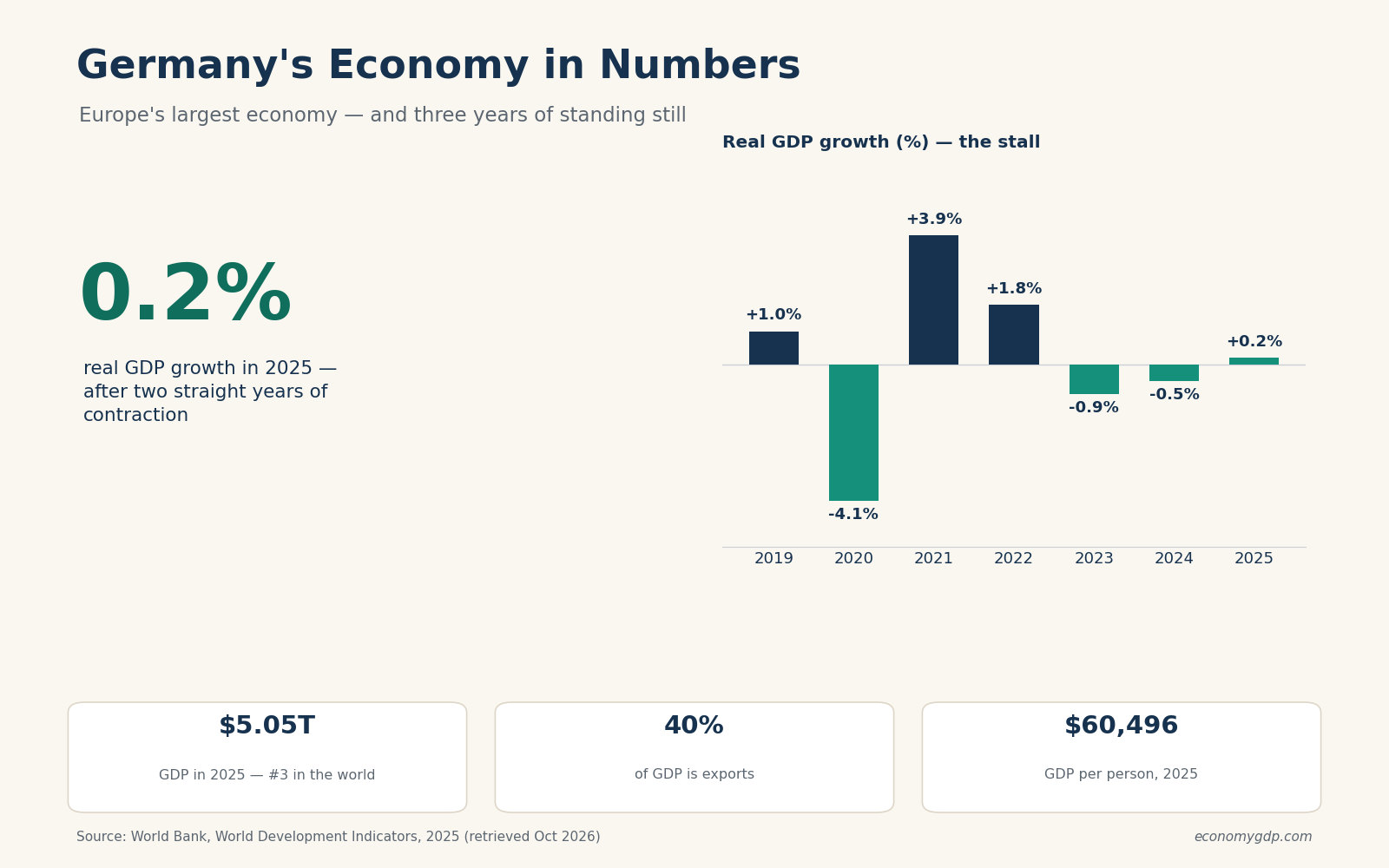
Germany is the world’s third-largest economy, and the biggest in Europe by a wide margin. It produces about $5.05 trillion of output a year — more than Japan, more than Britain, more than India — from a country of just 83.5 million people. Per person, that’s about $60,500, one of the highest figures among large countries.
And yet Germany has spent the last few years going nowhere. The economy shrank in 2023, shrank again in 2024, and grew just 0.2% in 2025. That’s three years of standing still for a country that spent decades as Europe’s growth engine. The puzzle of Germany right now is how a place so good at making things ended up stuck.
The factory that sells to everyone
Germany’s economy still runs on making stuff in a way no other big rich country quite does. Industry accounts for about 25% of output — roughly double the share in Britain or America — and services make up about 64%. Agriculture is under 1%.
The names tell the story: Volkswagen, BMW, Mercedes, Siemens, BASF. Cars, machinery, chemicals, precision tools — the expensive, complicated things the rest of the world buys when it wants to build something. Exports are about 40% of GDP, an extraordinary share for a country this large. For comparison, America’s export share is roughly a tenth of its economy. Germany doesn’t just trade with the world. It depends on it.
That model worked brilliantly for a long time, and then three things hit it at once. Cheap Russian gas, which had powered German factories for years, vanished after the invasion of Ukraine. China, once Germany’s best customer for cars and machinery, started building its own — and selling them back. And the car industry’s shift to electric vehicles caught Germany’s giants flat-footed, just as Chinese rivals raced ahead.
The stagnation years
The numbers show the stall plainly. After rebounding 3.9% in 2021 from the pandemic crash, growth faded to 1.8% in 2022, then turned negative for two straight years. Inflation spiked to 6.9% in 2022 as energy prices surged, before cooling back to 2.2% in 2025.
What’s striking is what didn’t break. Unemployment sits at just 3.7% — German firms, famously reluctant to lay people off, mostly hoarded workers through the downturn. Wages kept rising, and the domestic economy held up better than the headlines suggested. Germany’s problem isn’t a collapse. It’s a slowdown: an export machine built for a world of cheap energy and open trade, running into a world that no longer offers either.
Can the workshop retool?
Germany has been here before, in a way. In the early 2000s it was called the sick man of Europe, then reformed its labour market and rode a decade-long export boom. The question now is whether it can pull off a second reinvention — this time in electric cars, in semiconductors, in defence, and in the infrastructure and energy grid its factories will need.
The raw material is still there: a skilled workforce, a dense network of mid-sized engineering firms that dominate quiet global niches, and a habit of building things properly. Germany’s economy isn’t broken. But for the first time in a generation, it has to prove it can grow again — and the rest of Europe is waiting on the answer.