The Congo economy relies heavily on oil, which dominates exports, alongside mining and agriculture. Timber and cobalt are key resources, but weak governance and conflict disrupt growth. Subsistence farming supports much of the population, yet poverty is widespread. Infrastructure deficits and corruption deter investment, while political instability exacerbates challenges. Efforts to improve mining regulations and attract foreign capital aim to stabilize the economy, but progress remains slow.
Congo Economy Size
The Democratic Republic of Congo’s economy, at $60 billion, is sizable but underdeveloped. Mining and agriculture drive its GDP, with vast potential constrained by conflict. See Congo GDP.

Congo Purchasing Power Parity (PPP)
The Democratic Republic of Congo’s economy has a PPP GDP of $150 billion, over double its $60 billion nominal GDP, due to low costs for mining and agriculture. PPP per capita is around $1,500, among the lowest globally, reflecting poverty. PPP underscores resource potential, but conflict severely constrains economic output and gains.

Congo Growth Rate
The economic growth rate is 4.5% in 2024, propelled by mining exports, particularly cobalt and copper. Foreign investment in resource extraction drives growth, but conflict and corruption constrain broader gains. Agriculture supports subsistence, while infrastructure deficits and political instability limit progress, despite the economy’s vast resource potential.

Congo Inflation
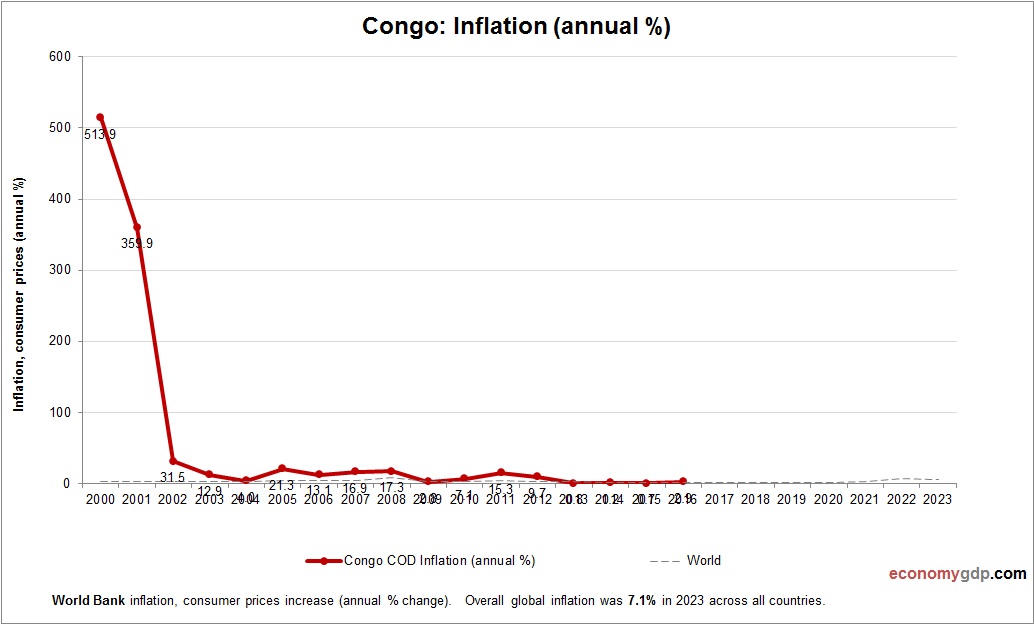
The Democratic Republic of Congo’s inflation rate is around 10% in 2024, driven by conflict-related supply disruptions and currency depreciation. Rising global commodity prices increase import costs, while strong mining exports fuel demand. Weak governance and infrastructure deficits sustain price volatility, with limited monetary tools to curb high inflation in this resource-rich economy.