
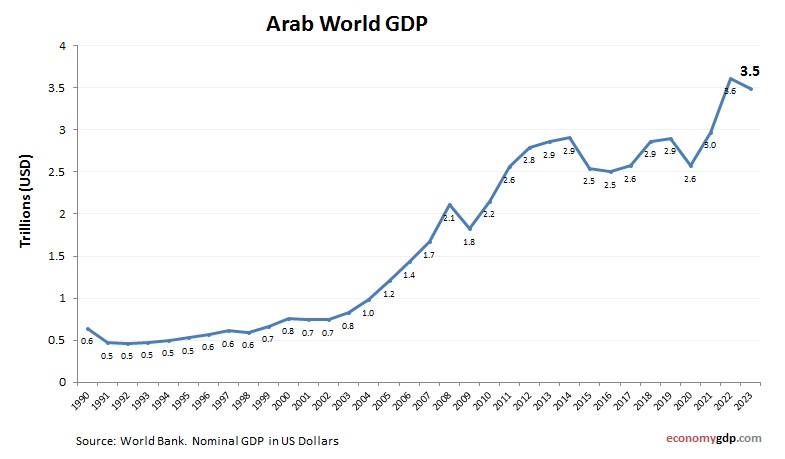
Arab World GDP from 2010 to today. World Bank and OECD data. GDP in US dollars. The Arab World's $3.5 trillion economy, growing 3.2% in 2025, spans oil-rich Gulf nations and diverse North African economies, with per capita varying widely. Hydrocarbons drive 50% of GCC GDP, supplemented by services and remittances across 450 million people. Youth unemployment (25%) and conflicts challenge progress. Recent diversification efforts, including UAE's renewables and Saudi tourism, stabilize growth. Investments in digital infrastructure and trade routes enhance connectivity. The region leverages energy wealth for green transitions, targeting 4% non-oil growth by 2030. Navigating inflation and geopolitical tensions, it fosters inclusive prosperity, positioning itself as a global energy and innovation hub.
Arab World GDP Statistics by Year
| Year | GDP Size (in billions $) |
| 2025 (projected) | 3,760 |
| 2024 | 3,705 |
| 2023 | 3,606 |
| 2022 | 3,739 |
| 2021 | 3,078 |
| 2020 | 2,596 |
| 2019 | 2,949 |
| 2018 | 2,907 |
| 2017 | 2,598 |
| 2016 | 2,524 |
| 2015 | 2,569 |
| 2014 | 2,926 |
| 2013 | 2,874 |
| 2012 | 2,805 |
| 2011 | 2,565 |
| 2010 | 2,155 |