
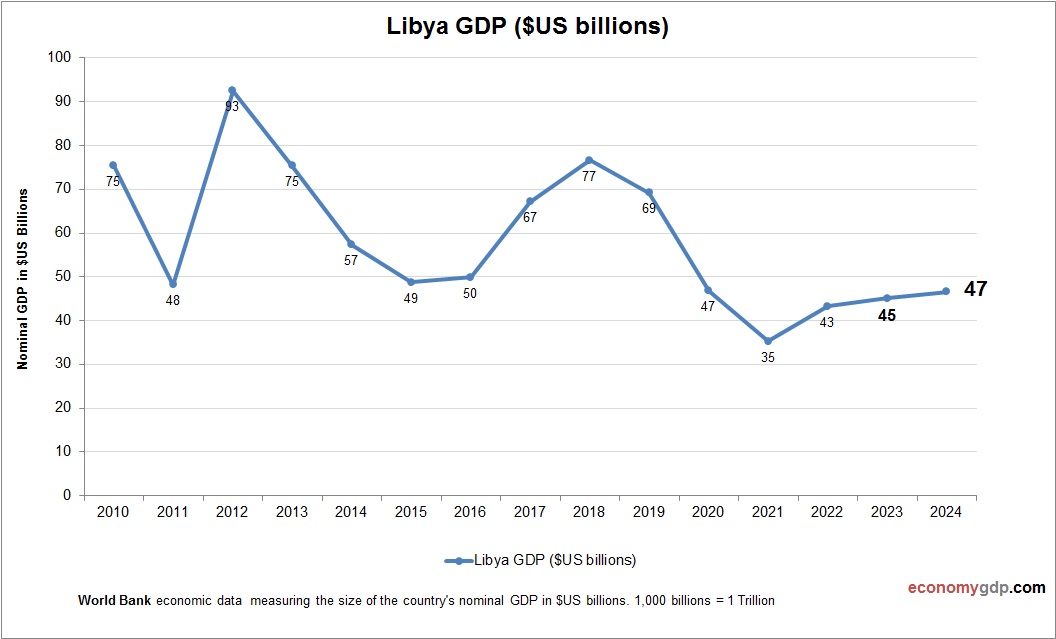
Libya's economy is overwhelmingly dependent on oil and gas, which account for most government revenue and exports. Despite vast reserves, political instability and conflict have disrupted production and deterred investment. Agriculture and manufacturing contribute little, while services remain underdeveloped. GDP is highly volatile, reflecting oil price fluctuations and security conditions. Reconstruction, infrastructure development, and diversification are critical for long-term growth. Libya's location and energy wealth provide potential for recovery if stability improves. For now, hydrocarbons dominate, making GDP performance tied to global energy markets and domestic political developments.
World Bank GDP economic data: 2010-2024. Last updated Oct 2025.
Libya GDP Statistics by Year
| Year | GDP Size (in billions $) |
| 2025 (projected) | 48 |
| 2024 | 47 |
| 2023 | 45 |
| 2022 | 43 |
| 2021 | 35 |
| 2020 | 47 |
| 2019 | 69 |
| 2018 | 77 |
| 2017 | 67 |
| 2016 | 50 |
| 2015 | 49 |
| 2014 | 57 |
| 2013 | 75 |
| 2012 | 93 |
| 2011 | 48 |
| 2010 | 75 |