
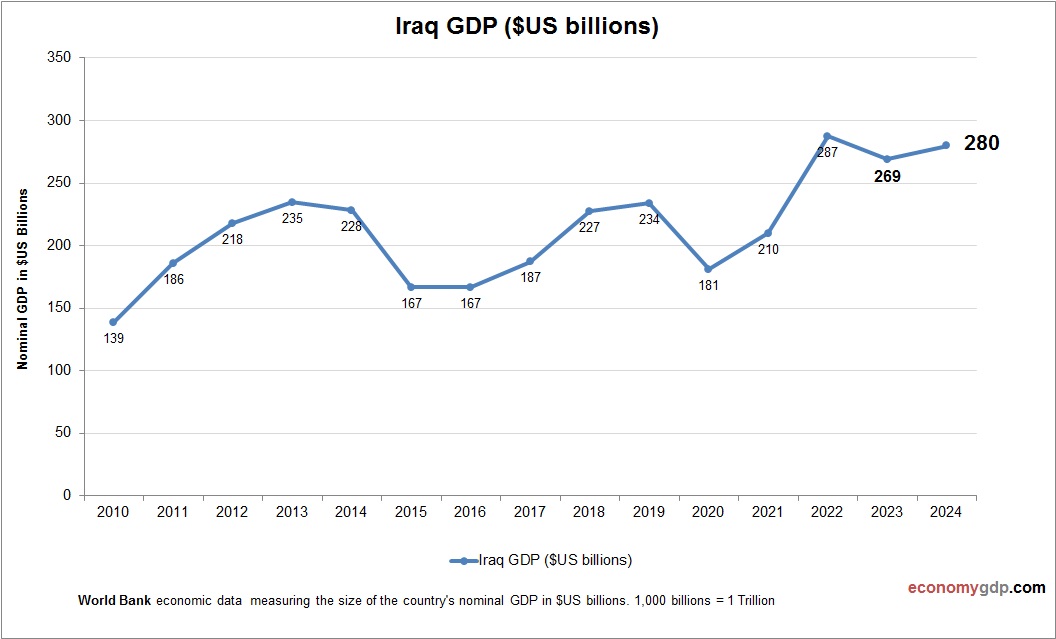
Iraq's GDP is overwhelmingly dependent on oil, which accounts for more than 90% of government revenue and export earnings. With one of the largest proven reserves in the world, oil dominates economic life, leaving non-oil sectors underdeveloped. Agriculture, construction, and limited services contribute modestly, while security challenges and political instability hinder broader diversification. Reconstruction and infrastructure development offer potential for growth, supported by international aid and investment. Despite challenges, Iraq's young population, fertile land, and untapped industries such as natural gas, renewable energy, and agriculture present long-term opportunities for sustainable economic expansion and reduced reliance on oil.
World Bank GDP economic data: 2010-2024. Last updated Oct 2025.
Iraq GDP Statistics by Year
| Year | GDP Size (in billions $) |
| 2025 (projected) | 290 |
| 2024 | 280 |
| 2023 | 269 |
| 2022 | 287 |
| 2021 | 210 |
| 2020 | 181 |
| 2019 | 234 |
| 2018 | 227 |
| 2017 | 187 |
| 2016 | 167 |
| 2015 | 167 |
| 2014 | 228 |
| 2013 | 235 |
| 2012 | 218 |
| 2011 | 186 |
| 2010 | 139 |