
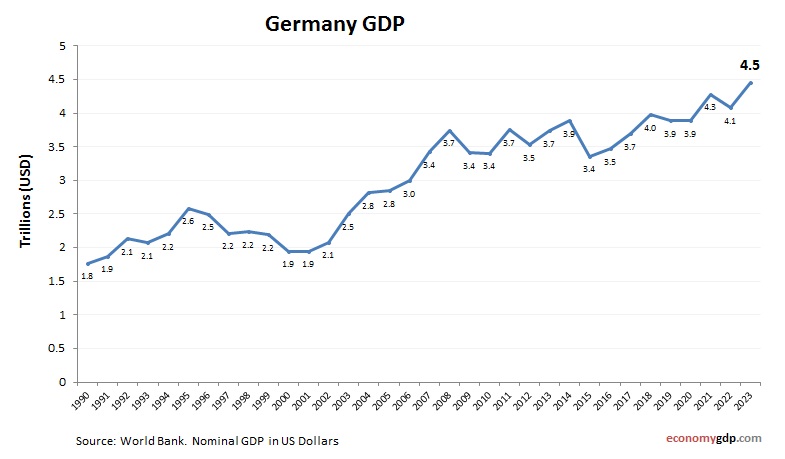
Germany GDP from 2010 to today. World Bank and OECD data. GDP in US dollars. Germany's GDP is Europe's largest, built on advanced manufacturing, exports, and innovation. Known globally for automobiles, machinery, and chemical industries, Germany is a leader in engineering and industrial production. Services, especially finance, logistics, and healthcare, also contribute strongly. Renewable energy and digitalization are shaping future growth. Germany's strong export orientation makes it sensitive to global trade dynamics, though its diversified industries provide resilience. With a highly skilled workforce, robust infrastructure, and EU membership, Germany is a key driver of the European economy and a global leader in technology, sustainability, and industrial competitiveness.
Germany GDP Statistics by Year
| Year | GDP Size (in billions $) |
| 2025 (projected) | 4,800 |
| 2024 | 4,660 |
| 2023 | 4,526 |
| 2022 | 4,164 |
| 2021 | 4,348 |
| 2020 | 3,940 |
| 2019 | 3,957 |
| 2018 | 4,052 |
| 2017 | 3,763 |
| 2016 | 3,538 |
| 2015 | 3,424 |
| 2014 | 3,966 |
| 2013 | 3,808 |
| 2012 | 3,598 |
| 2011 | 3,825 |
| 2010 | 3,468 |