
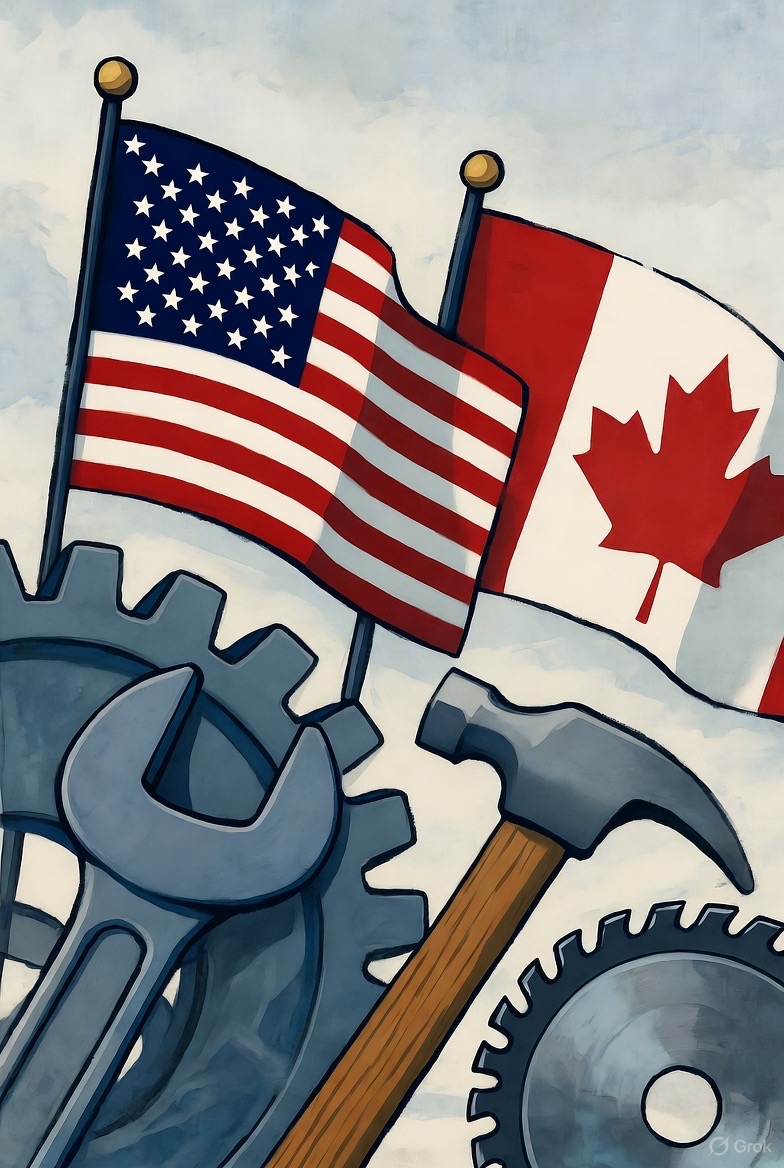
The long-standing economic partnership between the United States and Canada—built on mutual trade, shared supply chains, and geographic proximity—is now under significant strain. In 2025, Canada’s economy was still much dependent on US economy and remained one of the United States’ top trading partners, with trade in goods and services between the two nations reaching nearly a trillion dollars. Yet despite this deep interdependence, the U.S. has recently imposed harsh tariffs on Canadian imports, prompting strong responses from Ottawa and marking one of the most serious rifts in modern North American trade relations.
Canada’s Ontario PM, Doug Ford, played the Ronald Reagan anti-tariff commercial during the Game One of the World Series of Major League Baseball. A Jab at Trump and USA. Now whether tariffs work or not, it is debatable but prime-time ads like this show the extent of the rift.
The current dispute is driven by a mix of political, economic, and strategic factors. Early in 2025, the U.S. government announced sweeping new tariffs on Canadian imports, claiming that national security, border issues, and trade imbalances justified the move. The initial tariffs stood at 25 percent on most goods, later rising to 35 percent by mid-year. Energy products faced lower rates, but the escalation affected critical industries like metals, vehicles, and machinery. Canada, in turn, accused Washington of violating trade agreements and responded with its own targeted measures. Officials also signaled plans to diversify trade ties toward Asia and Europe, reducing the nation’s heavy reliance on U.S. markets. The breakdown in formal negotiations later in the year, reportedly triggered by diplomatic tensions and political messaging disputes, underscored how strained the relationship had become.
The long-standing economic partnership between the United States and Canada—built on mutual trade, shared supply chains, and geographic proximity—is now under significant strain. In 2025, Canada remained one of the United States’ top trading partners, with trade in goods and services between the two nations reaching nearly a trillion dollars. Yet despite this deep interdependence, the U.S. has recently imposed harsh tariffs on Canadian imports, prompting strong responses from Ottawa and marking one of the most serious rifts in modern North American trade relations.
What’s Happening and Why
The current dispute is driven by a mix of political, economic, and strategic factors. Early in 2025, the U.S. government announced sweeping new tariffs on Canadian imports, claiming that national security, border issues, and trade imbalances justified the move. The initial tariffs stood at 25 percent on most goods, later rising to 35 percent by mid-year. Energy products faced lower rates, but the escalation affected critical industries like metals, vehicles, and machinery.
Major Issues at Stake
1. Tariff escalation:
The 35 percent tariffs on Canadian goods have disrupted cross-border trade and driven up prices on both sides of the border. Many of the affected products are part of integrated North American supply chains, so even small barriers ripple through manufacturing networks.
2. Sector-specific pain points:
Canada’s steel, aluminum, and auto industries are among the hardest hit. These sectors depend heavily on access to U.S. buyers, and higher tariffs have raised production costs, reduced competitiveness, and delayed investments.
3. Legal and institutional strain:
The U.S. justification of tariffs under “national security” exceptions has raised concerns about the erosion of established trade rules. Legal experts warn that such arguments could set a precedent for future conflicts and weaken the credibility of trade agreements like the USMCA.
4. Diversification of Canada’s trade strategy:
Facing the reality of prolonged tensions, Canada has begun strengthening partnerships with other regions, particularly the Indo-Pacific. This represents a strategic pivot aimed at reducing vulnerability to U.S. policy swings.
5. Breakdown in communication:
Trade negotiations have been repeatedly interrupted by political disagreements. What once were structured, policy-driven talks have become reactive exchanges, often derailed by public statements and symbolic gestures.
Impacts and Implications
The impact of the trade conflict is being felt across industries and households alike. In Canada, exporters face reduced access to their most important market, leading to slower growth and job uncertainty. Manufacturers are struggling with higher costs, especially in resource-intensive sectors.
In the U.S., the tariffs are also pushing up prices for consumers and businesses. Many American manufacturers rely on Canadian raw materials, so tariffs are raising input costs and disrupting long-established production chains. For consumers, the effects appear in the form of higher prices for cars, construction materials, and household goods.
Beyond the immediate economic pain, the standoff threatens the broader stability of the North American trade framework. Trust between the two nations has eroded, and companies are beginning to rethink their supply chains, exploring whether production should shift to other markets. Canada’s push to expand trade with Asia and Europe could accelerate this long-term restructuring.
Outlook: What to Watch
The short-term future of U.S.–Canada trade relations remains uncertain. Canada has expressed willingness to return to the negotiating table, but discussions have been unpredictable, often halted and restarted over unrelated political issues.
Observers are watching several key developments:
- Whether the United States maintains, raises, or rolls back its 35 percent tariffs.
- Canada’s response—through legal challenges, retaliatory tariffs, or new trade agreements elsewhere.
- How the USMCA’s exemptions and definitions are enforced in practice.
- The effect of rising costs on North American manufacturing competitiveness.
- The influence of domestic politics, including upcoming elections, on trade decisions.
The U.S.–Canada trade war of 2025 marks a turning point in one of the world’s most stable economic relationships. Tariffs, once a tool reserved for adversarial disputes, are now being used between close allies. The conflict reflects deeper shifts in global trade policy—where national security arguments, populist politics, and economic leverage increasingly shape decisions once guided by cooperation.
For Canada, the challenge lies in safeguarding its industries while pursuing greater independence from U.S. markets. For the United States, the tariffs may yield short-term political wins but risk long-term economic costs and strained alliances. Both nations now face a critical choice: continue down a path of escalating confrontation, or rebuild the trust and predictability that once defined North American trade.